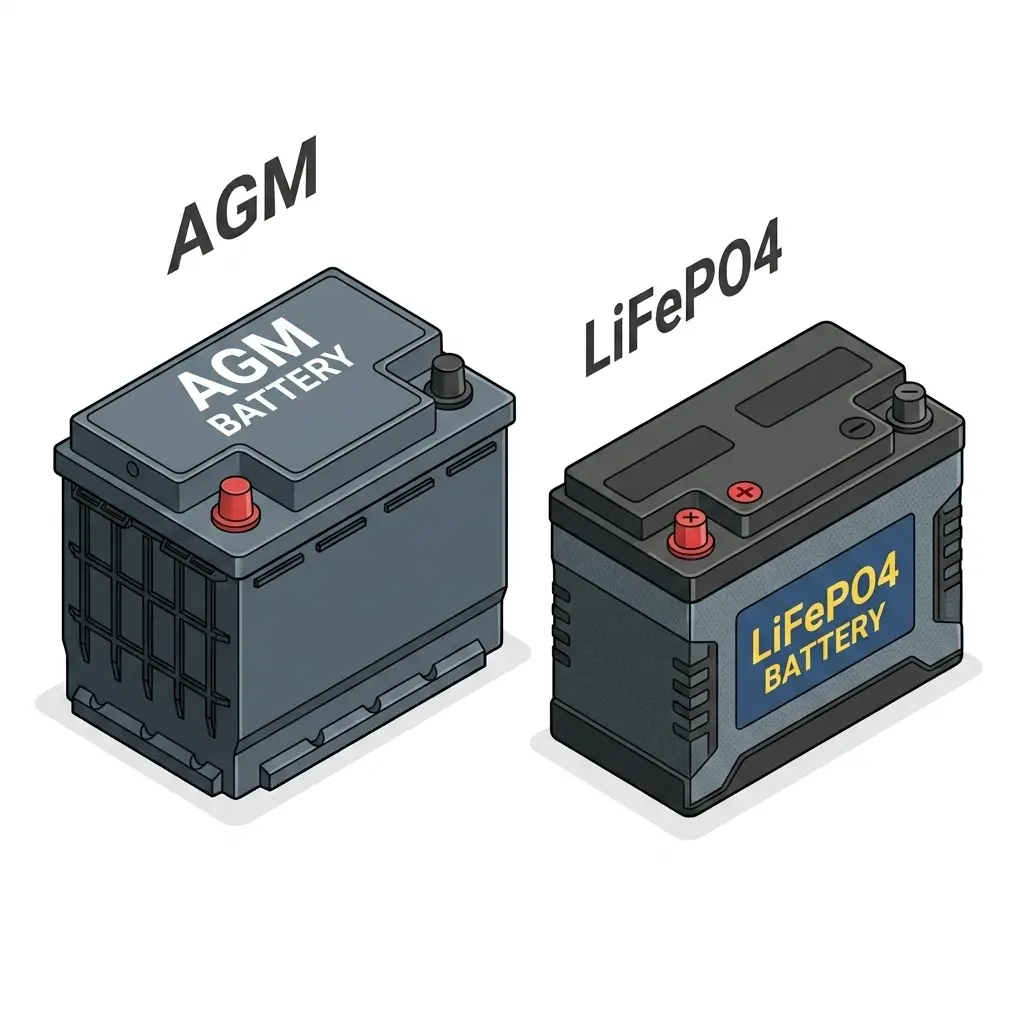
Switching from AGM to LiFePO4 batteries can significantly reduce the total battery capacity you need to achieve the same usable energy in an off-grid solar system. The commonly cited figure is 20–30% less capacity, but the real advantage is often larger than that once you account for how these two chemistries actually behave under daily cycling.
The same label, very different usable energy
A 12V 235Ah AGM battery and a 12V 200Ah LiFePO4 battery both have amp-hour ratings printed on the case. But those ratings describe total capacity under ideal lab conditions: not how much energy you can safely pull from the battery every day without destroying it.
Depth of discharge is where the math diverges. AGM batteries are rated for a recommended depth of discharge (DoD) of about 50%. Discharge beyond that regularly, and the cycle life drops from roughly 500 cycles to under 200. For a battery that cycles daily, 200 cycles is less than seven months.
LiFePO4 batteries routinely operate at 80% DoD with a cycle life of 2,000–5,000 cycles. Some manufacturers rate their cells at 80% DoD for 3,500 cycles: nearly ten years of daily use.
So the 235Ah AGM delivers about 117Ah of usable capacity per cycle, while the 200Ah LiFePO4 delivers about 160Ah. The battery with the smaller label gives you 37% more usable energy.
Efficiency makes the gap wider
Round-trip efficiency: the percentage of energy you get back out relative to what you put in, is another place AGM and LiFePO4 diverge significantly.
AGM batteries typically achieve 80–85% round-trip efficiency under real-world cycling conditions. The remaining 15–20% is lost as heat during charge and discharge. LiFePO4 batteries operate at 95–98% round-trip efficiency.
In an off-grid solar system, this efficiency gap compounds. Every watt-hour your panels generate that goes into the battery and comes back out loses more energy with AGM. Over a year of daily cycling at 10 kWh per day, the difference between 82% efficiency (AGM) and 96% efficiency (LiFePO4) is roughly 500 kWh of lost energy: solar production that your panels generated but your battery bank wasted.
Running the actual numbers
To deliver 1,000 Wh of usable energy per cycle:
:::cta

Ah to kWh Calculator
Convert amp-hours to watt-hours and kilowatt-hours for your battery bank. Calculate usable capacity based on depth of discharge.
:::
AGM at 50% DoD and 82% round-trip efficiency requires about 2,440 Wh of nominal battery capacity.
LiFePO4 at 80% DoD and 96% round-trip efficiency requires about 1,300 Wh of nominal capacity.
That works out to roughly 47% less nominal capacity needed from LiFePO4 to deliver the same usable energy. The commonly cited 20–30% figure is conservative: it holds only under unusually generous assumptions about AGM performance or unusually conservative LiFePO4 usage at 60–70% DoD.
The advantage widens further at higher discharge rates. AGM batteries are subject to the Peukert effect: at a 0.8C discharge rate, an AGM may deliver only 60% of its rated capacity. LiFePO4 capacity stays essentially constant regardless of discharge rate, which matters for high-draw loads like air conditioning, power tools, or medical equipment like oxygen concentrators.
What this means for sizing a battery bank
Consider a household using roughly 34 kWh per day (about 1,167 kWh per month). To store one full day of energy:
With AGM at 50% DoD: You need about 68 kWh of nominal battery capacity. At 12V with 235Ah batteries (2.82 kWh each), that is 24 batteries.
With LiFePO4 at 80% DoD: You need about 42.5 kWh of nominal capacity. At 12V with 200Ah batteries (2.56 kWh each), that is 17 batteries.
Seven fewer batteries is a significant reduction in cost, weight, and space. And the LiFePO4 bank will last 5–10x longer before replacement.
The cost equation has shifted
LiFePO4 batteries cost more upfront. A 12V 200Ah LiFePO4 runs $380–$600 depending on brand, compared to $150–$250 for a 12V 235Ah AGM. But lifetime cost tells a different story.
:::cta
Solar Savings Calculator
Estimate your solar savings over time. Compare upfront costs vs long-term energy savings for your system.
:::
AGM batteries cycled daily last roughly 1.5–3 years before replacement. LiFePO4 batteries last 7–15 years under the same conditions. Over a 10-year period, a system using AGM will require 3–6 full battery replacements, while a LiFePO4 bank may not need any.
Industry analyses put the cost per kWh delivered over a battery's lifetime at roughly $0.42–$0.57 for AGM and $0.14–$0.15 for LiFePO4. AGM costs three to four times more per kWh cycled, despite the lower sticker price.
Budget LiFePO4 options have also dropped considerably. Tested batteries from manufacturers like Redodo, LiTime, and SOK now sell at $78–$120 per kWh of capacity, down over 60% from 2020 pricing.
A complete off-grid system including solar panels, charge controllers, inverters, and a LiFePO4 battery bank may run $15,000–$25,000 upfront depending on system size and component choices. That is a significant investment, but the battery bank portion is where long-term savings compound most.
What to change when switching chemistries
Swapping AGM for LiFePO4 in an existing solar system is not a direct drop-in replacement. The charge controller and inverter settings must be adjusted, and ignoring this is the most common mistake people make during the transition.
Charge controller settings:
| Parameter | AGM | LiFePO4 |
|---|---|---|
| Bulk/Absorption voltage | 14.4–14.8V | 14.2–14.6V |
| Float voltage | 13.2–13.8V | 13.4–13.6V (or disabled) |
| Equalization | 15.0–15.5V | Must be disabled |
| Low-voltage cutoff | 11.5V | 10.0V |
| Temperature compensation | Enabled | Must be disabled |
Leaving equalization mode enabled is particularly dangerous: it pushes voltage above 15V, which can damage the LiFePO4 battery management system (BMS) and permanently harm cells.
Most modern MPPT charge controllers (Victron, Renogy, EPEver) have a LiFePO4 preset. Select it. If your controller only offers AGM/Flooded/Gel presets, use a programmable "User" or "Custom" mode to set the correct voltages.
Do not mix AGM and LiFePO4 batteries in parallel. Their voltage curves and charge behaviors are incompatible. If you are transitioning gradually, each chemistry needs its own charge controller and circuit. Using a combiner box with multiple battery strings can help organize a larger bank, but all strings in a parallel bank should be the same chemistry, same capacity, and ideally the same age and manufacturer.
When AGM still makes sense
LiFePO4 is not the right choice in every scenario:
- Infrequent cycling. A grid-tied backup system that cycles only 10–20 times per year can get 15–25 years from AGM on calendar life alone. The cycle life advantage of LiFePO4 is irrelevant if you rarely cycle.
- Extreme cold without heating. Standard LiFePO4 cannot charge below 32°F (0°C) without risking permanent cell damage from lithium plating. Self-heating models add $50–$100 per battery. AGM accepts charge at any temperature in its operating range. This is not a concern in warm climates like Hawaii, but matters in northern off-grid installations.
- Tight upfront budget with light use. For a seasonal cabin that cycles batteries 50–100 times per year, AGM's lower upfront cost may never be offset by LiFePO4's longer cycle life.
The bottom line
The rated capacity on a battery label does not tell you how much energy you can actually use. AGM and LiFePO4 batteries with similar amp-hour ratings deliver very different amounts of usable energy due to differences in safe depth of discharge, round-trip efficiency, and discharge rate sensitivity.
For any off-grid solar system that cycles batteries daily, LiFePO4 requires roughly 35–50% less nominal capacity to deliver the same usable energy as AGM. It costs more upfront but three to four times less per kWh over its lifetime. The transition requires adjusting charge controller and inverter settings: not a drop-in swap, but the sizing, cost, and longevity advantages are substantial.