If you're shopping for residential solar, you've probably heard a contractor suggest making your system "battery ready." The pitch sounds simple: spend a little more now so you can add batteries later without ripping everything out. But "battery ready" means different things to different installers, and the gap between marketing and reality can cost you thousands of dollars.
The term has no standard definition
"Battery ready" is not a regulated label. Some contractors use it to mean they'll install a hybrid inverter with a built-in DC battery port. Others mean they'll run extra conduit and reserve breaker space. A few use it loosely to mean the system could work with an AC-coupled battery add-on, which is true of virtually any grid-tied solar system.
The distinction matters. A hybrid (DC-coupled) inverter like the SolarEdge Home Hub or SMA Sunny Boy Smart Energy has a dedicated port where a compatible battery plugs in directly, with no additional inverter hardware needed. A standard string inverter or microinverter system requires a separate battery inverter for an AC-coupled retrofit, adding equipment cost, installation labor, and a 5–10% efficiency penalty from extra DC-to-AC conversion stages.
What genuine battery-ready preparation involves
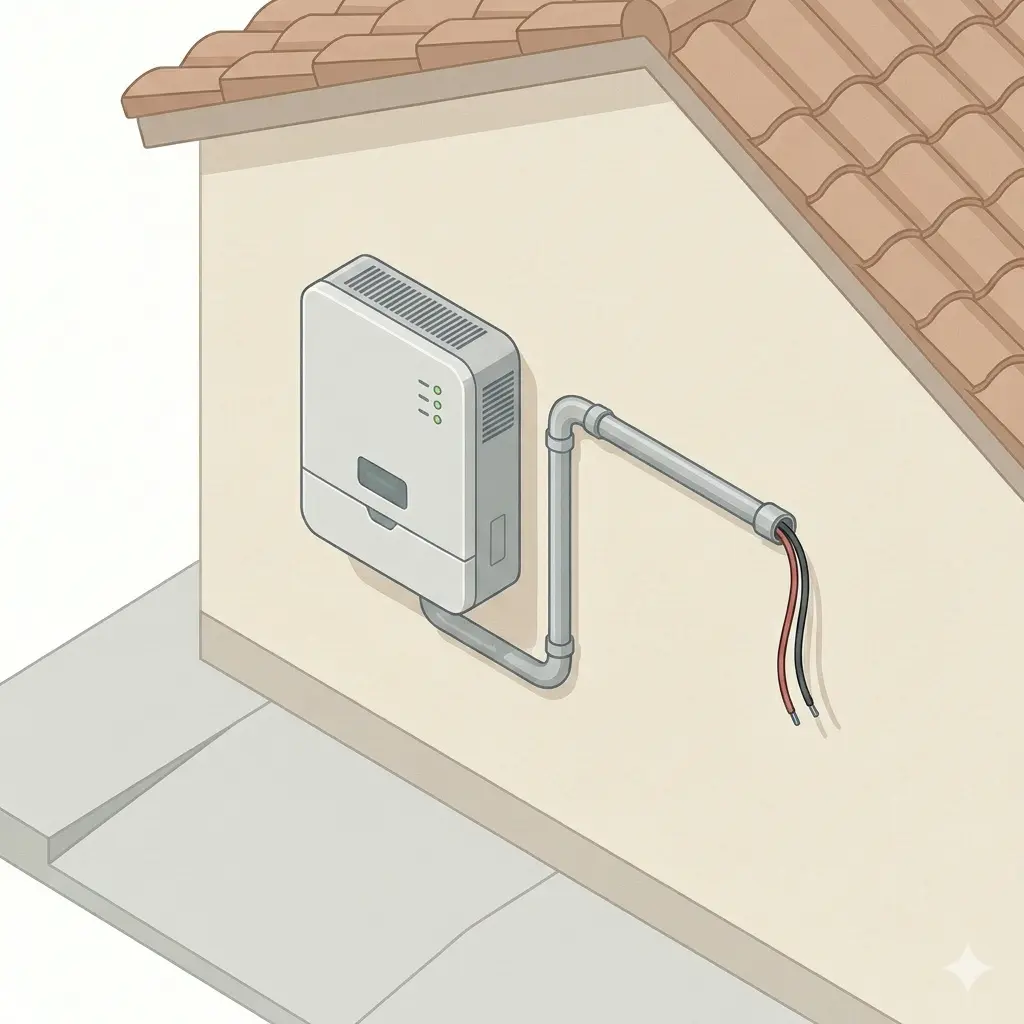
At a minimum, a properly battery-ready installation includes:
- A hybrid inverter with a DC battery connection port, or microinverters (like Enphase IQ8) designed to form a local microgrid for battery integration
- Pre-run conduit sized for battery interconnect wiring — the DOE Zero Energy Ready Home program specifies 1-inch metal conduit from the array to the inverter location
- Reserved breaker space in the main electrical panel, typically a pre-installed 70-amp dual-pole breaker
- A designated mounting area for the battery and balance-of-system equipment — a labeled 4×4-foot plywood mounting area is the DOE-recommended standard
The DOE's Building America program codifies these as best practices, not optional extras. When all four elements are in place, adding a battery later is a relatively straightforward project. When one or more is missing, the "battery ready" label may not save you much on a future retrofit.
What it costs — and what it saves
The upfront premium for genuine battery-ready preparation is modest. Choosing a hybrid inverter over a standard string inverter typically adds roughly $200–$300 to the initial system cost. Conduit, breaker space, and mounting prep add labor and materials but are inexpensive when bundled into the original installation.
:::cta

Solar Savings Calculator
Calculate how much you could save with solar energy. Compare costs, incentives, and long-term savings for your home.
:::
The payoff comes later. Retrofitting a battery onto a system that was not designed for one costs roughly 10–15% more than adding storage during the original solar installation, according to multiple industry analyses. The added expense comes from extra wiring, potential inverter replacement, a second permitting cycle, and sometimes main panel upgrades.
In dollar terms, a typical residential battery retrofit (around 13.5 kWh) runs approximately $12,000–$18,000 before incentives. Installing a battery with solar from the start saves roughly $1,000 in soft costs — labor, permitting, and system integration — compared to an equivalent retrofit, according to analysis from the Rocky Mountain Institute.
AC-coupled vs. DC-coupled: the efficiency tradeoff
How a battery connects to your solar system affects both cost and long-term performance.
DC-coupled systems (hybrid inverter with built-in battery port) route solar power directly to the battery without converting to AC first. Round-trip efficiency is typically 94–97%.
AC-coupled systems (separate battery inverter added to an existing grid-tie system) convert solar DC to AC, then back to DC for storage, then back to AC for use — three conversion steps. Round-trip efficiency drops to roughly 85–90%.
Over a battery's 10–15-year lifespan, that 5–10% efficiency gap compounds. A system cycling 10,000 kWh per year through battery storage could lose 500–1,000 kWh annually to conversion inefficiency in an AC-coupled setup compared to DC-coupled, equivalent to roughly $50–$150 per year at average US residential electricity rates.
When battery-ready makes sense
Battery-ready preparation is a reasonable hedge when:
- You plan to add storage within 3–5 years but can't afford or justify the full cost now.
- Your state's net metering policy is uncertain. If export credits drop, a battery becomes more valuable for self-consumption. Some states still offer 1:1 retail-rate net metering, but others like California (NEM 3.0) have already reduced export compensation substantially, making batteries far more attractive.
- Backup power matters to you. Grid-tied solar systems without batteries shut down completely during outages due to anti-islanding protection — a fact many homeowners don't learn until their first blackout. Average US grid outage duration exceeded 8 hours per customer in 2022, more than double a decade earlier.
- Battery costs are still falling. NREL cost benchmarks show residential battery pack costs dropped to roughly $115/kWh at the cell level in 2024. Waiting a few years while keeping your system ready for an easy retrofit may net you better technology at a lower price.
When it may not be worth the premium
Battery-ready prep adds cost that may never pay off if:
- You have strong, stable net metering and no interest in backup power. In that case, a battery may never make financial sense.
- You won't add batteries for many years. Battery-ready hardware like communication modules and gateways can age out of warranty or become obsolete before you use them. Battery technology evolves fast; what's compatible today may not be the best option in 7–10 years.
- AC-coupled options meet your needs. Products like the Tesla Powerwall 3 or Enphase IQ Battery can be AC-coupled to virtually any existing solar system without requiring battery-ready prep from the original installation.
What to ask your contractor
If a solar contractor describes their proposal as "battery ready," pin down the specifics:
- What inverter are you installing? A hybrid inverter with a DC battery port (like SolarEdge Home Hub, SMA Sunny Boy Smart Energy, or Generac PWRcell) is genuinely battery-ready. A standard string inverter is not, regardless of other preparation.
- Which batteries are compatible? Many hybrid inverters only work with the same manufacturer's batteries. SolarEdge requires SolarEdge batteries for DC coupling; Enphase IQ8 systems require Enphase IQ Batteries. Confirm the specific models before signing.
- Is conduit pre-run for the battery connection? If not, you'll pay for conduit and wiring during the retrofit.
- Is breaker space reserved? A dedicated breaker for future battery interconnection avoids panel upgrades later.
- What will it cost to add a battery later? Get a written estimate now so you can compare against installing a battery today.
The bottom line
"Battery ready" is a real concept backed by specific technical choices, but only when those choices are actually made. The term has no regulated definition, so the difference between a system genuinely prepared for future storage and one that merely doesn't prevent it can be thousands of dollars in avoided retrofit costs.
If you're considering solar without batteries, the smartest move is understanding exactly what "battery ready" means in your specific proposal rather than accepting the label at face value.