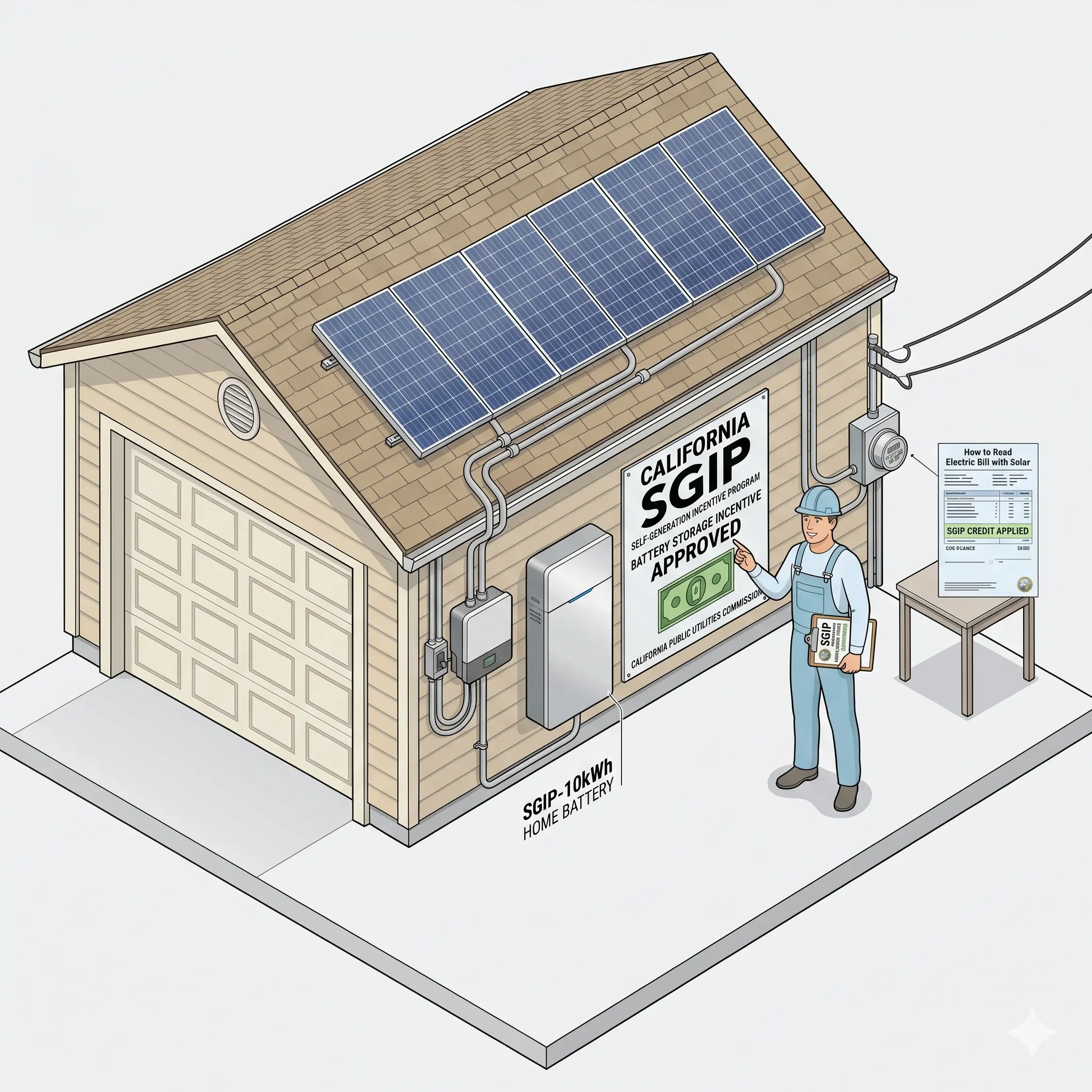
California's Self-Generation Incentive Program (SGIP) has funded residential battery storage for over two decades. But as of January 2026, every ratepayer-funded SGIP budget category has closed. The only pathway still accepting applications is the Residential Solar and Storage Equity (RSSE) program, and it requires income qualification.
If you're a California homeowner considering battery storage, understanding what RSSE offers, who qualifies, and what you commit to matters more now than whether SGIP "still exists" in a general sense.
What Changed: Why RSSE Is the Only Remaining Pathway
SGIP historically offered multiple budget categories with different incentive rates. The program is primarily focused on battery storage incentives, though it originally covered a broader range of distributed energy resources when it launched in 2001. General Market storage incentives started at $500/kWh for early adopters and had stepped down to $150/kWh by the final tier.
All ratepayer-funded SGIP budgets stopped accepting new applications on December 31, 2025. The program's authorization under SB 700 set that sunset, and while administrative functions continue through January 1, 2027, no new reservations are available from those funds.
What remains is RSSE, which operates on a different funding mechanism. Assembly Bill 209 (2022) allocated $280 million from California's Greenhouse Gas Reduction Fund: the first time SGIP received non-ratepayer funding. The CPUC authorized RSSE through Decision 24-03-071, and applications opened on June 2, 2025.
Who Qualifies for RSSE
The RSSE pathway is reserved for income-qualified applicants. For single-family homes, you must meet at least one of the following criteria:
- Household income at or below 80% of your county's Area Median Income (AMI)
- Current enrollment in CARE (California Alternative Rates for Energy)
- Current enrollment in FERA (Family Electric Rate Assistance)
- Current enrollment in ESA (Energy Savings Assistance)
- Prior participation in SASH or DAC-SASH solar programs
Income is typically verified through IRS Form 1040, California Form 540, or utility program enrollment records. AMI thresholds vary significantly by county, so your installer can provide the current table for your location.
Multifamily properties face a different set of requirements: at least five rental units, deed-restricted as low-income housing, and either located in a CalEnviroScreen-identified disadvantaged community or having at least 80% of households with incomes at or below 60% of AMI.
RSSE also expanded eligibility beyond the investor-owned utilities (PG&E, SCE, SDG&E, SoCalGas) that previous SGIP categories required. Customers of publicly owned utilities and community choice aggregators can now participate, a first for the program.
How Much the RSSE Incentive Is Worth
RSSE offers $1,100 per kWh for battery storage and $3,100 per kW for paired solar, rates that can cover up to 100% of system costs. This is substantially more than the General Market's final rate of $150/kWh.
:::cta
Solar Savings Calculator
Explore solar, battery & home energy solutions with independent guides, calculators, and product info.
:::
For single-family homes, the standard cap is 15 kWh of battery storage and 5 kW of solar, with larger amounts available if justified by household load. At standard rates, that translates to roughly $16,500 for the battery component and $15,500 for the solar array: approximately $32,000 in combined incentives. Resiliency-qualifying households may access up to 80 kWh of storage capacity.
RSSE also includes an Advanced Payment Program that provides 50% of the incentive upfront to the installer, reducing what a homeowner needs to finance before receiving the full rebate.
Current Program Status: Budget Windows and Waitlists
SGIP budget windows open and close periodically, and the RSSE pathway is no exception. The $280 million AB 209 budget was fully reserved within months of opening in June 2025. As of mid-2026, new applications in most utility territories are placed on waitlists.
The status varies by program administrator:
- CSE (SDG&E territory): Some AB 209 POU budget remains available; other sub-categories are waitlisted
- PG&E: Limited AB 209 funds remain in certain sub-categories; others are waitlisted
- SCE and SoCalGas: Waitlisted across all RSSE sub-categories
Waitlist positioning is based on application submission order. The program continues to issue reservations as existing applications lapse or budgets receive additional allocation, but there is no confirmed timeline for when waitlisted applicants will receive funding. Checking the current status at the official program metrics page (selfgenca.com) before making installation decisions is advisable.
The NEM 3.0 Connection
One of the least understood aspects of SGIP is how participation can trigger changes to your utility billing plan. For homeowners on legacy NEM 1.0 or NEM 2.0 tariffs, this has major financial implications.
Under NEM 3.0 (the Solar Billing Plan), export compensation dropped roughly 75% compared to NEM 2.0: from around $0.30/kWh to approximately $0.05–$0.08/kWh. This makes maximizing self-consumption and performing time-of-use rate arbitrage with batteries far more valuable than exporting solar energy to the grid.
The critical policy detail: General Market SGIP participants on NEM 1.0 or 2.0 must transition permanently to NEM 3.0 before submitting their Incentive Claim Form. This is an irreversible switch.
RSSE participants are exempt from this NEM transition requirement. If you qualify for RSSE and have existing NEM 1.0 or 2.0 solar, you can add battery storage through the program without losing your legacy net metering tariff. This exemption also applies to Equity Resiliency (low-income pathway) and San Joaquin Valley Residential program participants.
For homeowners already on NEM 3.0, battery storage becomes particularly valuable for TOU arbitrage: charging from solar during low-value midday hours and discharging during peak rates (typically 4–9 PM). The rate spread varies by utility: SDG&E offers the widest differential at roughly $0.68/kWh, translating to approximately $4,200 per year in savings, while SCE customers typically see $1,200–$1,800 annually.
What SGIP Compliance Requires
Accepting an SGIP incentive creates ongoing obligations that last a decade.
52 discharge cycles per year. Your battery must complete at least 52 full discharge cycles annually, with discharges occurring during peak hours (4–9 PM). A "full discharge" can be accumulated across partial discharges over a week. This requirement is uniform across all SGIP budget categories: despite suggestions in some discussions that cycling requirements vary by budget category or program vintage, they do not. Setting your battery to backup-only mode will violate this requirement.
10-year permanency. The system must remain at the installation site for 10 years. Moving triggers prorated incentive repayment: (years remaining / 10) × rebate amount.
Performance monitoring through a separate compliance channel. SGIP requires contracting with a Performance Data Provider (PDP) for a minimum of five years. The PDP submits data to program administrators monthly. While battery systems from manufacturers like Enphase, Tesla, and SolarEdge include built-in monitoring through their apps, the SGIP compliance metering system operates separately. All meters must be CEC-listed Revenue Grade and report data daily, with seven days of on-site data storage for outage resilience.
Demand Response enrollment. You must enroll in a qualifying demand response program within 12 months of installation. The battery responds automatically to DR events, typically up to once weekly during peak hours.
How the Application Process Works
Homeowners cannot apply for SGIP directly. An installer typically manages the entire paperwork submission process, from the initial Reservation Request Form through final payment.
Your installer submits the RRF and, once approved (typically 30–60 days), receives a Conditional Reservation Letter specifying the rebate amount and installation deadline (usually 12–18 months). After installation and inspection, the installer files the Incentive Claim Form (ICF), with payment processing taking another 30–45 days. The total timeline from application to payment typically runs 6–12 months, though waitlisted applications extend that considerably.
Some installers charge a separate processing fee for managing SGIP paperwork, particularly when they use specialist partners to navigate program compliance.
Pitfalls Worth Knowing About
Several common mistakes can cost homeowners their SGIP incentive:
- Installing before approval: Equipment installed before receiving a Confirmed Reservation Letter is not eligible for rebates.
- Missing the claim deadline: The 18-month deadline for submitting the Incentive Claim Form is strict and non-negotiable.
- Using a non-approved contractor: Only SGIP-registered developers can submit applications. Work done by unregistered contractors cannot be claimed retroactively.
- Failing discharge requirements: Systems that don't meet the 52-cycle minimum face prorated incentive recapture.
- The NEM transition trap: If you qualify for General Market SGIP rather than RSSE, evaluate whether the rebate amount offsets the export credits you'll lose by switching off NEM 1.0 or 2.0. This switch is permanent.
SGIP incentives are not considered taxable income and do not affect eligibility for MediCal, Medicare, or other assistance programs.