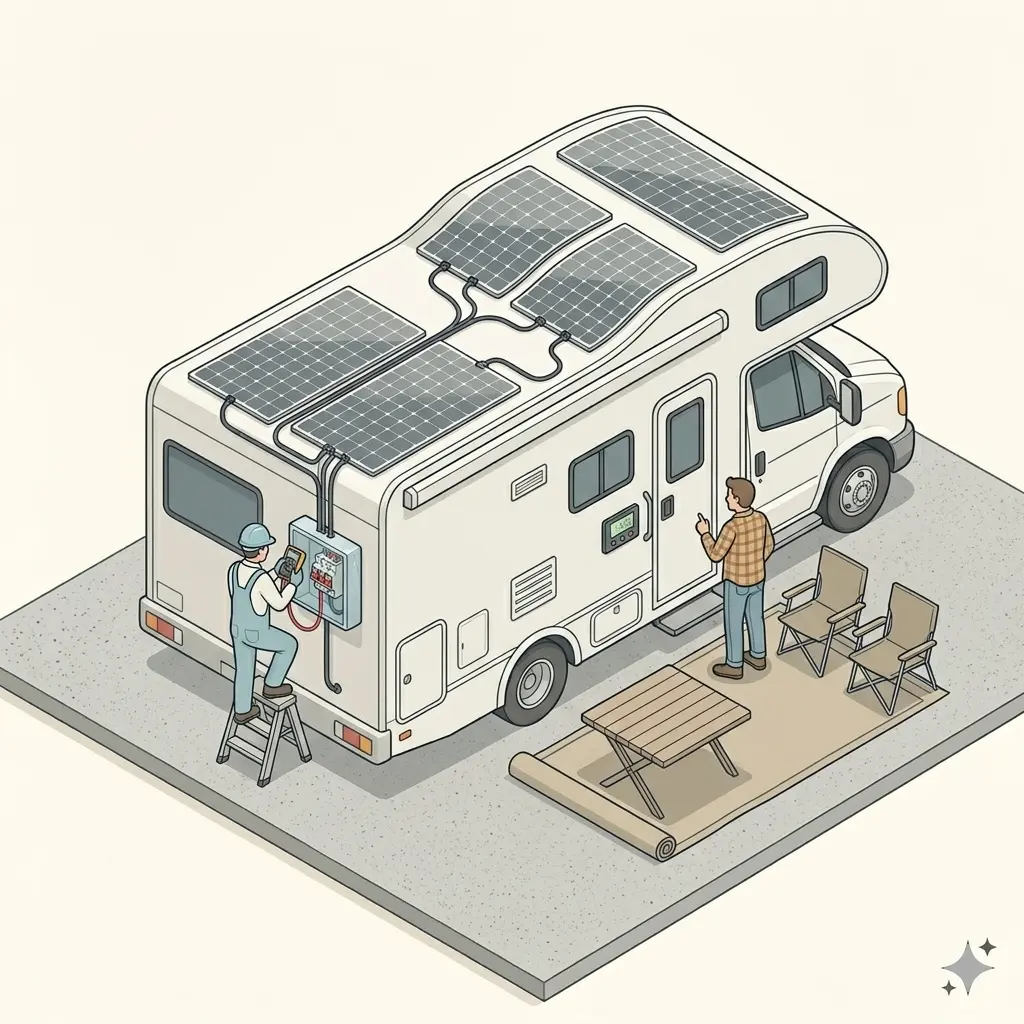
Flexible solar panels look perfect on paper. They are lightweight, easy to mount, and conform to curved surfaces like van roofs, boat decks, and shed rooftops without drilling or racking. But a recurring complaint from owners is that real-world output falls well short of the rated wattage, especially in summer when you would expect the most production. The reason is often heat, and the way most flexible panels are installed makes the problem significantly worse.
Why Flexible Panels Run Hotter
Standard rigid solar panels mount on racks or brackets that hold them several inches above the roof surface. That air gap allows convective airflow to carry heat away from the back of the panel. According to the Sandia National Laboratories NOCT cell temperature model, reducing the gap between a panel and the roof surface from open-rack to flush-mount (0-0.5 inches) adds approximately 18 degrees C to the cell operating temperature.
Flexible panels are typically glued or taped directly to the mounting surface with no gap at all. They absorb heat from direct sunlight on top and from the roof surface underneath, with no path for the trapped heat to escape. Measured surface temperatures on flush-mounted flexible panels regularly reach 60-70 degrees C (140-158 degrees F) in summer conditions, and can exceed 75 degrees C on dark metal roofs.
NREL's analysis of building-integrated photovoltaics directly addresses this: flush-mounted modules "do not permit airflow between module and host structure, which may degrade the semiconducting material of the module and could decrease the conversion efficiency more quickly and precipitate early failure." The DOE's own request-for-information summary on BIPV challenges found that insufficient ventilation causes "reliability, durability, and safety concerns" and explicitly recommends "designing the mounting so that air can circulate underneath."
The Immediate Output Penalty
Solar panels have a temperature coefficient that describes how much power output drops for each degree Celsius above the standard test condition of 25 degrees C. For monocrystalline cells, the type used in most flexible panels, this coefficient is typically -0.35% to -0.45% per degree.
At a cell temperature of 65 degrees C, a routine summer afternoon for a flush-mounted panel, the panel is 40 degrees above STC. At a coefficient of -0.40% per degree, it loses 16% of its rated output purely from temperature, before any degradation or soiling is factored in. Independent testing has measured 20-25% real-world output losses on flush-mounted flexible panels during peak summer conditions. One side-by-side comparison in southern France found a flush-mounted 200W flexible panel producing only 128W while an identical-rated rigid panel on a raised mount produced 172W on the same day.
This is not a defect; it is physics. The same temperature coefficient applies to rigid panels, but they typically run 15-20 degrees C cooler because of the air gap beneath them.
Accelerated Long-Term Degradation
The more consequential problem is what sustained high temperatures do over months and years. Heat accelerates every degradation mechanism in a solar panel: encapsulant yellowing, delamination, solder joint fatigue, and micro-crack propagation in the cells.
NREL's compendium of photovoltaic degradation rates, drawing on over 11,000 measurements across 200 studies, reports a median degradation rate of 0.5-0.6% per year for crystalline silicon panels under normal conditions. Flexible panels in flush-mount configurations typically degrade at 0.8-1.0% per year, roughly 60% faster.
The encapsulant material matters enormously. Budget flexible panels use PET (polyethylene terephthalate) front sheets, which yellow and crack under UV exposure within 18-36 months in high-UV environments. ETFE (ethylene tetrafluoroethylene) encapsulation is substantially more UV-resistant. One study found ETFE degraded only 2.3% after 5,000 hours of UV exposure compared to 12% for PET.
The practical result: PET-fronted flexible panels commonly show visible degradation within 3-5 years and may lose functionality within 5-8 years. ETFE panels typically last 8-15 years under the same conditions. By comparison, glass-fronted rigid panels routinely deliver 25-40 years of service.
The One-to-Two-Year Failure Claim
Online forums frequently report flexible panels becoming "basically useless" within one to two years. This is not a universal experience, but it is not fabricated either. The 1-2 year failure timeline is realistic under a specific combination of conditions: budget PET-encapsulated panels, dark mounting surface, hot climate with high UV, and zero air gap.
Under those conditions, the panel experiences both accelerated cell degradation from sustained operating temperatures above 70 degrees C and rapid encapsulant breakdown from combined heat and UV exposure. Marine installations in tropical climates report particularly fast failures, with some panels delaminating within 12-14 months.
Under more moderate conditions (temperate climate, lighter roof color, ETFE encapsulation) flexible panels commonly last 5-10 years before output drops below useful levels. Quality panels with engineered air gaps can reach 10-15 years.
The manufacturer warranty gap tells the same story. SunPower offers a 5-year power warranty on its flexible E-Flex panels versus a 40-year warranty on its rigid Maxeon line. Rich Solar covers flexible panels for 1 year versus 25 years for rigid. Even where the warranty duration matches on paper, installation guidelines from manufacturers like Renogy include specific requirements for silicone bead spacing to preserve airflow, implying that improper flat-seal mounting could void coverage.
What Actually Helps
The single most effective intervention is creating an air gap between the panel and the mounting surface.
Research from Sandia National Labs and multiple field studies converges on these numbers:
- A gap of just 10-15 mm provides measurable temperature reduction.
- A 50 mm (2-inch) gap typically reduces cell temperature by 10-15 degrees C.
- The optimal gap for minimum cell temperature is 100-125 mm (4-5 inches), which can reduce operating temperature by up to 20 degrees C.
An NREL study on close-roof-mounted systems found that panels with less than about 8-9 cm of clearance routinely exceed 70 degrees C at the 98th percentile, the threshold above which standard IEC 61215 certification testing no longer applies. Panels operating above this threshold may be outside their certification envelope entirely.
For installations where an air gap is not practical, choosing ETFE-encapsulated panels over PET is the next most important factor. Some manufacturers now offer honeycomb aluminum backsheets that create built-in ventilation channels, reducing operating temperature by 5-8 degrees C compared to standard flat-mounted panels.
When Flexible Panels Still Make Sense
Flexible panels are not universally a poor choice. They fill real niches that rigid panels cannot:
- Curved surfaces where rigid panels will not physically fit.
- Weight-sensitive applications where 2-4 kg matters versus 10-15 kg for a rigid equivalent.
- Temporary or portable installations where drilling and racking are not options.
- Low-power applications under 100W in temperate climates, where the thermal penalty is small enough to be acceptable.
For a permanent installation on a flat surface, such as a shed roof, a house, or a stationary RV, rigid panels with proper racking will almost always deliver better economics over any timeframe beyond two to three years. The initial cost advantage of flexible panels is consumed by the shorter lifespan and lower real-world output.
If you do choose flexible panels, prioritize ETFE encapsulation over PET, create any air gap you can manage, and set realistic expectations for lifespan. A well-installed flexible panel can deliver useful power for a decade. A poorly installed one may not last two summers.