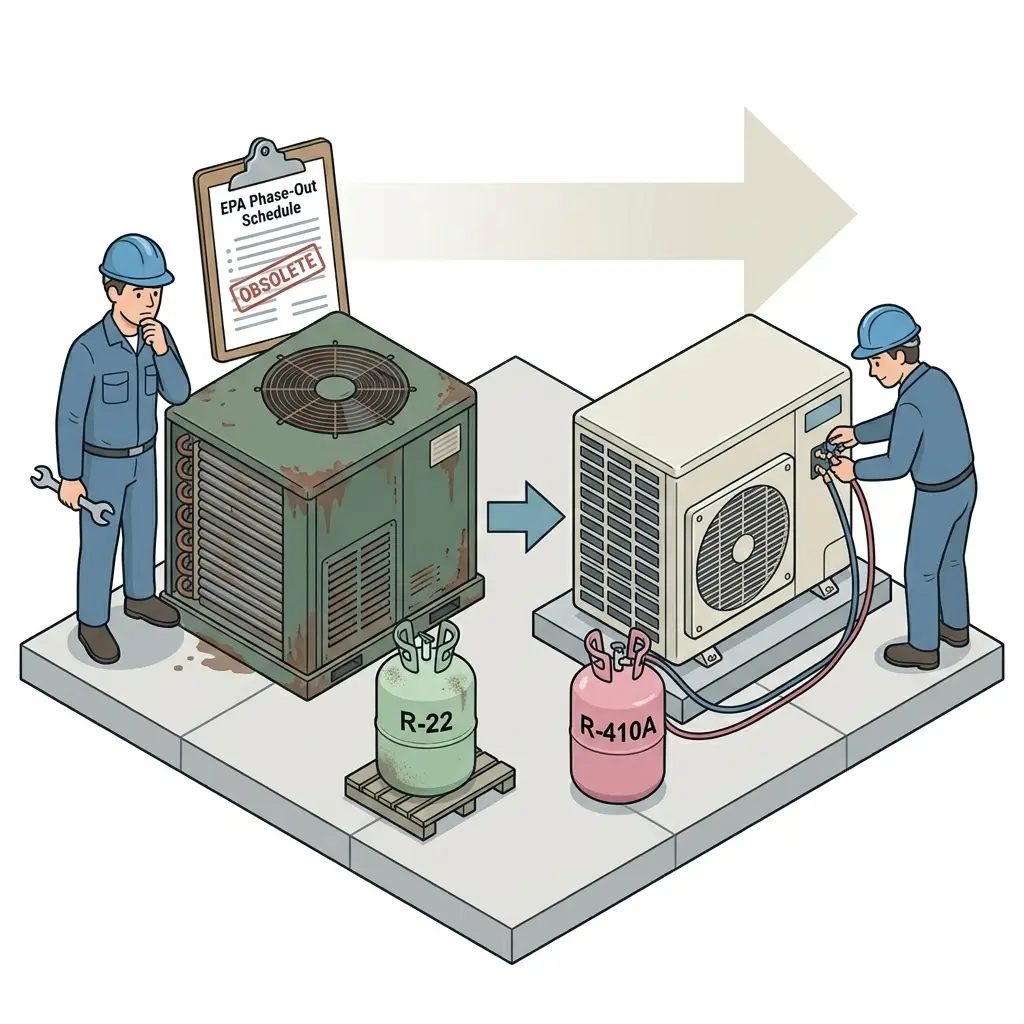
A common worry among homeowners is that HVAC refrigerant standards change so often that equipment becomes obsolete before it wears out. The concern is understandable; if you bought an R-22 air conditioner in the 2000s, you watched the price of a simple recharge climb from under $10 per pound to over $150 per pound after production was banned in 2020. And now, barely 15 years after R-410A became the standard, another transition is underway.
But the idea that frequent refrigerant changes render HVAC equipment obsolete quickly deserves closer scrutiny. The reality is more nuanced than the panic suggests.
Three transitions in 40 years
The United States has gone through exactly three major residential HVAC refrigerant transitions:
- CFC (R-12) to HCFC (R-22): Driven by the 1987 Montreal Protocol to address ozone depletion. CFCs were phased out by 1996.
- HCFC (R-22) to HFC (R-410A): Also driven by the Montreal Protocol. New R-22 equipment was banned in 2010; R-22 production and import were banned in 2020.
- HFC (R-410A) to A2L (R-454B/R-32): Driven by the AIM Act of 2020 and the Kigali Amendment. New R-410A residential equipment manufacturing was banned on January 1, 2025.
That is roughly one transition every 15 to 20 years; each announced decades in advance. The Montreal Protocol was signed in 1987; the R-22 production ban did not take full effect until 2020, a 33-year runway. The AIM Act, signed in 2020, gives the industry until 2036 to achieve an 85% reduction in HFC production.
These are not sudden changes. They are phased transitions with long lead times.
Your existing system is not illegal
A critical distinction that often gets lost: refrigerant phase-outs restrict the manufacture and import of new equipment, not the use of existing systems. The EPA does not require homeowners to replace functioning HVAC equipment because of a refrigerant change.
R-22 systems installed before 2010 can still be operated and serviced today, using recycled or reclaimed R-22. Similarly, R-410A systems installed before 2025 can be operated and serviced indefinitely; R-410A remains legal to produce, sell, and use as a service refrigerant with no end date. In May 2026, the EPA finalized a rule removing the installation deadline for R-410A split systems manufactured before January 2025, allowing existing inventory to be installed until supplies are depleted.
The real issue: rising service costs
Where the obsolescence concern has merit is in the economics. When a refrigerant's production is phased down, the available supply shrinks and prices rise; sometimes dramatically.
R-22 provides the clearest precedent. Prices climbed from roughly $10–$20 per pound before production limits to $90–$250 per pound by 2025. A full recharge on a 3-ton system can cost $1,500 or more at current prices. At those levels, a single major leak repair can approach 25–50% of the cost of a new system.
R-410A is following a similar trajectory. Recharge costs have risen to roughly $50–$80 per pound in 2026, up approximately 40–60% from 2023 levels. As production allowances tighten under the AIM Act; dropping to 30% of baseline by 2029 and 15% by 2036; prices are expected to continue climbing.
The result is a kind of economic obsolescence. The equipment still works, and it is still legal to operate, but servicing it becomes progressively more expensive. For a system that develops a refrigerant leak late in its life, the repair-versus-replace calculation increasingly favors replacement.
Equipment lifespan versus transition timing
The transition timelines roughly match; and in some cases exceed; the typical lifespan of residential HVAC equipment. Central air conditioners typically last 15–20 years. Heat pumps typically last 10–20 years.
The R-22 phase-out illustrates this alignment. The last R-22 equipment was manufactured in 2009. By 2026, those units are 17 or more years old; at or beyond the expected lifespan for a central air conditioner. Most homeowners who installed R-22 systems in the mid-2000s would have needed to replace them by now regardless of the refrigerant transition.
A system installed at the start of one refrigerant era will typically approach the end of its natural service life around the time the next transition takes effect. The transitions do not force premature replacement; they create cost pressure on systems that are already aging out.
What the current transition means for homeowners
As of January 1, 2025, new residential air conditioners and heat pumps must use refrigerants with a global warming potential below 700. R-410A, with a GWP of 2,088, no longer qualifies for new equipment manufacturing. The primary replacements are R-454B (GWP 466, used by Carrier, Trane, Lennox, and Rheem) and R-32 (GWP 675, used by Daikin, Mitsubishi, and Fujitsu).
:::cta
How many solar panels to run an air conditioner?
Explore solar, battery & home energy solutions with independent guides, calculators, and product info.
:::
R-454B and R-32 are classified A2L under ASHRAE Standard 34; mildly flammable with very low burning velocity. New systems include integrated leak detection sensors and automatic safety mechanisms required by UL 60335-2-40.
For homeowners with existing R-410A systems:
- Your system does not need to be replaced. Continue operating it normally.
- R-410A remains available for servicing with no regulatory end date. Recycled and reclaimed R-410A is not subject to production caps.
- Budget for rising service costs. If your system develops a refrigerant leak in later years, recharge costs will be higher than when you bought it.
- Plan replacement around equipment condition, not refrigerant panic. When your system reaches 15 years or older and needs a major repair, that is the natural time to upgrade.
New R-454B systems currently carry a premium of roughly 8–15% above comparable late-model R-410A systems at the same efficiency rating, though this gap has narrowed as manufacturers have scaled production.
The bottom line
Refrigerant transitions create real economic pressure on older equipment. But the claim that standards change frequently enough to make systems obsolete quickly overstates both the pace of change and the practical impact. Three transitions in 40 years, each with decade-long lead times, is not frequent. And no transition has ever required homeowners to replace functioning equipment.
The more accurate framing: refrigerant regulations evolve on roughly 15-to-20-year cycles that align with typical equipment lifespans. They increase the long-term servicing costs of older systems, which eventually tips the repair-versus-replace calculation toward replacement. But that is a gradual economic shift; not a sudden obsolescence event.