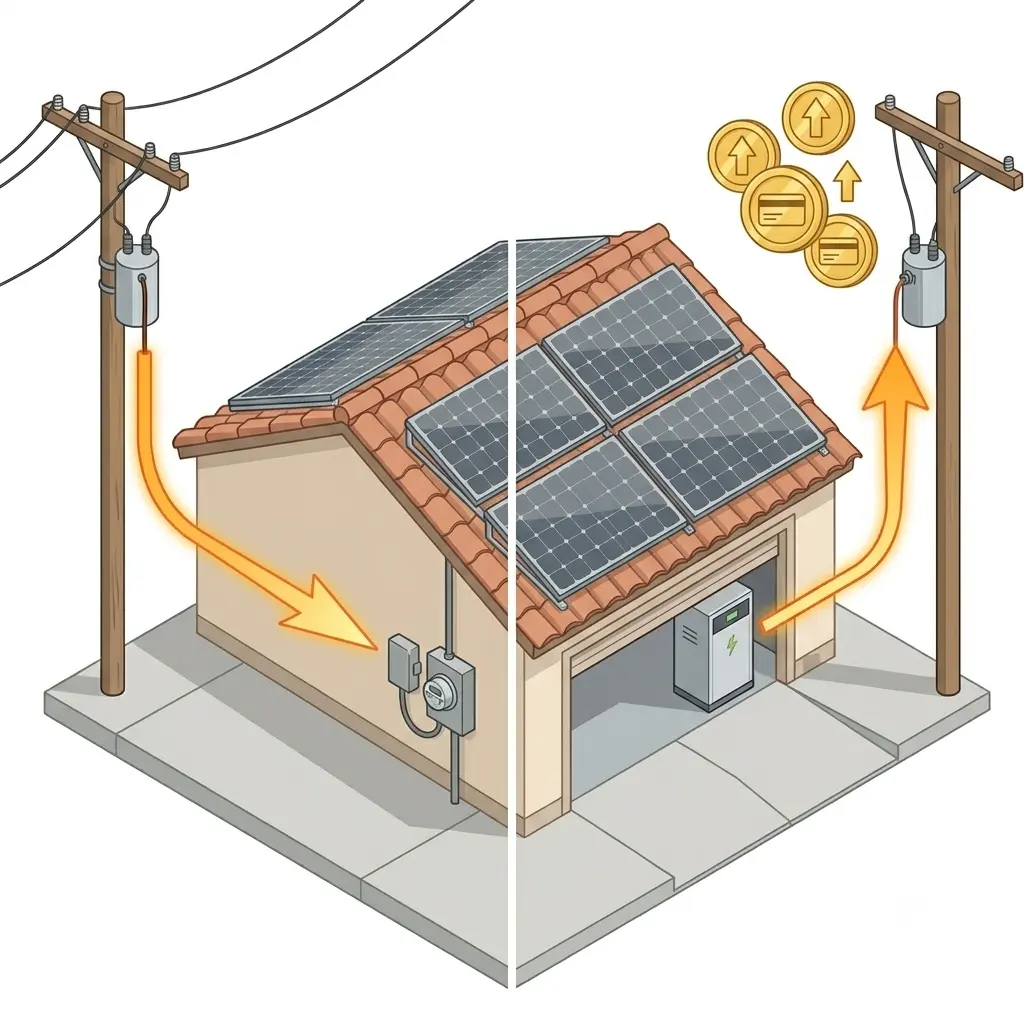
If you have a solar battery in California, or are shopping for one, you will eventually encounter a confusing rule: your battery can either charge from the grid or export energy for credits, but not both. This is not a software limitation. It is a regulatory requirement built into your interconnection agreement with PG&E, SCE, or SDG&E.
Understanding this rule matters because it determines how your battery operates every day and directly affects your electricity bill.
The rule: two modes, one choice
Under California's Net Billing Tariff (NBT, commonly called NEM 3.0), battery storage systems paired with solar must operate in one of two modes:
Export Only (solar-charged). The battery charges exclusively from the solar panels. It can discharge to power the home and export surplus energy to the grid for credits. This is the mode required to earn NBT export credits from battery-stored energy.
Import Only (grid charging permitted). The battery can charge from both solar panels and the grid. However, it cannot export any energy to the grid. Solar panels can still export directly, but the battery itself is locked out of grid export.
The choice is made at installation and documented in the interconnection agreement with the utility. Changing modes later requires contacting the battery manufacturer; Enphase, for example, locks the mode after seven days; and may incur a utility modification fee.
Why the rule exists
The restriction traces back to CPUC Decision D.14-05-033 in 2014, refined through subsequent decisions (D.19-01-030, D.20-06-017) and carried into the NEM 3.0 framework via Decision D.22-12-056 in December 2022.
The regulatory rationale has two parts.
First, anti-arbitrage protection. Under NEM 2.0, export credits were at or near retail rates; roughly $0.30–$0.35/kWh. If a homeowner could charge a battery from the grid at cheap overnight rates and export that energy at retail-rate credits, the resulting arbitrage would shift costs to other ratepayers. Prohibiting grid-charged exports eliminates this possibility.
Second, renewable energy integrity. California's Renewable Portfolio Standard requires that energy credited as solar generation actually originated from solar panels. A battery that charges from the grid draws power from a mix of sources including natural gas. The utility cannot distinguish solar-sourced electrons from grid-sourced electrons once they are stored in a battery, so the rules use operating mode restrictions as a proxy for source verification.
There is one narrow exception: CPUC Decision D.20-06-017 allows batteries in Export Only mode to charge from the grid during declared Public Safety Power Shutoff (PSPS) events.
How NEM 3.0 export compensation works
Under NEM 2.0, exports earned near-retail credit; roughly $0.30–$0.35 per kWh. NEM 3.0 replaced that with the Avoided Cost Calculator (ACC), which compensates exports based on what the utility would have paid to acquire the same energy on the wholesale market.
The ACC produces roughly 576 distinct export rates per year, varying by month, hour of day, and weekday vs. weekend. Annual averages by utility are roughly:
- PG&E: ~$0.05/kWh
- SCE: ~$0.05/kWh
- SDG&E: ~$0.06/kWh
That represents a 75–80% reduction from NEM 2.0 credits. But the rates are not uniform across hours. Midday solar hours (10 AM–3 PM) pay the least; typically $0.04–$0.08/kWh; because abundant solar generation depresses wholesale energy value. Evening peak hours pay significantly more. And during high-demand periods like September weekday evenings, ACC rates can spike to $2.50–$3.50 or more per kWh.
Export rates are locked at the values in effect when the system receives Permission to Operate (PTO) and remain fixed for nine years. An ACC Plus adder provides a small supplemental credit for the first five years; roughly $0.02/kWh for PG&E, $0.04/kWh for SCE; declining 20% annually.
Self-consumption matters more than exports
The most important number under NEM 3.0 is the gap between import and export rates. Importing a kWh during peak hours costs roughly $0.50–$0.70 at current PG&E and SCE rates. Exporting a kWh earns an average of $0.05–$0.06. A battery that avoids one peak-rate import is worth roughly ten times more than one that exports the same kWh.
This arithmetic is why self-consumption; using stored solar energy to power the home during expensive peak hours instead of buying from the grid; drives most of the financial value of battery storage under NEM 3.0. Industry modeling shows solar-plus-storage systems save roughly $1,600 in the first year compared to roughly $720 for solar alone, with most of the difference coming from avoided imports rather than export credits.
Battery attachment rates at California solar installers reflect this shift. Under NEM 2.0, roughly 10% of solar installations included batteries. Under NEM 3.0, that figure has risen to 60–95% depending on the installer, and approximately 70% of NBT customers had added batteries by the end of 2024 according to CPUC data.
The export window that matters
For homeowners in Export Only mode, there is a narrow window where battery exports produce meaningful revenue: late summer evenings, particularly in August and September between roughly 5–9 PM.
During these hours, grid demand peaks as air conditioning loads remain high while solar generation fades. ACC export rates during these windows have reached $2.50–$3.50/kWh or higher; enough to make strategic battery discharge genuinely profitable. A 13.5 kWh battery fully discharged during a $3.00/kWh window would earn roughly $40 in a single evening.
Outside this window; roughly October through July; the peak-to-off-peak export rate spread is typically too small to overcome battery round-trip efficiency losses (roughly 10–15% of stored energy is lost in each charge-discharge cycle). During those months, self-consumption is the better strategy.
Practical battery settings
Battery manufacturers implement the regulatory modes differently, but the underlying binary choice is the same.
Tesla Powerwall. The installer configures "Export Permission" at setup; options include Solar Only (the default for California), Solar and Battery, and Permanent Non-Export. The homeowner controls two settings in the Tesla app: "Energy Exports" (Solar vs. Everything) determines whether the battery participates in grid export during Time-Based Control, and "Grid Charging" enables or disables charging from the grid. For NEM 3.0 Export Only operation, the recommended configuration is Time-Based Control mode with Energy Exports set to Everything, Grid Charging off, and Backup Reserve at 0%.
Enphase. The installer selects Export Only or Import Only mode during commissioning. Export Only mode restricts battery charging to solar and enables grid export. This choice is locked after seven days and requires contacting Enphase support to change.
FranklinWH. Similar binary; Export Only (solar-charged, can export) or Import Only (grid charge permitted, no export). California's regulatory requirement applies regardless of battery manufacturer.
The seasonal strategy debate
The solar and battery community actively debates whether to use Time-Based Control (TBC) or Self-Powered mode year-round.
Tesla recommends Time-Based Control with Energy Exports set to Everything as the default NEM 3.0 configuration. In this mode, the Powerwall algorithm decides when to charge, discharge, and export based on the utility rate schedule.
However, many homeowners have found that TBC is only advantageous during summer months (roughly June through September), when the peak-to-off-peak spread justifies cycling the battery for export. In winter, the rate differential is too small to overcome round-trip efficiency losses, and TBC's algorithm may discharge the battery at suboptimal times.
One specific quirk to be aware of with custom rate plans in Time-Based Control: if you set the export price higher than the import price for a given time period, the system will internally raise the buy price to match the sell price. This is documented in the Tesla Fleet API and exists to prevent arbitrage behavior when grid charging is not restricted at the hardware level. In practice, homeowners who want to encourage exports during specific hours should set both buy and sell prices high for those periods rather than raising only the sell price.
An additional complexity: under NEM 3.0, export credits are "unbundled" into generation and delivery components. Credits earned from exports can only offset the generation portion of the bill, not delivery or transmission charges. TBC's algorithm does not account for this distinction, which can lead to dispatch decisions that look profitable on paper but produce smaller bill savings than expected.
The practical consensus among experienced NEM 3.0 homeowners is to use Time-Based Control during summer for the peak export window, and switch to Self-Powered mode from October through May when self-consumption dominates the value equation.
Virtual Power Plants: an alternative export path
Battery owners in Export Only mode can also participate in Virtual Power Plant (VPP) programs. These programs dispatch batteries during grid emergencies at compensation rates that typically exceed standard ACC export values. VPP participation does not require Time-Based Control mode and works alongside normal battery operation.
The bottom line
California's NEM 3.0 forces a genuine tradeoff for battery owners. Choosing Export Only mode; solar-charged only, no grid charging; preserves the ability to earn export credits, which can be significant during narrow peak windows. Choosing Import Only mode; grid charging permitted; enables off-peak grid arbitrage but permanently forfeits battery export credits.
For most homeowners with sufficient solar production to charge their battery during the day, Export Only mode is the stronger choice. The self-consumption value alone justifies the battery, and the late-summer export window provides a meaningful bonus. Grid charging is primarily valuable for homes that cannot fully charge their battery from solar; typically those with undersized arrays, heavy shading, or very large battery systems relative to their solar capacity.
The anti-arbitrage rule may seem outdated in a world where NEM 3.0 export rates are too low to make grid-to-grid arbitrage profitable. But it remains embedded in utility interconnection agreements and was upheld along with the broader NEM 3.0 framework when a California appeals court affirmed CPUC Decision D.22-12-056 in March 2026.