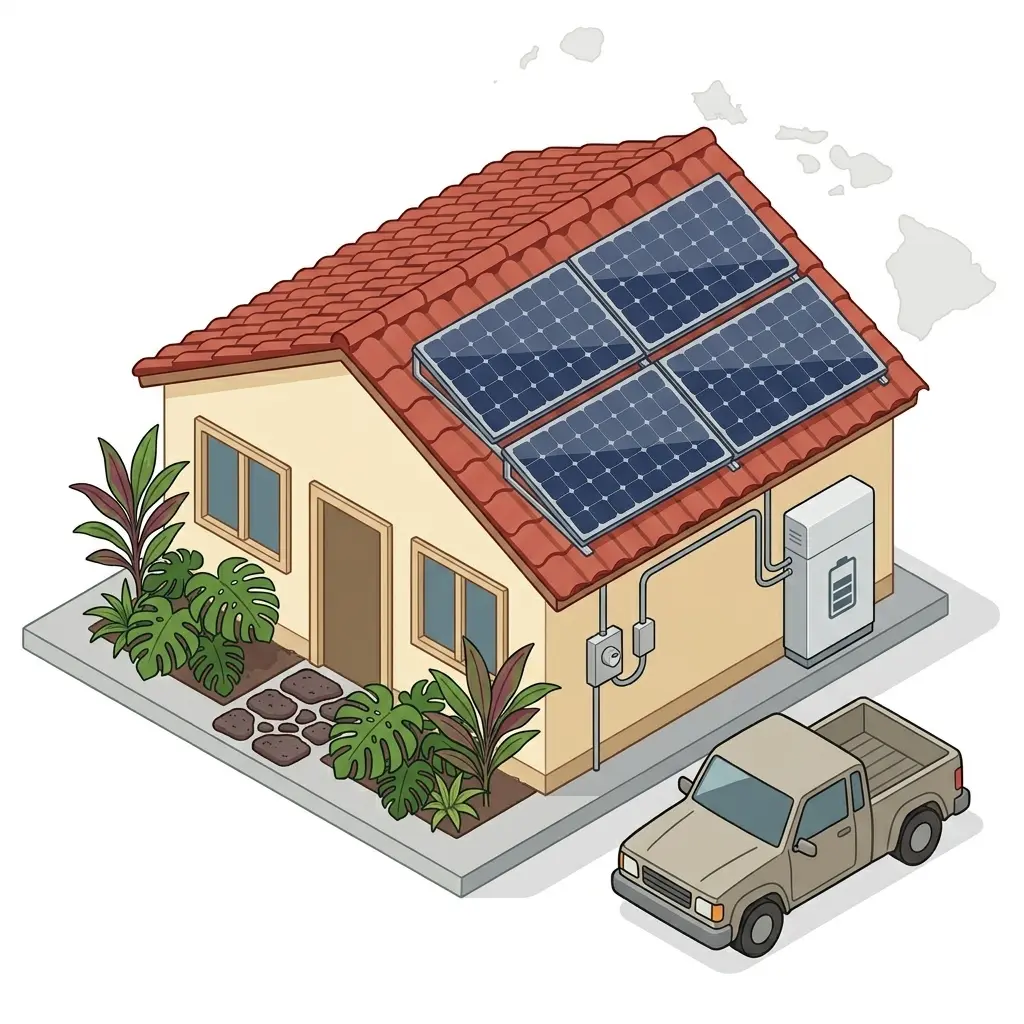
Nearly every new home solar installation in Hawaii now includes a battery. In Illinois, roughly one in four does. Nationally, the share has climbed from around 6% in 2020 to somewhere between 25% and 40% today, depending on who's counting. Those splits reveal what actually drives the decision to add a battery, and it's not the same calculation in every state.
The national picture
In 2020, just 6% of residential solar installations in the United States included battery storage, according to Lawrence Berkeley National Laboratory's Tracking the Sun dataset. By the end of 2023, LBNL reported that figure had reached 12% nationally, but that number understates the pace of change in the states leading the shift.
The gap between data sources matters. LBNL tracks every installation in its sample. EnergySage, which tracks quotes from its online marketplace of more engaged shoppers, reported a 45% attachment rate in the second half of 2024, dropping to 38% in late 2025. Wood Mackenzie and the Solar Energy Industries Association placed the national rate at 25% in early 2024 and projected roughly 35% for 2025.
The variation isn't just measurement noise. It reflects a market splitting into two very different worlds: states where batteries are becoming standard, and states where they remain a niche add-on.
Hawaii: where batteries are the default
Hawaii's residential solar-plus-storage attachment rate has ranged from 92% to 100% since 2022, depending on the source and time period. The Hawaii Department of Business, Economic Development and Tourism reported that 92.4% of residential solar permits in 2025 included battery storage. LBNL's Tracking the Sun found 95% for 2023. Sunrun and Wood Mackenzie have both reported rates at or near 100%.
This wasn't always the case. In 2017, only 26.8% of Hawaii's solar permits included batteries. By 2018, that had climbed to 62.7%. By 2022, it exceeded 90%.
The catalyst was the Hawaii Public Utilities Commission's decision to end net energy metering for new customers in October 2015. Under the old program, homeowners received full retail rate credits for electricity exported to the grid. The replacement programs, Customer Self-Supply (zero export allowed), Customer Grid-Supply (wholesale-rate export credits), and later Smart Export and Smart DER, made solar without a battery economically impractical for most homeowners.
Hawaii's electricity rates compound the effect. At $0.38–$0.44 per kilowatt-hour, roughly three to four times the national average, the value of storing and self-consuming solar energy rather than buying from the grid is unusually high.
There is no state mandate requiring batteries with solar in Hawaii. The near-universal adoption is driven entirely by economics and rate design.
California's similar experience illustrates the power of this dynamic: when NEM 3.0 slashed export compensation by roughly 75% in 2023, battery attachment on new residential solar installations jumped from approximately 10% to 60% within months. Texas shows a different path—battery adoption surged after Winter Storm Uri exposed grid vulnerabilities, reaching 61% by mid-2025—but Hawaii's case is the clearest example of rate structure alone driving near-universal adoption. Hawaii moved first on ending net metering and has the highest electricity rates in the country, creating a one-two punch that makes batteries the only economically rational choice for most homeowners.
Where batteries don't pencil out
In states with stable grids, flat electricity rates, and intact full-retail net metering, the return on investment for adding a battery is significantly harder to justify. With full net metering, the grid effectively acts as a free battery, homeowners export excess solar during the day and receive full retail credits to offset nighttime usage.
Adding a battery in these markets can extend payback from roughly 6–9 years for solar alone to 10–13 years for solar-plus-storage. At $0.12–$0.15 per kilowatt-hour with flat rates and few outages, the arbitrage value of a battery is minimal. Payback periods stretching past 10 years represent a difficult sales argument in markets where the grid is reliable and net metering is intact.
Illinois sits at a roughly 25% attachment rate, notably higher than many Midwest and Southeast states in the 4–10% range. That's partly because the state offers a $300 per kilowatt-hour battery rebate and a 25% state solar tax credit. In much of the Southeast, Mountain West, and Plains states where electricity runs $0.10–$0.13 per kilowatt-hour with few outages, single-digit attachment rates remain the norm.
What drives the decision
Three factors explain most of the state-by-state variation:
Rate structure. Reduced net metering, time-of-use rates with large peak-to-off-peak spreads, and low export compensation all improve battery economics. This is the strongest driver, it explains Hawaii, California, and increasingly Texas.
Incentive availability. California's Self-Generation Incentive Program can cover $150–$1,000 per kilowatt-hour for qualifying households. Massachusetts's ConnectedSolutions pays $275 per kilowatt annually. Vermont's Green Mountain Power offers up to $950 per kilowatt upfront. Many states offer nothing comparable.
Grid reliability. In areas prone to extended outages, island grids, hurricane zones, wildfire-prone regions, or areas with strained winter capacity, backup power becomes a motivation that can override marginal economics.
Markets where all three factors align see attachment rates above 70%. Markets with one or two see 30–60%. Markets with none remain in single digits.
State incentives and virtual power plant programs become more important without federal support. For homeowners in states with strong programs, the economics may still work. For those without, the payback calculation has become harder.
What this means if you're considering solar
If your state has curtailed net metering, has high electricity rates, or faces grid reliability concerns, a battery likely improves your system economics. If you're in a state with full-retail net metering, low flat rates, and a stable grid, the financial case is weaker, though backup power during outages has value that doesn't appear in a payback calculation.
:::cta
Calculate Your Solar Savings
Estimate how much you can save with a solar system in your area. Factors in electricity rates, net metering policies, and local incentives.
:::
Battery costs have dropped significantly. Wholesale pack prices fell to $70 per kilowatt-hour in 2025, a 45% decline from the prior year. Installed residential system costs remain higher, typically $700–$1,300 per kilowatt-hour depending on brand and location, reflecting labor, permitting, inverter integration, and installer margins.
The most important variable isn't battery technology. It's your utility rate structure. Check whether your state has modified net metering, what your peak-to-off-peak rate spread is, and what state incentives are available. Those three factors determine whether a battery pays for itself in 5 years or 15.