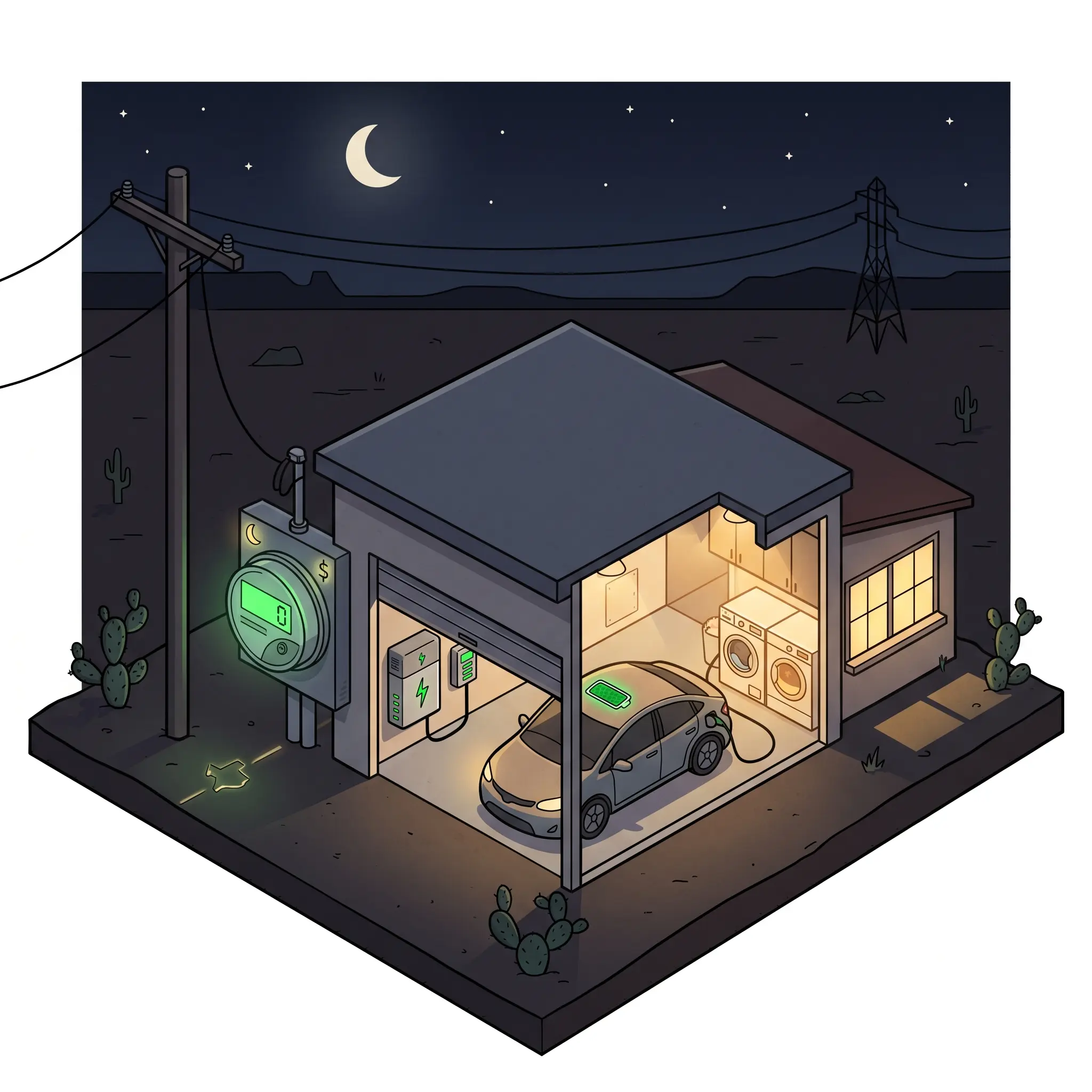
A widely shared claim on social media says Texas utilities shut down their free nighttime electricity plans after homeowners started using whole-home batteries to charge overnight and run their houses for free during the day.
The reality is more nuanced than the viral version.
What are Texas free nights plans?
Texas deregulated its electricity market in 2002, creating a competitive retail market where dozens of retail electric providers (REPs) compete for customers. Providers like TXU Energy, Reliant Energy, Green Mountain Energy, and CleanSky Energy offer plans where the energy charge drops to zero during overnight hours: typically 8 PM to 6 AM or 9 PM to 7 AM.
The catch: daytime rates on these plans run significantly higher than standard fixed-rate plans. A typical free nights plan charges 24–35 cents per kWh during the day, compared to 13–15 cents per kWh on a fixed-rate plan. The provider's bet is that most residential customers use most electricity during the day, so the elevated daytime rate covers the cost of the free overnight window.
There is a second catch that many customers miss: transmission and distribution utility (TDU) delivery charges of roughly 5–6 cents per kWh still apply around the clock, including during "free" hours. So "free" electricity actually costs about 6 cents per kWh in delivery charges alone.
The battery arbitrage strategy
The strategy is straightforward. Install a whole-home battery system—a Tesla Powerwall, Enphase IQ Battery, FranklinWH aPower, or similar—and configure it to charge from the grid during the free overnight window. At dawn, switch to battery power. If you also have solar panels, solar production supplements the battery during daylight hours.
Every major home battery manufacturer supports and markets rate arbitrage as a feature. Tesla calls it "Time-Based Control." Enphase offers "Savings Mode" with off-peak charging schedules. FranklinWH titles a product page "Energy Arbitrage Explained." Generac lists "Rate Arbitrage" as one of three official operating modes for the PWRcell.
Solar installers in Texas publish configuration guides for this setup. Community forums have active threads with homeowners reporting near-zero electricity bills.
Did providers actually shut it down?
No. Free nights plans remain available across multiple Texas REPs as of mid-2026. TXU Energy offers Free Nights and Solar Days. Reliant offers Truly Free Nights. Green Mountain Energy, CleanSky Energy, and others continue to market variations.
What has happened is subtler:
Some providers now exclude solar or distributed generation customers. Just Energy's Nights Free Plan states that homes with solar panels or other distributed generation systems are not eligible. This blocks the solar-plus-battery combination from accessing free nights pricing.
Some providers have declined to renew contracts. Forum discussions describe customers who ran negative or near-zero balances for months being dropped at contract renewal. Most free nights plans are 12-month terms, and providers are not required to renew.
At least one provider removed solar buyback from free nights plans. Direct Energy dropped the solar export credit component from their free nights offering as of early 2025.
Providers retain broad contractual discretion. Reliant's plan terms include the right to discontinue the offer without notice.
None of this amounts to an industry-wide shutdown. But the pattern shows providers gradually tightening their plan structures as battery adoption grows.
The economics are harder than they look
The viral framing suggests free electricity plus a battery equals free daytime power. The actual math is less exciting.
TDU delivery charges are unavoidable. Even during "free" hours, you pay roughly 6 cents per kWh in delivery charges in Oncor territory.
Round-trip efficiency losses. A home battery loses roughly 10–15% of stored energy in the charge-discharge cycle. NREL's representative figure is 85% round-trip efficiency for residential lithium-ion systems. Every kWh charged overnight delivers only about 0.85 kWh of usable daytime power.
Battery degradation. Daily deep cycling accelerates battery wear. Research shows degradation reduces net arbitrage profit by 13–24% annually. LFP batteries handle daily cycling better than NMC, but the degradation cost is nonzero for either chemistry.
Without a battery, free nights plans usually cost more. An EnergyBot study of 501 Texas households found that free nights and weekends plans cost 30% more than fixed-rate alternatives on average. Real smart-meter data from two Dallas homes showed only 15–22% of usage fell during the free window—far short of the roughly 47% needed to break even.
The federal tax credit has expired. The 30% Residential Clean Energy Credit (Section 25D) expired December 31, 2025, adding $3,000–$6,000 to the net cost of a new battery installation.
A battery can change the equation by shifting consumption to the free window—but the installed cost of a residential battery system ($10,000–$16,000 for a single unit) means the payback period for pure grid-charge arbitrage in Texas typically runs 8–15 years, assuming the plan survives that long.
What the claim gets right and wrong
The original claim captures a real dynamic but overstates the response.
What it gets right: Free nights plans were designed assuming most residential usage happens during the day. Home battery storage disrupts that assumption by letting customers shift all consumption to the free window. Some providers have responded by restricting eligibility or declining to renew contracts for customers who exploit the arbitrage aggressively.
What it gets wrong: In Texas's deregulated market, retail electric providers set plan pricing—not traditional utilities like Oncor or CenterPoint, which only operate the wires. No provider has broadly discontinued free nights plans. The response has been individual contract management and gradual eligibility changes, not an industry shutdown.
The bottom line
Free nights plans with battery storage can produce real savings, especially paired with rooftop solar. Some homeowners report electricity bills near zero.
But the strategy carries risks. Your provider may decline to renew your contract. Some providers already exclude battery and solar customers. Payback depends on the plan surviving 8–15 years. And the federal tax credit that offset battery costs has expired.
If you are considering this approach, check your provider's terms of service for solar and distributed generation exclusions, model your actual usage pattern against the plan's daytime rate, and factor in the roughly 6 cents per kWh in TDU delivery charges when calculating what "free" electricity actually costs.