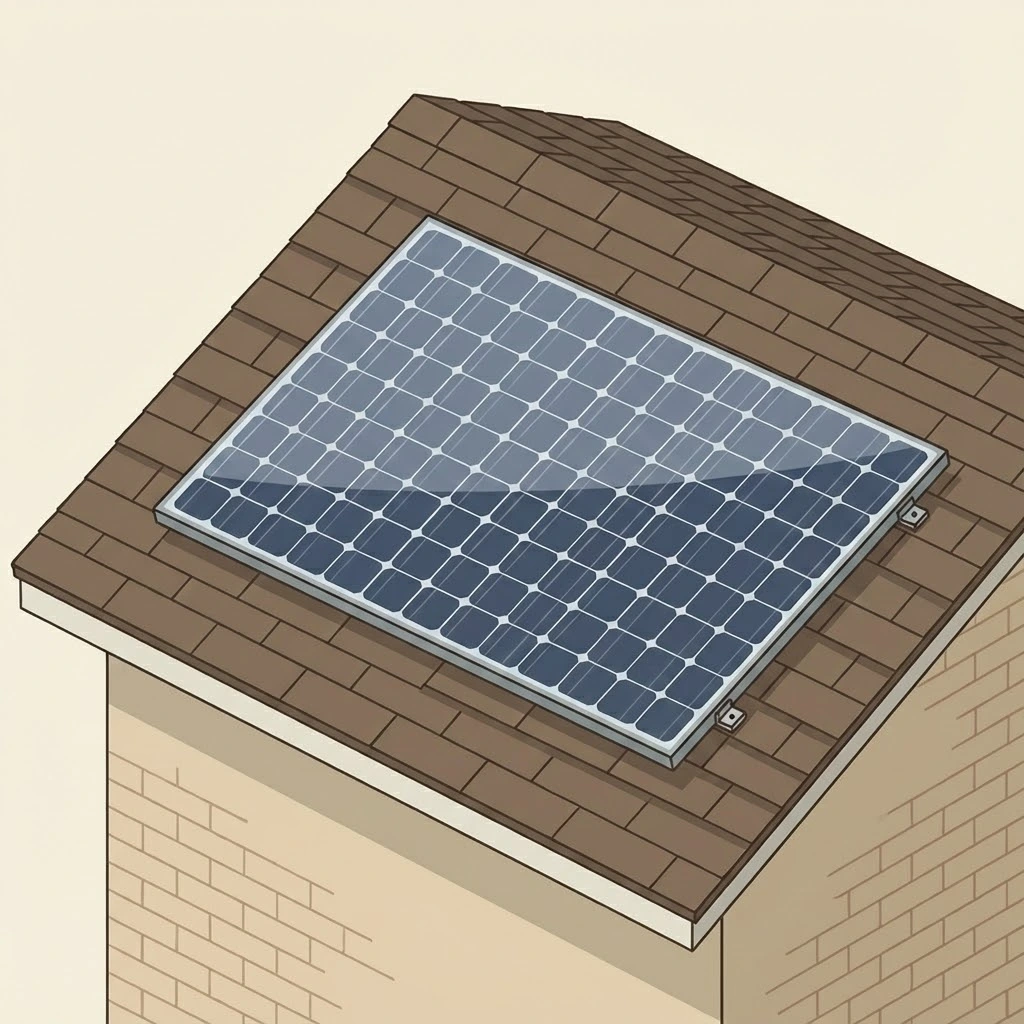
If you have been shopping for solar panels lately, or even just browsing online, you have probably noticed a trend that feels a lot like the horsepower wars in cars or the megapixel race in cameras. The numbers are getting bigger. A lot bigger.
Just a few years ago, a standard solar panel for a house was rated at about 250 to 300 watts. If you saw a 350-watt panel, that was the premium, top-shelf stuff. Today? You will see advertisements and spec sheets boasting 400, 500, and even 600+ watts per panel. It is exciting. It feels like technology is moving at warp speed. And for a homeowner, the promise of a high-wattage panel is incredibly tempting.
The logic seems simple enough: if I buy more powerful panels, I need fewer of them to power my home. Fewer panels mean less clutter on the roof, fewer holes drilled into my shingles, and maybe even a lower total cost. Who wouldn’t want the bragging rights of having the most powerful solar technology available on their block?
But here is the thing about solar power: it is rarely that simple. While it is true that residential solar panels have become significantly more powerful—breaking the 500-watt barrier in standard sizes for the first time in 2025—there is a catch. Actually, there are several catches. The highest wattage panels available today often blur the line between "residential" and "commercial" equipment. Some of these panels are giants, designed for massive warehouses or solar farms, not the roof of a suburban home.
This report is your deep dive into the world of high-wattage solar. We aren't just going to list the panels; we are going to look under the hood to see how they get so powerful. We will explore the cutting-edge technology—like N-type cells, Heterojunction, and Back Contact architecture—that makes 2025 a landmark year for solar efficiency. We will also have a very honest conversation about the drawbacks. What happens when you try to carry a 60-pound, 7-foot-tall sheet of glass up a ladder on a windy day? What happens when your super-powerful panel produces more energy than your inverter can handle? And does a 700-watt monster actually save you money, or is it just overkill?
By the end of this guide, you will know exactly which high-wattage panels are the real deal for homeowners and which ones are best left to the utility companies. You will understand the difference between a panel that is powerful because it is smart (efficient) and one that is powerful just because it is big.
---
Part 1: Defining "High Wattage" in 2025
To understand which panels are the "highest wattage," we first need to define what a residential solar panel actually is. This might sound obvious—it’s a panel you put on a house—but in the solar industry, the lines have become very blurry.
The Two Classes of Solar Panels
Historically, solar panels came in two distinct flavors, almost like mattress sizes. You had your "Twin" and your "King."
- Standard Residential Format (60-Cell or 108-Cell): These were the "right size" for a home. They typically measured about 5.5 feet long by 3.5 feet wide (roughly 1.7 meters by 1 meter). They weighed around 40 pounds, which meant a single installer could lift one comfortably. In the past, these panels produced 250W to 350W. They were designed to be nimble, fitting around chimneys, skylights, and vent pipes.1
- Commercial/Utility Format (72-Cell or 144-Cell): These were the big siblings. They were taller—usually around 6.5 feet or 2 meters—and wider. They were designed for flat warehouse roofs or open fields where size didn't matter. Because they were physically bigger, they produced more power (350W to 450W back in the day), but they were heavy and awkward to handle on a steep roof.2
The Convergence
In 2025, those two worlds have collided. Manufacturers realized that homeowners wanted more power, so they started squeezing more efficiency out of the standard cells, but they also started making the "standard" panels physically larger.
Today, a "residential" panel isn't just one size. We now have:
- High-Efficiency Standard Panels: These stick to the smaller, manageable dimensions (under 6 feet tall) but use advanced tech to hit 450W to 500W.
- Large-Format Residential Panels: These push the boundaries, often measuring over 6 feet tall, and can reach 550W to 600W.
- Crossover Commercial Panels: Some homeowners with large, simple roofs are opting to install true commercial giants that reach 650W to 700W+.
The "Wattage Trap"
It is crucial to understand that wattage is a function of two things: Efficiency and Size.
Think of a solar panel like a window that lets in light. If you want more light (power), you can do two things:
- Make the glass clearer: This is Efficiency. You get more light through the same size window.
- Make the window bigger: This is Size. You get more light, but you need a bigger hole in the wall.
You can make a panel higher wattage by making it more efficient (better technology), or you can simply make it bigger (more surface area).
- The "Smart" Way: A 470W panel that is the same size as an old 300W panel. This is achieved through efficiency. This is great for homeowners because you get more power without needing more roof space.
- The "Big" Way: A 550W panel that is 30% larger than a 400W panel. You aren't necessarily getting better technology; you're just buying a bigger slab of silicon.
In this report, when we talk about the "highest wattage panels," we will distinguish between these two. The best high-wattage panel for you is usually the one that packs the most power into a manageable size, not necessarily the one with the absolute highest number printed on the sticker.
---
Part 2: The Technology Behind the Power
You might be wondering, "How did they suddenly jump from 300 watts to 500 watts?" It wasn't magic; it was a shift in the fundamental chemistry and architecture of the solar cells. Understanding this helps you justify the price tag of premium panels like the Aiko or Maxeon.
1. The Death of P-Type, The Rise of N-Type
For decades, most solar panels used "P-Type" silicon (positive). It was cheap and reliable, but it had a limit on how efficient it could be. It was prone to "Light Induced Degradation" (LID), meaning it lost a chunk of power the moment it was first exposed to sunlight.
In 2024 and 2025, the industry shifted en masse to N-Type silicon (negative). N-Type cells are inherently more efficient and don't suffer from LID. This switch alone bumped average panel wattages up by 20-30 watts.2
2. Back Contact Architecture (IBC, ABC, HPBC)
This is the secret sauce for the top-tier 500W residential panels.
Look at a standard solar panel. Do you see those thin silver lines running across the blue or black squares? Those are "busbars"—wires that collect electricity. The problem is, wherever there is a wire, sunlight can't get through. You are essentially shading your own panel with its wiring.
- Back Contact (BC) technology moves all those wires to the back of the panel.
- Result: The front is 100% unshaded surface area.
- Benefit: This increases efficiency dramatically (pushing it toward 25%) and allows manufacturers to squeeze 500 watts into a frame that would normally only hold 430 watts.
- Who uses it: Aiko (ABC), Maxeon (IBC), LONGi (HPBC).1
3. Heterojunction (HJT)
Used by REC, this technology is like a sandwich. It takes a crystalline silicon layer and sandwiches it between ultra-thin layers of amorphous (thin-film) silicon.
- Benefit: It captures more wavelengths of light and performs incredibly well in heat. Standard panels lose power quickly as they get hot; HJT panels keep producing high power even on scorching summer days.4
4. Bifacial Modules
Many high-wattage panels are now "bifacial," meaning they have glass on both sides and can generate power from the back using reflected light.
- Residential Reality Check: On a typical home, panels are mounted flush against the roof (asphalt shingles). There is no light hitting the back. So, while a bifacial panel might be rated for "500W+" with rear-side gain, on a home roof, it effectively operates as a standard panel. Don't pay extra for bifacial features unless you have a ground mount or a flat white roof where light can reflect underneath.5
---
Part 3: The Heavy Hitters — Top High-Wattage Panels for 2025
Let's get into the specific models. Based on the latest market data for 2025, here are the leaders in the race for residential power. We have categorized them by their "class" so you can compare apples to apples.
Category A: The "Holy Grail" (High Wattage, Standard Size)
These are the most exciting panels for homeowners. They fit on standard roofs, they look good, and they pack a massive punch thanks to superior technology.
1. Aiko Neostar 3P54 (500 Watts)
- Wattage: 500W
- Efficiency: 25.0%
- Technology: N-Type ABC (All Back Contact)
- The Scoop: This is arguably the most impressive residential panel on the market in 2025. Aiko has managed to hit the magical 500-watt mark using a standard 54-cell format. Usually, 500W is reserved for massive commercial panels. Aiko achieved this by moving all the electrical contacts to the back of the panel (All Back Contact), so the front is 100% pure black silicon soaking up the sun.1
- Why it wins: It offers commercial-grade power in a residential-friendly size. Plus, with 25% efficiency, it is significantly better than the industry average of 22%.
2. LONGi Hi-MO X10 Explorer (490 - 500 Watts)
- Wattage: 490W - 500W
- Efficiency: 24.8%
- Technology: HPBC 2.0 (Hybrid Passivated Back Contact)
- The Scoop: Similar to Aiko, LONGi is using Back Contact technology to eliminate the metal grid lines on the front of the panel. This boosts efficiency and makes the panel look incredible—a deep, uniform black. Hitting 490W-500W in a format under 2 meters in length is a major engineering feat.1
- Why it wins: LONGi is a massive manufacturer, meaning these panels are likely to be widely available and competitively priced compared to boutique brands.
3. REC Alpha Pure-RX (470 Watts)
- Wattage: 470W
- Efficiency: 22.6%
- Technology: Heterojunction (HJT)
- The Scoop: REC has long been a favorite of premium installers. The Alpha Pure-RX uses Heterojunction technology, which layers different types of silicon to capture more light spectrum. It is also lead-free and has a very strong frame design.4
- Why it wins: While 470W is lower than 500W, REC is legendary for reliability and performance in hot climates. Their temperature coefficient is excellent, meaning they don't lose as much power when it gets hot in the summer.
4. Maxeon 7 (445 - 475 Watts)
- Wattage: 445W - 475W
- Efficiency: 24.1%
- Technology: IBC (Interdigitated Back Contact)
- The Scoop: Maxeon (formerly SunPower) held the efficiency crown for a decade. The Maxeon 7 is their response to the competition. It is incredibly robust, with a copper backing that prevents cracking.1
- Why it wins: It has a 40-year warranty, the longest in the industry. If you plan to be in your house forever, this is the "buy it for life" option.
Category B: The "Gentle Giants" (Large Format Residential)
These panels are physically larger than the ones above. They are often marketed as "residential," but they are pushing the limit of what fits comfortably on a complex roof.
1. Canadian Solar TOPBiHiKu7 (520 - 550 Watts)
- Wattage: 520W - 550W (Residential variants)
- Efficiency: ~22.5%
- Technology: TOPCon (Tunnel Oxide Passivated Contact)
- The Scoop: Canadian Solar often focuses on value and high power. The BiHiKu7 series is physically large. They use TOPCon technology, which is the current industry standard for good performance at a reasonable price.9
- Trade-off: You get big watts, but you are dealing with a larger physical footprint. These might not fit on a roof with lots of dormers or vents.
2. Jinko Solar Tiger Neo (525 - 545 Watts)
- Wattage: 525W - 545W
- Efficiency: ~22.5 - 23%
- Technology: N-Type TOPCon
- The Scoop: Jinko is one of the largest manufacturers in the world. Their Tiger Neo N-type panels are workhorses. They offer very high wattage for the price, making them a favorite for budget-conscious homeowners who have plenty of open roof space.2
Category C: The "Commercial Crossovers" (Massive Wattage)
These are true commercial panels (72-cell or larger) that some installers might put on a home if the roof is big enough and simple enough.
1. Aiko Neostar 2N+7 / Canadian Solar HiKu7 (640W - 700W+)
- Wattage: 640W up to 700W+
- The Scoop: These are monsters. They are often over 7.5 feet tall (2.3 meters) and weigh over 60-70 pounds.10
- The Reality: While you can buy these, they are rarely the right choice for a standard home. We will discuss why in the "Drawbacks" section.
---
Comparison Table: Top Residential Panels 2025
| Brand | Model | Wattage Range | Efficiency | Cell Tech | Approx. Size | Best For |
|---|---|---|---|---|---|---|
| Aiko | Neostar 3P54 | 500 W | 25.0% | N-Type ABC | Standard | Max Power / Small Roofs 6 |
| LONGi | Hi-MO X10 | 490 - 500 W | 24.8% | HPBC 2.0 | Standard | Aesthetics & Power 1 |
| REC | Alpha Pure-RX | 470 W | 22.6% | HJT | Standard | Hot Climates / Reliability 4 |
| Maxeon | Maxeon 7 | 445 - 475 W | 24.1% | IBC | Standard | Longevity (40yr Warranty) 8 |
| Canadian Solar | TOPHiKu6 | 445 - 470 W | 22.3% | TOPCon | Standard | Budget / Value 11 |
| Qcells | Q.TRON | 425 - 440 W | 22.5% | Q.ANTUM NEO | Standard | Made in USA / All-Rounder 12 |
| Jinko | Tiger Neo | 525 - 545 W | 22.5% | TOPCon | Large | Large, Simple Roofs 2 |
---
Part 4: The Drawbacks — Why "Bigger" Isn't Always Better
This is the most critical section for homeowners. If you simply ask for "the highest wattage panel," a solar installer might quote you a massive 600W or 700W commercial module. On paper, it looks great. In reality, it can be a headache.
Here is why you need to be careful with high-wattage, large-format panels.
1. The "Tetris" Problem (Geometry)
Residential roofs are complicated. They have chimneys, plumbing vents, skylights, ridges, valleys, and hips.
- Standard Panels (Standard Size): They are like small Lego bricks. You can fit them easily into tight spaces, work around a chimney, and fill up the roof efficiently.
- Large Panels (Commercial Size): These are like giant Duplo blocks. They are cumbersome. If you have a weirdly shaped roof section, you might only fit one big panel where you could have fit two standard panels.
- Result: You might actually end up with less total system power (fewer kilowatts) because the big panels utilize the available space poorly. A roof that fits 20 standard panels (20 x 440W = 8.8kW) might only fit 12 large panels (12 x 550W = 6.6kW) due to setbacks and obstacles.13
2. Weight and Installation Safety
Standard panels weigh about 40-45 pounds. A single installer can carry one up a ladder on their shoulder.
High-wattage commercial panels can weigh 60, 70, or even 80 pounds.13
- Labor Cost: Installing heavy panels often requires two people per panel to lift and position them safely. This slows down the installation and increases labor costs.
- Risk: Maneuvering a 70-pound sheet of glass on a sloped roof is dangerous. There is a higher risk of dropping a panel, damaging your roof, or installer injury.
- Structural Load: While most residential roofs can handle the static load (dead load) of these panels (usually 2-3 lbs per sq ft), the point loads during installation (installers walking + heavy gear) are higher.
3. Wind and Snow Loads (The Clamping Zone)
Solar panels are held onto the rails by clamps. Manufacturers have very specific "clamping zones"—usually a few inches along the side of the frame—where the clamps must go to ensure the panel can withstand high winds or heavy snow.
- The Issue: Large panels (over 2 meters long) are more flexible. If they are not clamped exactly right, they can flex and micro-crack in the wind, or even bow under snow load.
- Warranty Void: If an installer struggles to hit the clamping zone because the panel is huge and the rafters don't line up perfectly, they might clamp it "wherever it fits." This often voids the manufacturer's warranty for wind/snow load. Standard panels are much more forgiving.14
4. Inverter Clipping (The Hidden Bottleneck)
This is a technical but crucial point. Most residential solar systems in the US use microinverters (specifically Enphase) or optimizers (SolarEdge).
- The Bottleneck: The microinverter sits under the panel and converts DC power to AC power for your home. Microinverters have a "maximum continuous output."
- Scenario: You buy a 500W Aiko panel. You pair it with a common Enphase IQ8M microinverter.
- The IQ8M peaks at roughly 325 Watts of AC output.15
- Your 500W panel produces 500W DC at noon.
- The microinverter can only output 325W AC.
- Result: You lose (or "clip") 175 Watts of power. It is wasted.
- The Fix: You need a more powerful microinverter, like the IQ8A (349W output) or IQ8H (380W output). But even the IQ8H tops out at 380W.16
- If you have a 500W panel and a 380W inverter, you are still clipping power on sunny days.
- Insight: In 2025, residential panel wattage has actually outpaced standard microinverter capacity. While some clipping is normal and acceptable (it's often cheaper to clip a little at noon than buy a massive inverter), putting a 600W commercial panel on a residential microinverter is often a waste of money because the inverter acts as a funnel that is too narrow.
5. Aesthetics
Commercial panels often have silver frames and white backsheets (to keep heat down). On a nice residential roof, this can look like an industrial grid. Residential-focused panels (even the high-wattage ones like the Longi Hi-MO X10 or REC Alpha) usually come in "All Black" versions. They blend in with the roof.17
- Warning: Large 7-foot panels can sometimes overhang the ridge of the roof or look out of proportion on a smaller home, ruining the curb appeal.
---
Part 5: Cost Analysis — Is High Wattage Worth the Price?
Does buying a 500W panel save you money compared to a 400W panel?
The "Price Per Watt" Metric
In solar, we compare everything by "Price Per Watt" ($/W).
- Standard Efficiency (400W) Panels: usually cost the least per watt. They are mass-produced commodity items.
- High Efficiency (500W Residential) Panels: usually command a premium. You are paying for the advanced ABC or HJT technology.
- Large Commercial (550W+) Panels: might actually be cheaper per watt than the premium residential ones because they are made in massive volumes for solar farms. However, the installation cost for these on a home is higher due to the labor difficulty mentioned above.
The Value Equation
Scenario A: Limited Roof Space
If you have a small roof and high energy bills (maybe you have an EV and a pool), you need maximum power density.
- Verdict: The premium 500W Aiko or 470W REC panels are worth the extra cost. You need to squeeze every drop of energy out of your limited square footage.2
Scenario B: Large, Open Roof
If you have a massive barn roof or a large suburban home with plenty of south-facing space.
- Verdict: You typically don't need the most expensive 500W panels. You can install standard 420W-440W Qcells or Jinko panels. You might need to install 22 of them instead of 18, but since the panels are cheaper per watt, the total project cost might be lower.2
Installation Savings?
There is an argument that high-wattage panels save on installation costs: "Installing 10 panels is faster than installing 15."
- This is true to a point. Installing 10 lightweight panels is faster. But installing 10 massive, heavy 70lb panels might actually take longer than installing 15 lightweight ones because the crew moves slower and needs more safety precautions.13
---
Part 6: Recommendations for US Homeowners
So, which panel should you choose? Here is our expert breakdown based on different homeowner profiles.
1. The "Performance Enthusiast" (Budget is secondary)
You want the best tech, the best look, and the most power possible.
- Recommendation: Aiko Neostar 3P54 (500W) or Maxeon 7 (445W-475W).
- Why: Best efficiency, incredible shade tolerance, industry-leading degradation rates (they last longer). Maxeon offers the best warranty (40 years).
2. The "Smart Shopper" (Best value for money)
You want high power but don't want to overpay for bleeding-edge tech.
- Recommendation: Canadian Solar TOPHiKu6 (450W-465W) or Qcells Q.TRON (430W-440W).
- Why: These are the "Toyota Camrys" of solar. Reliable, powerful enough for almost anyone, and widely supported by US installers. Qcells are assembled in the USA (Georgia), which appeals to many US buyers.12
3. The "Hot Climate" Homeowner (Arizona, Texas, Florida)
Heat kills solar performance.
- Recommendation: REC Alpha Pure-RX (470W).
- Why: Their Heterojunction technology handles heat better than almost anything else. On a 100°F day, an REC panel will produce more power than a standard panel rated at the same wattage.4
4. The "Large Roof" Owner (Rural, sprawling homes)
You have tons of space and want to offset a huge electric bill.
- Recommendation: Jinko Tiger Neo or Canadian Solar HiKu7 (Large Format).
- Why: If your roof is simple enough to fit these larger panels, you can build a massive 15kW or 20kW system cost-effectively.2
---
Part 7: Technical Checklist for Your Installer
If you decide to go with high-wattage panels, you need to ask your installer these specific questions to avoid problems down the road:
- "What inverter model are you pairing with these panels?"
- Red Flag: If they pair a 500W panel with an Enphase IQ8+ (290W max output). That is too much clipping.
- Good Answer: Enphase IQ8A or IQ8M, or a SolarEdge system with S500 optimizers.
- "Can my roof structure handle the point loads during installation?"
- Ask if they have done a structural check, especially if using 60lb+ panels on an older home.
- "Are you using the manufacturer's specified clamping zones?"
- Crucial for warranties. Ask them to confirm they won't be clamping the panels on the corners or short sides unless the manual allows it.
- "Will these panels be visible over the ridge of my roof?"
- Ask for a CAD design drawing. Large panels can sometimes peek over the top of the roof, which looks sloppy and can violate HOA rules.
---
Conclusion: The Verdict on High Wattage
In 2025, the solar industry has successfully broken the 500-watt barrier for residential homes. This is a massive achievement. Panels like the Aiko Neostar and REC Alpha Pure-RX prove that you don't need a clunky, commercial-sized slab to generate huge power. You just need better technology.
For most homeowners, the "sweet spot" in 2025 is between 440W and 500W.
- Below 400W: You are buying older technology (likely P-Type). It's cheap, but it degrades faster.
- 440W - 500W: This is the Goldilocks zone. High efficiency, manageable size, good value.
- Above 550W: You are entering commercial territory. Unless you have a specific reason (like a massive, simple roof), the installation difficulties and inverter clipping issues often outweigh the benefits.
Don't get blinded by the wattage number alone. Look at the efficiency percentage, the warranty, and the physical size. The best panel for your home is the one that fits your roof perfectly, maximizes your savings, and lasts for 25+ years without a headache.
Go for efficiency (Smart Watts), not just size (Big Watts).
---
Detailed Analysis: Highest Wattage Residential Solar Panels
1. The Wattage Landscape in 2025
1.1 The Evolution of Residential Solar Power
To appreciate where we are today, we must look at the trajectory of solar panel power.
- 2015: Standard residential panels were ~250-280 Watts.
- 2020: The "300 Watt Club" was the standard. 350W was considered premium.
- 2023: 400 Watts became the new baseline.
- 2025: The baseline has shifted to 420-440 Watts, with premium "High Wattage" panels pushing 470W to 500W in standard form factors.
This rapid increase isn't just about making panels bigger. While size has crept up (from 1.6 meters long to roughly 1.75 meters), the primary driver has been efficiency.
- Efficiency in 2015: ~15-17%
- Efficiency in 2025: ~22-25%.1
This 8% jump in efficiency allows a modern panel to generate significantly more power from the same amount of sunlight and roof space.
1.2 Residential vs. Commercial Dimensions
Understanding the physical difference is vital for homeowners.
- Standard Residential ("54-cell" or "108 half-cell"):
- Dimensions: Approx 68" x 44" (1.7m x 1.13m).
- Area: ~20 sq ft (1.9 sq meters).
- Weight: 40-50 lbs (18-22 kg).
- Wattage: 400W - 500W.
- Pros: Easy to handle, fits complex roofs, standard racking compatibility.
- Commercial / Large Format ("72-cell" or "144 half-cell"):
- Dimensions: Approx 89" x 44" (2.2m x 1.13m) or larger.
- Area: ~27 sq ft (2.5 sq meters).
- Weight: 60-75 lbs (28-34 kg).
- Wattage: 550W - 700W+.
- Pros: Fewer electrical connections per kW.
- Cons: Hard to handle, heavy, harder to fit on small roof planes.2
---
2. Top High-Wattage Panels (Detailed Specs)
2.1 Aiko Neostar 3P54 (The Efficiency King)
- Power: 500 W 1
- Efficiency: 25.0%
- Tech: N-Type ABC (All Back Contact).
- Insight: Aiko has disrupted the market by mass-producing "All Back Contact" cells. By removing front busbars, they achieve 100% active area on the front. This allows them to hit 500W in a 54-cell frame size (approx 1.76m length).18 This is a game-changer because it provides "commercial wattage" in a "residential size."
- Drawback: Availability in the US can be more limited compared to giants like Qcells, as Aiko is a newer entrant to the residential top-tier space in North America.19
2.2 LONGi Hi-MO X10 (The Aesthetic Powerhouse)
- Power: 490 W - 500 W (Explorer model).1
- Efficiency: 24.8%
- Tech: HPBC 2.0.
- Insight: LONGi's HPBC (Hybrid Passivated Back Contact) is similar to Aiko's tech. It creates a sleek, grid-less look. For homeowners concerned with curb appeal, this is a top contender. It blends high power with the "all-black" look that HOAs often prefer.
- Commercial Variant: LONGi also makes a Hi-MO X10 commercial version that hits 670W, but that is the larger 72-cell format.2
2.3 REC Alpha Pure-RX (The Heat Beater)
- Power: 470 W.4
- Efficiency: 22.6%
- Tech: Heterojunction (HJT).
- Insight: The 470W rating is impressive, but the real story is the Temperature Coefficient of -0.24%/°C.4
- Standard panels lose roughly 0.34% of their power for every degree Celsius above 25°C.
- REC loses only 0.24%.
- Real World Impact: In a Phoenix summer (ambient 110°F, panel temp 150°F+), the REC panel will effectively act like a higher wattage panel compared to a competitor because it retains more of its generating capacity.
2.4 Maxeon 7 (The Durability Champion)
- Power: 445 W - 475 W.1
- Efficiency: 24.1%
- Tech: IBC (Interdigitated Back Contact).
- Insight: Maxeon (SunPower) panels are famous for their copper backing. Silicon cells are brittle; they crack when bent. Maxeon cells are glued to a copper backing, making them almost immune to micro-cracks from wind flexing or thermal expansion. This justifies their 40-year warranty.3 They might not have the absolute highest number (vs Aiko's 500W), but their lifetime energy production is often highest due to low degradation.
2.5 Canadian Solar TOPHiKu6 (The Value Giant)
- Power: 445 W - 470 W.9
- Efficiency: ~22.3%
- Tech: N-Type TOPCon.
- Insight: Canadian Solar is rarely the "best" in specs, but they are often the "best value." Their move to N-Type TOPCon allows them to offer high wattage at a price point significantly lower than Maxeon or REC. For homeowners where ROI (Return on Investment) is the only metric, these are often the winner.
2.6 Canadian Solar HiKu7 / BiHiKu7 (The "Commercial" Option)
- Power: 640 W - 670 W.9
- Format: Large (CS7N is 2.3m tall).
- Use Case: While these appear in searches for "highest wattage," they are difficult to recommend for typical suburban roofs. They are best suited for ground mounts on large properties where the weight and size don't complicate installation.
---
3. The "Gotchas" of High Wattage Panels
3.1 Clipping: When Your Inverter Can't Keep Up
This is the most common technical issue with high-wattage residential solar.
- The Mechanism: Solar panels produce DC power. Inverters convert it to AC. Microinverters (like Enphase) sit on the roof. They have a hard limit on AC output.
- The Mismatch:
- Panel: 500 Watts (DC).
- Inverter (e.g., IQ8M): 325 Watts (AC) max continuous.15
- DC:AC Ratio: 500 / 325 = 1.53.
- The Result: Ideally, you want a ratio around 1.2 to 1.3. A ratio of 1.53 is aggressive. It means that for several hours a day in spring and summer, your panel will be producing energy that the inverter simply throws away.
- The Solution: You must upgrade to the IQ8A (349W) or IQ8H (380W).16 This adds cost. If you buy a 500W panel but cheap out on the inverter, you wasted money on the panel.
- SolarEdge Option: SolarEdge systems use a central inverter and "optimizers" on the roof. Optimizers like the S500 or S440 21 are designed to handle high-wattage panels better than microinverters in some high-clipping scenarios, as the clipping happens at the central inverter level which can be sized larger (e.g., a 10kW inverter for 10kW of panels).
3.2 Structural Load (Dead Load)
- Standard Roof Capacity: Most residential roofs are designed for a "Live Load" (snow/rain/people) of 20 PSF (pounds per square foot) and a "Dead Load" (shingles + structure) of 10-20 PSF.22
- Panel Weight:
- Standard Panel: ~2.5 PSF installed.
- Large Commercial Panel: ~3-4 PSF installed (heavier glass, more rail).
- The Verdict: While 3-4 PSF rarely breaks a roof, it eats into the "Live Load" margin. If you live in a heavy snow area (e.g., Buffalo, NY or Tahoe), adding heavy large-format panels might require structural reinforcement of your rafters, which kills the project economics. Always check with a structural engineer if using commercial panels on a home.
3.3 Aesthetic Risks
- Overhangs: Standard panels are ~44 inches wide. Large panels might be ~52 inches wide.
- The Problem: If your roof plane is 15 feet high, you can fit exactly three rows of standard panels (3 x 44" = 132" = 11 feet). If you use large panels, you might only fit two rows (2 x 52" = 104"), leaving huge gaps, or you try to squeeze three and they hang over the gutter or ridge.
- HOA Rules: Many HOAs require panels to be flush and not visible above the roofline. Large panels make compliance harder on smaller roof sections.24
---
4. Cost vs. Value: A Case Study
Let's look at a hypothetical 10 kW system installation.
Option A: Standard Value (400W Panels)
- Panel: Qcells Q.PEAK DUO (400W)
- Quantity: 25 panels
- Inverter: Enphase IQ8+
- System Cost: ~$2.80/watt = $28,000
- Pros: Proven, cheap, easy install.
- Cons: Uses more roof space (25 panels).
Option B: Premium High Wattage (500W Panels)
- Panel: Aiko Neostar 3P54 (500W)
- Quantity: 20 panels
- Inverter: Enphase IQ8A (more expensive inverter required)
- System Cost: ~$3.30/watt = $33,000
- Pros: Uses less space (20 panels), better aesthetics, higher efficiency.
- Cons: Higher upfront cost.
Comparison:
Option B costs $5,000 more. Is it worth it?
- Yes, if: You only have space for 20 panels. Option A would only give you an 8kW system (20 x 400W) in that space, whereas Option B gives you the full 10kW. The extra energy production over 25 years pays for the difference.
- No, if: You have space for 25 panels easily. Option A generates the same total power for $5,000 less.
---
5. Summary Checklist
When shopping for high-wattage solar in 2025, follow this checklist:
- Check Dimensions: Ensure the panel is "Residential Size" (approx 68-75 inches long). Avoid panels over 85 inches unless you have a ground mount.
- Verify Cell Tech: Look for "N-Type," "HJT," or "Back Contact." Avoid "P-Type" or standard "PERC" if you want top-tier performance.
- Match Inverters: Ensure the microinverter rating is appropriate (e.g., IQ8A/M/H for 450W+ panels).
- Check Degradation: Look for a 25-year power warranty of 90% or higher (Aiko/Maxeon/REC are usually 92%+).
- Get a Layout: Ask for a visual design to ensure the larger panels fit your roof aesthetically.
---
Final Thoughts
The era of the 500-watt residential panel is here. With technology from companies like Aiko, LONGi, and Maxeon, you can now put massive power on your roof without turning your home into an industrial site. Just remember: high wattage is a tool, not a magic wand. Use it to maximize limited space or boost efficiency in hot climates, but don't overpay for power you don't need if you have a large, sunny roof.
Go for efficiency (Smart Watts), not just size (Big Watts).
Works cited
- Most efficient solar panels 2025 - Clean Energy Reviews, accessed December 6, 2025, https://www.cleanenergyreviews.info/blog/most-efficient-solar-panels
- Highest Watt Residential Solar Panels: 2025 Complete Buyer's Guide, accessed December 6, 2025, https://solartechonline.com/blog/highest-watt-residential-solar-panels-guide/
- Maxeon Solar Panels: Complete 2025 Guide To Specs, Performance & Value - SolarTech, accessed December 6, 2025, https://solartechonline.com/blog/maxeon-solar-panels-complete-guide/
- REC Solar Panels Review 2025: Performance, Cost & Expert Analysis - SolarTech, accessed December 6, 2025, https://solartechonline.com/blog/rec-solar-panels-review-2025/
- 500-Watt Solar Panels Guide: Efficiency, Cost & Suitability - Sunhub, accessed December 6, 2025, https://www.sunhub.com/blog/are-500w-solar-panels-worth-it/
- 10 Most Efficient Solar Panels of 2025 (25.0%+ Efficiency Guide) - Haina Solar, accessed December 6, 2025, https://www.hainasolar.com/most-high-efficiency-solar-panels-2025-guide
- REC Alpha Pure-RX 470W Solar Panel | Available at SES, accessed December 6, 2025, https://www.solarelectricsupply.com/rec-rec470aa-alpha-pure-rx-470w-solar-panel
- SunPower Maxeon 7 475W solar panel review - Federation of Master Builders, accessed December 6, 2025, https://www.fmb.org.uk/homepicks/solar-panels/sunpower-solar-panels-review/
- HiKu7 – CSI Solar – Global, accessed December 6, 2025, https://www.csisolar.com/hiku7/
- The 11 most powerful solar panels [2025] - Sunsave, accessed December 6, 2025, https://www.sunsave.energy/solar-panels-advice/solar-technology/most-powerful
- Canadian Solar 450W Panels: Complete 2025 Buyer's Guide & Review - SolarTech, accessed December 6, 2025, https://solartechonline.com/blog/canadian-solar-450w-panels-guide/
- Expert Review Of Qcells Solar Panels For 2025 - SolarReviews, accessed December 6, 2025, https://www.solarreviews.com/blog/hanwha-q-cells-solar-panels-complete-review
- The Dangers of Giant Commercial Panels On Domestic Roofs - SolarQuotes, accessed December 6, 2025, https://www.solarquotes.com.au/blog/oversized-solar-panels/
- Large 72 Cell Solar Panels Can Go On Home Roofs But Beware Of Shoddy Installers, accessed December 6, 2025, https://www.solarquotes.com.au/blog/72-cell-solar-panels/
- IQ8M and IQ8A Microinverters - Enphase, accessed December 6, 2025, https://enphase.com/download/iq8m-iq8a-microinverter-data-sheet
- IQ8+, IQ8M, and IQ8A Microinverters simulation with higher current modules having I >12 A - Enphase, accessed December 6, 2025, https://enphase.com/download/iq8-iq8m-and-iq8a-microinverters-simulation-higher-current-modules-having-imp-12
- Best Solar Panels of 2025: Expert Guide - SolarReviews, accessed December 6, 2025, https://www.solarreviews.com/blog/what-are-the-best-solar-panels-to-buy-for-your-home
- Aiko Neostar 3P 485W N-Type ABC 54 Cell Single Glass Black Frame Gen 3 Solar Panel, accessed December 6, 2025, https://solareon.co.uk/products/aiko-neostar-3p-485w-n-type-abc-54-cell-single-glass-black-frame-gen-3-solar-panel
- AIKO Begins Global Delivery of its Third-generation INFINITE Modules, accessed December 6, 2025, https://aikosolar.com/en/third-generation-infinite-modules/
- Most Efficient Solar Panels for 2025: US Customers Still Waiting on Record-Setting Panel, accessed December 6, 2025, https://www.cnet.com/home/solar/most-efficient-solar-panels/
- Residential Power Optimizers - SolarEdge, accessed December 6, 2025, https://www.solaredge.com/en/products/residential/power-optimizers
- CAN YOUR ROOF HANDLE THE WEIGHT OF SOLAR PANELS?, accessed December 6, 2025, https://www.olsonsolarenergy.com/wp-content/uploads/2020/05/load-limits-for-soalr.pdf
- Understanding Roof Load Capacity for Solar Panels | KPost Company, accessed December 6, 2025, https://kpostcompany.com/understanding-roof-load-capacity-for-solar-panels/
- Can a Homeowners Association Prohibit Solar Panels? Understanding Your Options, accessed December 6, 2025, https://www.parkerandsons.com/blog/can-a-homeowners-assocation-prohibit-solar-panels-understanding-your-options