For decades, buying electricity was simple. You flipped a switch, the lights turned on, and at the end of the month, you paid a flat rate for every unit of energy you used. It didn't matter if you used that energy at 3:00 AM or 3:00 PM; the price was the same. The electric grid was a one‑way street, sending power from massive, always‑on power plants directly to your home. But that world is disappearing.
Today, the electric grid is undergoing its biggest transformation in a century. We are moving toward a smarter, cleaner, and more complex system. As renewable energy sources like wind and solar power become a larger part of the mix, the “value” of electricity changes throughout the day. In response, utility companies across the United States are shifting homeowners from flat‑rate plans to Time‑of‑Use (TOU) rates.
Under these new plans, the price of electricity changes like the price of an airline ticket or an Uber ride—it is more expensive when everyone wants it (peak hours) and cheaper when demand is low (off‑peak hours). For the modern homeowner, especially those considering solar panels or batteries, understanding this shift is no longer optional. It is the key to unlocking thousands of dollars in savings and taking control of your energy future. This report will walk you through exactly how these rates work, why they exist, and how you can master your home’s energy timing.
1.2 The Hidden Engine: How the Grid Actually Works
To understand why electricity prices change by the hour, we have to look behind the curtain at how the electric grid operates. The grid has a fundamental rule: Supply must always match Demand. The moment you turn on a hairdryer, a power plant somewhere must generate that extra bit of electricity instantly.
The Bucket Analogy
Imagine the electric grid is a giant bucket of water with a hole in the bottom.1
- The Water Level: This represents the stability of the grid. It must stay at a perfect level.
- The Leak (Demand): This is the water flowing out. It represents every lightbulb, air conditioner, and factory running in the country. The leak gets bigger in the evening when everyone comes home.
- The Hose (Supply): This is the water flowing in from power plants.
In the old days, utilities controlled the hose. If the leak got bigger (more demand), they just turned the faucet up. Today, with solar and wind, we have less control over the hose. The sun shines when it wants to, not necessarily when we need the power. This makes balancing the bucket much harder.
The Problem with “Peaker Plants”
When everyone turns on their air conditioning on a hot summer afternoon, the “leak” in the bucket becomes a gusher. The standard power plants (baseload plants), like nuclear or coal, operate like a steady, slow river—they can’t speed up quickly.2 To keep the bucket from running dry (a blackout), the utility has to turn on special emergency power plants called Peaker Plants.
Think of a Peaker Plant like a sprinter.2 They are fast and powerful, capable of ramping up to full power in minutes to meet sudden spikes in demand. However, they have three major downsides:
- They are Expensive: Because they might only run for a few hundred hours a year, the utility has to charge a huge amount of money for that power to pay for the cost of building and maintaining the plant.3
- They are Inefficient: Peaker plants often use natural gas turbines that are less efficient than plants designed to run 24/7.5
- They are Dirty: Because they are often older and less efficient, they can produce more pollution per unit of energy than other plants.6
This is why Time‑of‑Use rates exist. By charging you more during “Peak Hours,” the utility is trying to convince you to use less power so they don’t have to turn on these expensive, dirty Peaker Plants.3
1.3 The “Duck Curve” and the Shift in Peak Hours
You might expect electricity to be most expensive at noon, when the sun is hottest and businesses are running full speed. Ten years ago, you would have been right. But today, in many parts of the country, noon is actually becoming one of the cheapest times to use power.
This phenomenon is called the Duck Curve (named because the graph looks like a duck).
- Midday (The Belly): From 9:00 AM to 3:00 PM, millions of solar panels on rooftops and in huge solar farms are producing massive amounts of clean electricity. In states like California and Arizona, there is sometimes too much solar power during the day. This drives the price of electricity down, creating a “Super Off‑Peak” window.3
- Evening (The Head): Around 4:00 PM or 5:00 PM, the sun starts to set, and solar power disappears. At the exact same time, people come home from work, turn on lights, cook dinner, and crank up the AC.
The result is a sudden, steep need for non‑solar power. This forces the “Peak Hours” to shift later in the day. Instead of peaking at 2:00 PM, modern Time‑of‑Use plans often have their most expensive rates from 4:00 PM to 9:00 PM.3
Table 1: The Evolution of Grid Pricing
| Feature | Old Flat Rate System | New Time‑of‑Use (TOU) System |
|---|---|---|
| Price per kWh | Same price 24/7 | Varies by time of day |
| Most Expensive Time | N/A | Usually 4 PM – 9 PM (Evening Peak) |
| Cheapest Time | N/A | Late Night (Off‑Peak) or Midday (Super Off‑Peak) |
| Primary Goal | Cover average costs | Discourage usage during grid stress |
| Best Strategy | Use energy whenever you want | Shift usage to cheap hours |
---
Part II: Decoding the Clock – When is Electricity Cheapest?
Understanding the clock is the single most important skill for saving money on a TOU plan. While every utility is different, most follow a seasonal and daily rhythm dictated by the weather and human behavior.
2.1 Defining the Zones
Utility companies divide the day into specific “zones” or “periods.” It is critical to know exactly which zone you are in, as the price difference can be massive. In some aggressive plans, the price during Peak hours can be three times higher than the price during Off‑Peak hours.10
On‑Peak Hours (The “Danger Zone”)
This is when electricity is most in demand and most expensive.
- Typical Times: 4:00 PM to 9:00 PM or 5:00 PM to 8:00 PM.9
- The Cost: This is often the highest rate you will see on your bill. In California, this can be over $0.50 or $0.60 per kWh.3
- Behavior: This is the time to conserve. Turn off unnecessary lights, delay the dishwasher, and avoid charging your car.
Off‑Peak Hours (The “Safe Zone”)
This is when demand is low, and the grid is relaxed.
- Typical Times: Early mornings, late evenings (after 9:00 PM), and weekends.3
- The Cost: This is your “discount” rate. It is significantly cheaper than Peak rates.
- Behavior: This is the best time for general household activities like watching TV, using computers, and running lights.
Super Off‑Peak Hours (The “Bargin Bin”)
Some utilities offer a third, ultra‑cheap zone. This usually happens when there is excess power on the grid that they are practically giving away.
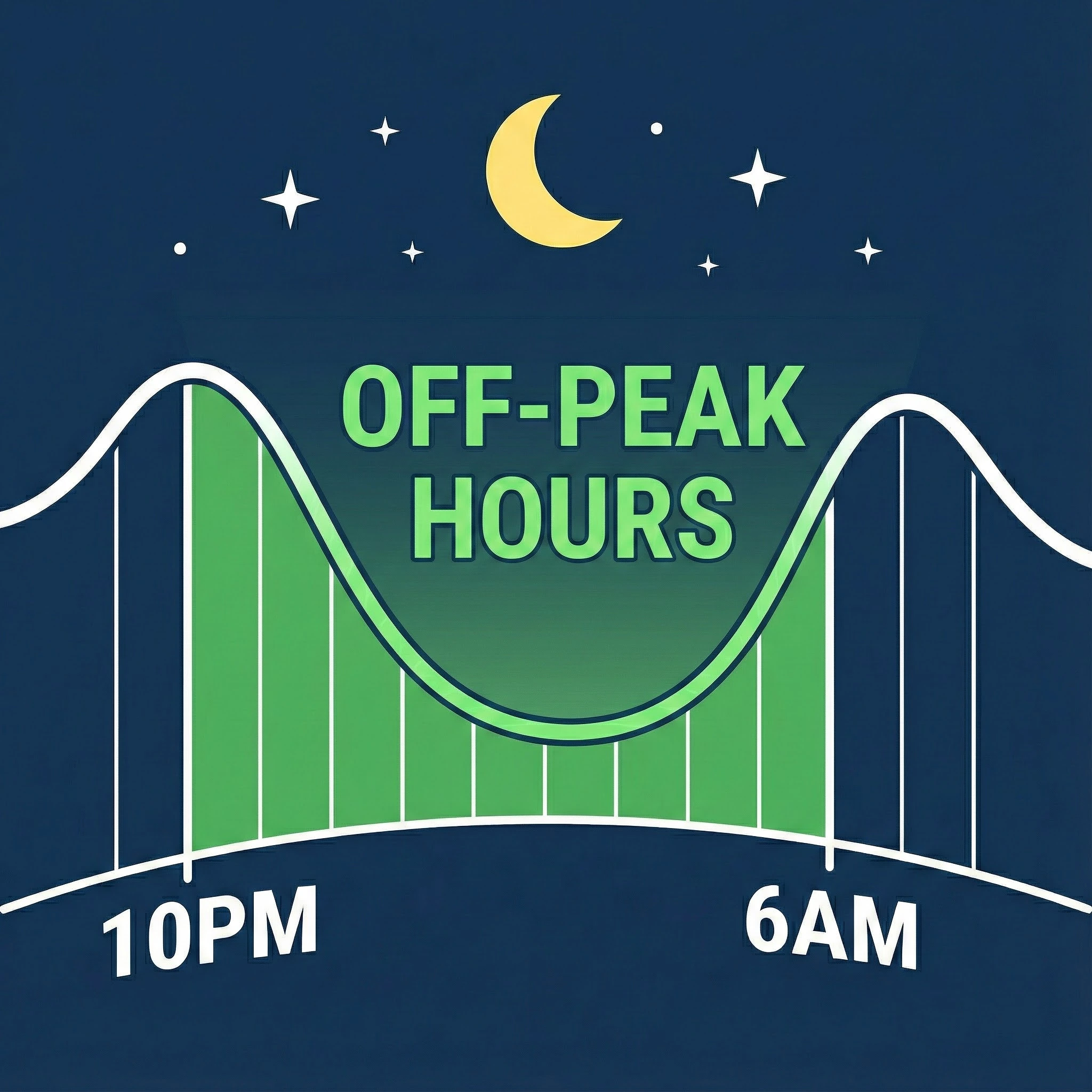
- Typical Times: Late night (12:00 AM to 6:00 AM) or, in solar‑heavy areas, midday (10:00 AM to 2:00 PM).8
- The Cost: Extremely low. Sometimes as low as $0.05 per kWh.10
- Behavior: This is the golden window for heavy energy users. Charge your electric vehicle (EV), run the pool pump, or do the laundry during this time.
2.2 Seasonal Variations: Summer vs. Winter
The grid behaves differently depending on the temperature outside. Therefore, your peak hours might change when the seasons change.
Summer (The Cooling Season)
Summer is the most stressful time for the electric grid because of air conditioning.
- Driver: Residential AC units fighting the afternoon heat.
- Peak Characteristics: Peaks are longer and prices are higher. The “On‑Peak” prices in summer are usually the most expensive rates of the entire year.3
- Region Specifics:
Winter (The Heating Season)
In winter, the dynamic changes. Air conditioners are off, but electric heaters and lights are on.
- Driver: Electric heating (heat pumps/space heaters) and shorter daylight hours.
- Peak Characteristics: Winter often features a “Double Peak.”
2.3 Peak Hours by Region
Because the United States is so large, “Peak Hours” happen at different times depending on where you live.
Table 2: Typical Peak Hours by US Time Zone
| Time Zone | Summer Peak Window | Winter Peak Window | Why? |
|---|---|---|---|
| Eastern (NY, FL, MA) | 2:00 PM – 6:00 PM | 6:00 AM – 9:00 AM & 5:00 PM – 9:00 PM | Humidity drives early AC use; heating drives winter mornings. |
| Central (TX, IL) | 1:00 PM – 5:00 PM | 5:00 AM – 9:00 AM & 5:00 PM – 9:00 PM | Industrial usage combined with residential cooling. |
| Mountain (CO, AZ) | 2:00 PM – 8:00 PM | 7:00 AM – 10:00 PM | Arizona has extreme heat, leading to very long peak windows. |
| Pacific (CA, WA) | 4:00 PM – 9:00 PM | 4:00 PM – 9:00 PM | Solar power pushes the peak late into the evening. |
Note: Always check your specific utility bill. A utility in Northern California (PG&E) might have different hours than one in Southern California (SDG&E) even though they are in the same state.
2.4 The “Free Nights” Phenomenon (Texas Specific)
In deregulated markets like Texas, you might see plans advertising “Free Nights and Weekends.”
- How it works: You pay a higher rate during the day, but from 9:00 PM to 6:00 AM, your electricity rate is effectively zero.10
- The Catch: If you are not disciplined, these plans can be expensive. But if you have an electric vehicle and flexible appliances, and you can shift 40‑50 % of your usage to the night, these can be incredibly cheap.10
---
Part III: The Homeowner's Guide to the Electric Bill
Before you can save money, you have to understand what you are currently paying. Reading a modern electric bill can feel like deciphering a secret code. This section will help you crack it.
3.1 Anatomy of a Bill: Supply vs. Delivery
Your bill is usually split into two main chunks. Understanding the difference is vital for calculating savings.18
- Supply Charge (Generation): This is the cost of the actual electricity you used. It pays for the coal, gas, wind, or solar power. In deregulated states (like Texas, Pennsylvania, or parts of New York), you can choose the company that provides this.19 This is the part of the bill that Time‑of‑Use rates usually affect.
- Delivery Charge (Transmission & Distribution): This pays for the poles, wires, meters, and the crew that fixes lines during a storm.20 This is usually a fixed rate set by your local utility (like Duke Energy or National Grid) and you cannot shop around for it.
Key Takeaway: When you are calculating how much money you save by shifting a load, you need to add the Supply rate and the Delivery rate together to get your “All‑In” price per kWh.
3.2 Finding Your Rate Plan
You cannot optimize your usage if you don't know which plan you are on. Utilities use cryptic codes to identify plans.
-
Look for the “Rate Code”: On your bill, usually near your account number, look for a text string like E‑TOU‑C, R‑1, or Res‑1.
- National Grid Example: Look for “Rate Code” on the first page. “R‑1” usually means a standard flat residential rate. “R‑4” might be for heating customers.21
- Duke Energy Example: Look for “Schedule R‑TOU” or “Schedule RES” (Standard).22
- PG&E Example: Look for “E‑TOU‑C” (Peak 4‑9 PM) or “E‑TOU‑D” (Peak 5‑8 PM).11
-
Action Step: Once you find the code, Google “Duke Energy Schedule R‑TOU PDF” (replacing with your utility). This will give you the official “Tariff Sheet” that lists the exact hours and prices.
3.3 Decoding the “Electricity Facts Label” (EFL)
If you live in a state like Texas where you choose your provider, you must read the Electricity Facts Label (EFL). This is like a “Nutrition Facts” label for energy.
- The Average Price Trap: Companies often advertise a low rate like “10 cents/kWh.” But if you look at the EFL, that price might only apply if you use exactly 1,000 kWh.17
- Base Charges: Many plans have a “Base Charge” of $10 or $20 if you use less than a certain amount. If you have solar panels and your grid usage drops to 500 kWh, your effective rate per kWh might skyrocket because that $20 fee is spread over fewer hours.17
3.4 Demand Charges: The Hidden Fee
Some modern residential plans, especially for solar owners, include a Demand Charge. This is different from an energy charge.
- Energy Charge (kWh): Charged for the amount of water you take out of the bucket.
- Demand Charge (kW): Charged for the size of the hose you use.10
The Scenario:
Imagine you come home at 5:30 PM. You plug in your EV (7,000 watts), turn on the dryer (3,000 watts), and crank the AC (4,000 watts). For 30 minutes, you are drawing 14,000 watts (14 kW).
Even if you turn everything off after 30 minutes, a Demand Charge plan will bill you for that “peak usage” of 14 kW. This one 30‑minute window could cost you $10 or $20 extra for the whole month, regardless of how much you save later.10
Strategy: If you have a Demand Charge, you must “stagger” your appliances. Don’t run the dryer and the oven at the same time.
---
Part IV: Appliance Energy Dynamics – What Costs What?
To win the game of Time‑of‑Use, you need to know which players on your team (your appliances) cost the most to run. Not all appliances are equal. A digital clock uses almost nothing; a clothes dryer uses a massive amount.
4.1 The “Big Three” Energy Hogs
These three items typically make up 60‑70 % of a home’s discretionary energy use. Shifting these is where 90 % of your savings will come from.
1. Air Conditioning & Heating (HVAC)
- Power Draw: 3,500 – 5,000 watts.23
- The Challenge: You need cooling exactly when peak hours happen (summer afternoons).
- The Strategy: Pre‑Cooling.
- Think of your house as a battery that stores “coolness” instead of electricity.
- 12:00 PM – 3:00 PM (Off‑Peak): Turn your thermostat down to 68 °F or 70 °F. The AC runs hard, but electricity is cheap.10
- 4:00 PM – 9:00 PM (On‑Peak): Turn the thermostat up to 78 °F. The AC turns off. Your house will slowly warm up, but the cool walls and furniture will keep it comfortable until the peak is over.10
2. Electric Vehicles (EVs)
- Power Draw: 6,000 – 7,200 watts (Level 2 Charger).25
- The Math: Charging a standard EV (60 kWh battery) costs about $9.00 off‑peak ($0.15/kWh). If you charge that same car during peak hours ($0.45/kWh), it costs $27.00. That is an $18 difference for a single charge!
- The Strategy: almost every EV has a built‑in timer. Set it to “Depart by 7:00 AM” or “Start Charging at 11:00 PM.” Never plug in and charge immediately when you get home from work.26
3. Water Heaters
- Power Draw: 4,500 watts.28
- The Strategy: Like your house, your water tank is a battery. It stores heat. You can install a timer (or a smart controller) that heats the water to a high temperature early in the afternoon, then turns off during peak hours. You still have hot water for your evening shower, but you didn’t pay peak prices to heat it.28
4.2 Laundry: The Silent Budget Killer
Laundry is the easiest habit to change because it is entirely discretionary. You can choose exactly when to do it.
The Electric Dryer
The dryer is a massive energy user because it uses electricity to create heat.
- Wattage: 3,000 – 5,000 watts.27
- Cost Per Load:
- Off‑Peak: ~$0.45 per load.
- On‑Peak: ~$1.35 per load.
- Annual Impact: If you run 5 loads a week, shifting from peak to off‑peak saves about $230 per year.27
- Technology Tip: If you buy a Heat Pump Dryer, it uses much less power (around 800‑1,000 watts) but takes longer to dry. This is great for avoiding Demand Charges because it doesn’t create a massive spike in power, even though it runs longer.29
The Washing Machine
- Wattage: 400 – 1,300 watts (mostly for heating water).23
- Strategy: Wash in cold water. This eliminates almost all the energy cost, meaning it matters less when you wash.
4.3 The “Phantom” Loads
Many devices sip power even when “off.”
- TVs, Game Consoles, Computers: These can draw 50‑100 watts in standby.
- Impact: During peak hours, even small loads add up. Smart plugs can automatically cut power to entertainment centers at 4:00 PM to ensure zero waste during the expensive window.10
Table 3: The Cost of Being Impatient (Peak vs. Off‑Peak Costs)
Assuming Off‑Peak Rate = $0.15/kWh and On‑Peak Rate = $0.45/kWh
| Appliance | Usage | Cost to Run at 2:00 PM (Off‑Peak) | Cost to Run at 6:00 PM (Peak) | Savings per Use |
|---|---|---|---|---|
| EV Charge | 40 kWh (partial fill) | $6.00 | $18.00 | $12.00 |
| Electric Dryer | 1 Hour Cycle | $0.45 | $1.35 | $0.90 |
| Dishwasher | 1 Cycle | $0.18 | $0.54 | $0.36 |
| Pool Pump | 4 Hours | $0.90 | $2.70 | $1.80 |
---
Part V: Advanced Strategies – Solar, Storage, and Net Billing
For homeowners who want to go beyond simple behavior changes, investing in technology—specifically solar panels and batteries—offers the ultimate control over Time‑of‑Use rates.
5.1 The New Rules: Net Metering vs. Net Billing
If you are thinking about solar, you need to ask: “What is my state’s Net Metering policy?”
- The Old Way (Net Metering / NEM 2.0): The utility acted like a free bank account. If you sent excess solar power to the grid at noon, they gave you a “1‑for‑1” credit. You could use that credit at night. In this system, batteries were optional.30
- The New Way (Net Billing / NEM 3.0): States like California have moved to Net Billing. Under this system, if you sell solar power to the grid at noon, they pay you very little (wholesale rate, e.g., $0.05). But if you buy power at night, they charge you full price (retail rate, e.g., $0.50).
- The Trap: If you only have solar panels, you are selling low and buying high. You lose money on the exchange.32
5.2 The Battery Solution: Arbitrage and Self‑Consumption
In a Net Billing world, a home battery (like a Tesla Powerwall or Enphase IQ) is essential. It changes the math completely.
Strategy 1: Solar Self‑Consumption
Instead of selling your excess solar power to the grid for pennies at noon, you dump it into your battery.
- Action: The battery charges from 10:00 AM to 3:00 PM.
- Payoff: At 4:00 PM, when rates spike, your house disconnects from the grid and runs entirely off the battery. You ride through the expensive evening hours using your free stored solar power.26
Strategy 2: Grid Arbitrage (Buy Low, Sell High)
If you don’t have solar (or if it’s cloudy), you can still use a battery to save money.
- Action: Program the battery to charge from the grid at 2:00 AM when power is super cheap.
- Payoff: Use that cheap stored power to run your house during the evening peak. You are essentially buying electricity at the wholesale discount and using it when it’s at a premium.35
5.3 Case Study: The “Load Shifting” Win
Consider a family in a region with a large difference between peak and off‑peak rates.
- Without Load Shifting: They run the AC and cook dinner at 6:00 PM. Their bill is $300/month.
- With Load Shifting:
- They pre‑cool the house until 4:00 PM.
- They program the EV to charge at midnight.
- They run the dishwasher at 9:00 PM.
- They use a battery to cover the lights and TV during the peak.
- Result: They reduce their consumption during the expensive window to near zero. Their bill drops to $150/month—a 50 % savings just by changing when they use power, not how much they use.36
5.4 The Future: Virtual Power Plants (VPP)
The grid is getting even smarter. In some areas, utilities will pay you to link your battery or smart thermostat to their network. During a heatwave, the utility sends a signal to your battery to export power to the grid to help your neighbors. In exchange, they pay you vast sums—sometimes $2.00 or more per kWh. This turns your home into a mini power plant that generates income.7
Part VI: Conclusion and Action Plan
The era of “set it and forget it” electricity is ending. While this adds complexity to homeownership, it also offers a powerful opportunity. By aligning your habits with the rhythm of the grid, you can insulate yourself from rising costs and contribute to a cleaner, more reliable energy system.
Your Action Checklist:
- Check Your Bill: Find your Rate Code and download your utility’s official pricing sheet. Know your Peak Hours exactly.
- Audit Your Appliances: Identify your top three energy users (HVAC, Dryer, EV).
- Automate: Buy a smart thermostat and use the “delay start” buttons on your dishwasher and EV charger.
- Consider Storage: If you are in a state with Net Billing or high peak prices, calculate the ROI of adding a battery to your home.
- Shift: Embrace the “Super Off‑Peak.” Move heavy usage to midday or late night.
By mastering the clock, you master your bill. The power is literally in your hands.
Works cited
- Back to the Basics: A Simple Analogy to Visualize the Evolution of the Modern Grid, accessed December 7, 2025, https://www.energycentral.com/energy-biz/post/back-basics-simple-analogy-visualize-evolution-modern-grid-FQNpDEdTnxBVyOe
- Peaking Power Plants → Term – Lifestyle → Sustainability Directory, accessed December 7, 2025, https://lifestyle.sustainability-directory.com/term/peaking-power-plants/
- Time of Use (TOU) rates explained: A smarter way to manage ..., accessed December 7, 2025, https://enphase.com/blog/homeowners/time-of-use-rates-explained
- Peaking power plant – Wikipedia, accessed December 7, 2025, https://en.wikipedia.org/wiki/Peaking_power_plant
- What Are Peak Energy Times and Why Do They Matter? – Networx, accessed December 7, 2025, https://www.networx.com/article/peak-energy-times
- Peak Energy Usage: Cut Your Electric Bill with Smart Timing – City Power & Gas, accessed December 7, 2025, https://citypowerandgas.com/blog/peak-energy-usage/
- What Is a Peaking Power Plant? | Enel North America, accessed December 7, 2025, https://www.enelnorthamerica.com/insights/blogs/what-is-a-peaking-power-plant
- Cheapest Electricity Hours: A Trick to Slash Your Bill! – EcoFlow, accessed December 7, 2025, https://www.ecoflow.com/us/blog/cheapest-time-to-use-electricity
- Time of Use, TOU, Pricing Plans, TOU Pricing Plans | San Diego Gas & Electric, accessed December 7, 2025, https://www.sdge.com/residential/pricing-plans/about-our-pricing-plans/whenmatters
- Peak Hours Electricity Rate Guide 2025: Time-of-Use Pricing & Savings – SolarTech, accessed December 7, 2025, https://solartechonline.com/blog/peak-hours-electricity-rate-guide/
- Time-of-Use Rate Plans | PG&E, accessed December 7, 2025, https://www.pge.com/en/account/rate-plans/time-of-use-rate-plans.html
- Peak vs. Off-Peak Electricity Hours – Constellation, accessed December 7, 2025, https://www.constellation.com/energy-101/energy-education/peak-vs-off-peak.html
- Off-Peak Electricity Hours: What time of Day is Cheapest? | EnergySage, accessed December 7, 2025, https://www.energysage.com/electricity/whats-the-cheapest-time-of-day-to-use-electricity-with-time-of-use-rates/
- Cheapest Time to Use Electricity in Arizona – Sun Valley Solar Solutions, accessed December 7, 2025, https://www.sunvalleysolar.com/blog/what-is-the-cheapest-time-to-use-electricity-in-arizona
- Peak and Off-Peak Hours by State – ElectricityRates.com, accessed December 7, 2025, https://electricityrates.com/how-to-compare/peak-off-peak-hours-by-state/
- Time-of-Use Residential Rate Plans – SCE, accessed December 7, 2025, https://www.sce.com/save-money/rates-financing/residential-rate-plans/time-of-use-plans
- How to Read an Electricity Facts Label, AKA EFL | Get to Learnin' with Our Knowledge Center – Energy Texas, accessed December 7, 2025, https://www.energytexas.com/get-to-learnin/how-to-read-a-texas-electricity-facts-label
- The Simple Way To Read Your Electric Bill – EnergySage, accessed December 7, 2025, https://www.energysage.com/electricity/read-your-bill/
- Supply Costs | Bills, Meters & Rates – National Grid, accessed December 7, 2025, https://www.nationalgridus.com/MA-Home/Rates/Supply-Costs
- How to Read an Electricity Facts Label (EFL) – Constellation, accessed December 7, 2025, https://www.constellation.com/energy-101/energy-education/how-to-read-electricity-facts-label.html
- Check Your Billing Rate Code – National Grid, accessed December 7, 2025, https://www.nationalgridus.com/media/pdfs/billing-payments/bill-inserts/mag/cm5466_6_13_ma-g_res.pdf
- Rate Information – Residential – Duke Energy, accessed December 7, 2025, https://www.duke-energy.com/home/billing/rates?jur=NC02
- Understanding Household Appliance Energy Consumption and Its Effect on Monthly Electricity Bills – Tools2Tiaras, accessed December 7, 2025, https://tools2tiaras.com/understanding-household-appliance-energy-consumption-and-its-effect-on-monthly-electricity-bills/
- The Best Time of Day to Run Your Dryer (and Keep Utility Costs Down) – PGE, accessed December 7, 2025, https://www.pge.com/en/newsroom/currents/energy-savings/the-best-time-of-day-to-run-your-dryer--and-keep-utility-costs-d.html
- What Is a Time-of-Use (TOU) Electricity Plan? – Constellation, accessed December 7, 2025, https://www.constellation.com/energy-101/energy-education/time-of-use-plans.html
- Time-of-Use (TOU) Rates Guide: What They Are and How to Save, accessed December 7, 2025, https://palmetto.com/solar/time-of-use-rates-tou-and-home-solar
- How Much Electricity Does a Dryer Use? Energy Costs & Saving Tips – EcoFlow, accessed December 7, 2025, https://www.ecoflow.com/au/blog/dryer-power-consumption
- Time of Use Energy in Pennsylvania | PAPowerSwitch, accessed December 7, 2025, https://www.papowerswitch.com/understanding-energy/about-rates-terms/time-of-use/
- How Much Electricity Does A Dryer Use? Complete 2025 Guide – SolarTech, accessed December 7, 2025, https://solartechonline.com/blog/how-much-electricity-does-dryer-use/
- Report State Net Metering Policies, accessed December 7, 2025, https://www.ncsl.org/energy/state-net-metering-policies
- What you need to know about net metering – Home Solar Blog, accessed December 7, 2025, https://www.aurorasolar.com/home-solar/blog/solar-101/net-metering
- Net Energy Metering and Net Billing – California Public Utilities Commission, accessed December 7, 2025, https://www.cpuc.ca.gov/industries-and-topics/electrical-energy/demand-side-management/customer-generation/net-energy-metering-and-net-billing
- Deep Dive into Net Metering Policies Across the US – The Solar Roof Guide, accessed December 7, 2025, https://roofsunsavings.wordpress.com/2024/12/17/understanding-net-metering-in-the-u-s/
- Time-of-Use Rates Explained: Save Big with Battery Storage System – Innotinum, accessed December 7, 2025, https://innotinum.com/blogs/time-of-use-rates-explained-save-big-with-battery-storage-system
- accessed December 7, 2025, https://palmetto.com/solar/time-of-use-rates-tou-and-home-solar#:\~:text=Use batteries,peak or super-peak rates.
- Load shifting – how to make money with solar panels and batteries?, accessed December 7, 2025, https://uksolargeneration.co.uk/load-shifting-how-to-make-money-with-solar-panels-and-batteries/
- Cutting Energy Bills in Half with Smart Load‑Shifting – GreenGenUK, accessed December 7, 2025, https://www.greengenuk.com/blog/blog-load-shifting-customer-cuts-energy-bill-in-half/
- Most U.S. households can save money and weather blackouts with solar plus storage, accessed December 7, 2025, https://energy.stanford.edu/news/most-us-households-can-save-money-and-weather-blackouts-solar-plus-storage