For decades, the image of "going solar" has been virtually identical for every American homeowner: a crew of workers climbing ladders to bolt rectangular blue or black slabs onto the roof of a house. It is the standard, the default, the "vanilla" option of the renewable energy world. But what if your roof isn't right for the job? Maybe it faces north, away from the sun. Maybe it is shaded by beautiful old oak trees that you—or your local tree ordinance—refuse to cut down. Or maybe you just have a complex roof line with too many dormers, vents, and chimneys to fit a decent‑sized system.
Enter the solar carport.
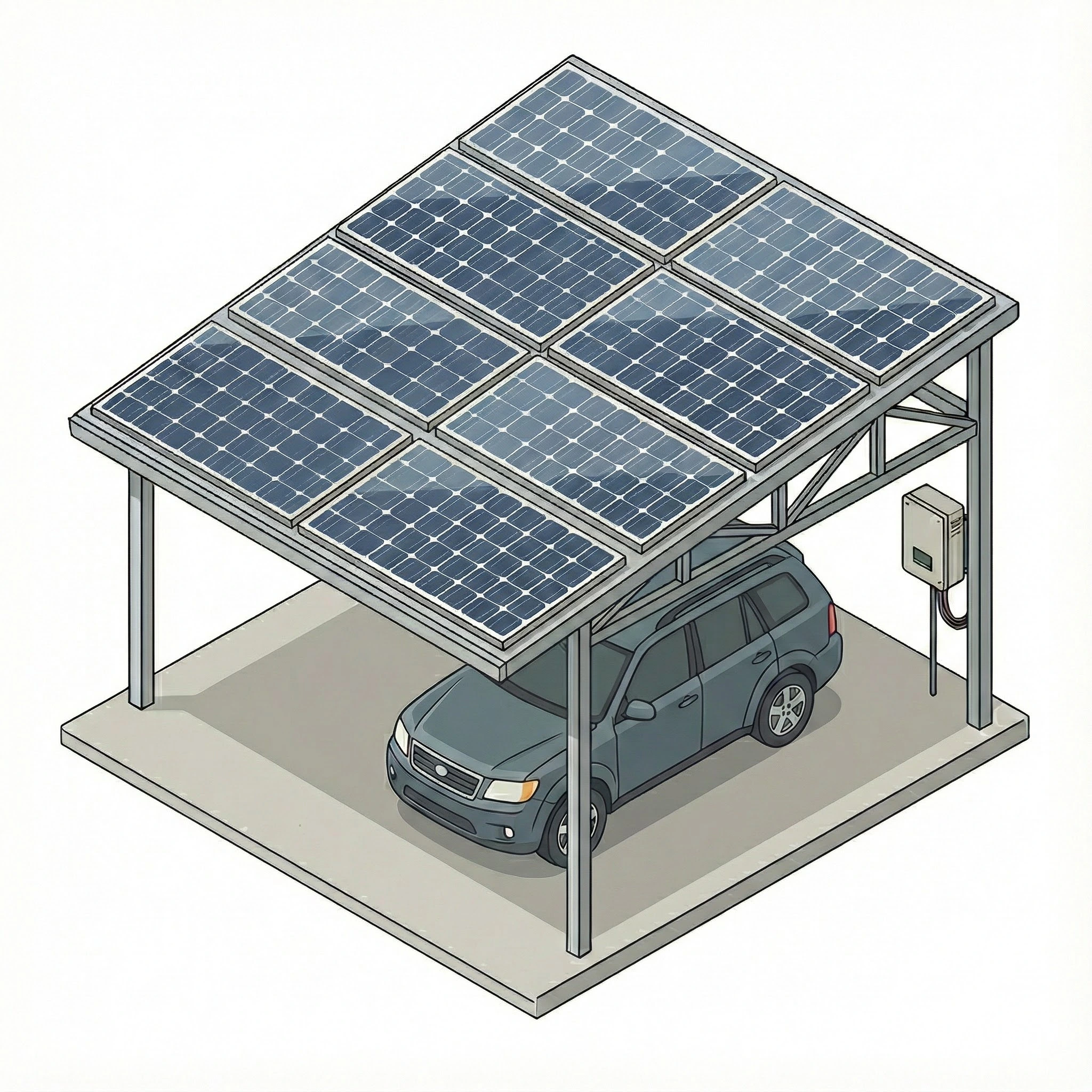
In the last few years, and specifically looking ahead to the 2025 market, the solar carport has graduated from a niche commercial product seen in corporate parking lots to a highly desirable residential upgrade. It is, quite simply, a structure that does double duty. It provides shelter for your vehicles—protecting them from the scorching summer sun, heavy rain, and damaging hail—while simultaneously acting as a power plant that generates clean electricity for your home. 1
This guide is written for you, the homeowner. We are going to skip the dense engineering jargon where we can, or explain it simply when we can't. We will break down the costs, the benefits, the "gotchas" with your Homeowners Association (HOA), and the critical tax deadlines you need to know about. We are aiming for a deep, exhaustive look at everything you need to know to decide if a solar carport is right for your driveway.
1.1 The "Two Birds, One Stone" Advantage
The primary reason homeowners are flocking to solar carports is efficient utility. In real estate and home improvement, we often look for "value stacking"—getting multiple benefits from a single investment.
- The Shelter Benefit: If you park your car outside, you know the pain of entering a vehicle that has been baking in the sun. The internal temperature can reach dangerous levels, and UV rays degrade your dashboard and upholstery over time. In winter, scraping ice and snow off the windshield is a morning ritual nobody enjoys. A carport solves these problems instantly. 3
- The Power Benefit: By moving the solar panels off the roof and onto a custom‑built structure, you gain total control. You don't have to worry about the angle of your roof. You can point the carport perfectly south to catch the maximum amount of sunlight. You can tilt it at the perfect angle for your latitude. This means a carport often produces more energy per panel than a rooftop system. 4
1.2 Who is This For?
You might be the perfect candidate for a solar carport if:
- You own an Electric Vehicle (EV): Or you plan to buy one soon. The synergy between a solar carport and an EV is undeniable. It is effectively a private gas station that runs on sunshine. 5
- Your Roof is "Solar Challenged": Too much shade, wrong orientation, or perhaps it is made of slate or clay tile that is expensive and risky to drill into. 1
- You Need More Space: You have maximized your roof usage but still have a high electric bill. A carport adds "new" roof space to your property. 6
- You Want Curb Appeal: Modern solar carports, especially the "cantilever" styles or timber "solar pergolas," can be stunning architectural additions to a home. 7
---
2. The Financial Picture: Costs, Savings, and ROI
Let's have a frank conversation about money. This is usually the first question homeowners ask: "Is it more expensive than putting panels on my roof?"
The short answer is: Yes.
The long answer is: Yes, but it might be a better value.
2.1 The "Solar Premium" Explained
When you install solar on your house roof, the "structure" is already there. The rafters, the sheathing, the shingles—you already paid for those when you bought the house. You are just paying for the panels and the aluminum rails to hold them.
With a solar carport, you are building a building. You have to pay for the steel columns, the heavy‑duty beams, the deep concrete foundations, and the labor to erect it all. Because of this, a solar carport typically costs about 24% more than a comparable rooftop system. 1
Let's look at the numbers for 2025. The industry measures cost in "Dollars per Watt" ($/Watt). This helps us compare systems of different sizes.
| System Type | Average Cost (2025) | What You Are Paying For |
|---|---|---|
| Rooftop Solar | $2.56 per Watt | Panels, Inverter, Racking, Labor. |
| Solar Carport | $3.17 per Watt | All of the above PLUS steel structure, concrete, trenching. |
| Ground Mount | $3.21 per Watt | Panels, Inverter, ground racking, trenching. |
Data Source: 1
The Real‑World Math:
Let’s say you need a 5‑kilowatt (kW) system. That’s roughly 12 to 14 solar panels.
- Rooftop Cost: ~$12,800
- Carport Cost: ~$15,850
So, you are paying a premium of about $3,000. However, you have to ask yourself: Could you build a high‑quality, two‑car carport for $3,000? Probably not. A standard, non‑solar metal carport can easily cost $4,000 to $10,000 depending on the style and strength. 8.
When you view the solar carport as purchasing a carport AND purchasing a power plant, that $15,850 price tag starts to look like a bargain.
2.2 Return on Investment (ROI)
"Payback period" is the time it takes for the savings on your electric bill to equal the amount you paid for the system.
- Rooftop Payback: Usually 5 to 7 years.
- Carport Payback: Usually 8 to 12 years. 1
While 8‑12 years seems longer, remember that solar panels are warranted to last 25 to 30 years. This means after year 12, you have nearly two decades of essentially free electricity. Over a 25‑year period, a solar carport can save a homeowner between $16,500 and $22,650 in electricity costs, even after paying for itself. 1
2.3 The "Soft Costs" Trap
We need to talk about the hidden costs that often surprise homeowners. In the industry, we call these "soft costs." For a carport, they can be higher than for a roof system.
- Trenching: Since the carport is usually detached from your house, wires need to get from the panels to your main breaker box. This means digging a trench through your yard, laying PVC conduit, and pulling wire. If you have a long driveway, or if you have to dig under a paved patio, this gets expensive quickly. 9
- Engineering: Every town requires a building permit. Because a carport is a structure that could fall on a car or a person, the town will likely demand a set of plans stamped by a Professional Engineer. This engineer calculates wind loads and snow loads to prove the structure is safe. This stamp can cost $500 to $1,500. 1
- Soil Testing: For big commercial carports, they test the soil. For residential, they might assume "standard" soil, but if you hit solid rock while digging foundations, your labor costs will spike.
---
3. The 2025 Tax Credit Alert: Act Now or Lose Out
If you take only one thing away from this guide, let it be this section. Time is running out on the biggest discount available.
3.1 The Residential Clean Energy Credit
The US government offers a massive incentive to go solar. It is called the Residential Clean Energy Credit (Section 25D of the tax code). It allows you to subtract 30% of the total cost of your solar project from the federal taxes you owe. 10
Let's go back to our $15,850 carport example.
- Total Cost: $15,850
- 30% Tax Credit: –$4,755
- Net Cost to You: $11,095
This is a dollar‑for‑dollar reduction in your tax bill, not just a deduction from your income. It is huge.
3.2 The Expiration Date
Here is the critical part: According to current legislation (referenced as Public Law 119‑21 in recent updates), this residential credit is set to expire after December 31, 2025. 11
In the past, these credits have been extended, or stepped down slowly (to 26%, then 22%). But the current law indicates a hard stop for the residential credit at the end of 2025. 12
- What does "Expire" mean? It means the system must be "placed in service" by December 31, 2025. 9
- What does "Placed in Service" mean? It doesn't mean you signed the contract. It doesn't mean you paid the deposit. It means the system is installed, inspected, and capable of producing power. 9
The Warning: Solar projects take time. From signing a contract to flipping the switch can take 3 to 6 months. If you wait until October 2025 to sign up, you might miss the deadline. If your project isn't turned on until January 2, 2026, you could lose that $4,755 credit entirely.
3.3 What is Included in the Credit?
A common question is: "Does the 30% credit apply to the steel structure, or just the panels?"
The IRS guidance generally allows you to claim the credit for "property which uses solar energy to generate electricity." Because the carport structure serves as the "racking" or "mount" for the panels, and is necessary for the panels to function, the cost of the structure is typically eligible. 9 However, if you build a luxurious garage with gold‑plated columns and put one solar panel on top, the IRS will likely reject that. The structure must be reasonable and integral to the solar system. Always consult a tax professional for your specific situation.
---
4. Designing Your Solar Carport: Engineering for Homeowners
A solar carport isn't just a shelf. It's a building that has to survive hurricanes, blizzards, and gravity. Let's look at the design choices you will need to make.
4.1 The Look: Cantilever vs. Four‑Post
This is the biggest aesthetic and functional decision you will make.
1. The Cantilever (The "L‑Frame" or "7‑Frame")
Imagine a structure supported by legs on only one side. The roof "hovers" over your parking space.
- The Vibe: Sleek, modern, high‑tech. It looks like something from a luxury car dealership. 13
- The Pros: It is incredibly easy to park. There are no poles to hit your bumper on, and no poles blocking your car doors from opening. It maximizes your usable space. 14
- The Cons: It is expensive. To hold up a heavy roof with legs on only one side requires massive steel beams and huge concrete foundations to keep it from tipping over.
- Best For: Tight driveways, modern homes, and people who hate navigating around poles.
2. The Four‑Post (The "Table" or "Pergola" Style)
This looks like a traditional carport or pergola. It has legs on all four corners (or more, for larger structures).
- The Vibe: Traditional, sturdy, familiar.
- The Pros: It is cheaper. Because the weight is shared by four legs, the beams can be lighter and the foundations smaller. It is very stable in high winds. 1
- The Cons: You have poles in the way. You have to be careful opening your car doors.
- Best For: Budget‑conscious buyers, windy areas, and wider driveways.
4.2 Materials: Steel, Aluminum, or Wood?
- Galvanized Steel: This is the heavy‑duty champion. It is strong, relatively affordable, and usually dipped in zinc (galvanized) to prevent rust. It looks a bit industrial, but it can be powder‑coated any color. It is the best choice for areas with heavy snow. 2
- Aluminum: This is the premium choice for coastal areas. Aluminum naturally resists corrosion from salt air. It is lighter than steel but can be more expensive. It has a very clean, finished look. 6
- Wood (Timber): This is often sold as a "Solar Pergola." It uses heavy timber beams. It looks beautiful and blends into a backyard garden perfectly. However, wood requires maintenance (staining/sealing) and can warp over time. If the wood warps, it can stress the solar panels bolted to it. 7
4.3 Understanding Loads: Wind and Snow
When you buy a carport kit or hire a builder, you will hear about "load ratings." This isn't just paperwork—it's safety.
Snow Load:
If you live in Florida, you don't care about this. If you live in Michigan or Colorado, this is everything. Snow is heavy. Wet snow can weigh 20 to 30 pounds per square foot (PSF). A two‑car carport is about 400 square feet.
- The Math: 400 sq ft × 30 lbs = 12,000 pounds.
That is the weight of three Ford Explorers parked on top of your carport.
If your carport isn't built to handle that, it will collapse, crushing the cars underneath. - Check the Rating: Standard carports are often rated for 20‑30 PSF. If you live in the mountains, you might need a rating of 60, 90, or even 100 PSF. 15 This requires heavier steel and closer spacing of the beams. 17
Wind Load:
Solar panels act like giant sails. If a 100 mph wind hits your carport, it doesn't just push it over; it tries to lift it up. This is called "uplift."
- The Foundation: This is why solar carports need concrete footings. The concrete isn't just there to support the weight; it acts as an anchor to keep the carport from flying away like a kite. In hurricane zones, these footings might need to be 4 or 5 feet deep. 13
---
5. The Electric Vehicle Connection: Your Personal Gas Station
If you own an Electric Vehicle (EV), a solar carport is a match made in heaven. It closes the loop, allowing you to drive on 100% clean energy. But how do you set it up?
5.1 How Much Solar Do I Need?
You want to size your carport to generate enough electricity to cover your driving. Here is the simple math for the average homeowner.
- Miles per kWh: A typical EV (like a Tesla Model 3 or Chevy Bolt) goes about 3 to 4 miles on 1 kilowatt‑hour (kWh) of electricity. 18
- Your Driving: Let's say you drive 12,000 miles a year.
- Electricity Needed: 12,000 miles ÷ 3 miles/kWh = 4,000 kWh per year.
Now, how many solar panels do you need to make 4,000 kWh?
In most of the US, 1 kilowatt (kW) of solar panels produces about 1,300 to 1,500 kWh per year.
- 4,000 kWh ÷ 1,400 = ~2.85 kW system.
The Result: A standard single‑car solar carport is usually around 3 kW to 5 kW (roughly 8 to 12 panels). This means a single‑car carport is almost perfectly sized to provide 100% of the fuel for one average commuter car. 5. If you have two cars, you might want a larger 6‑8 kW system.
5.2 Charging Speed: Level 2 is Key
You don't want to plug your car into a standard wall outlet (Level 1) at your carport—it's too slow (3‑5 miles of range per hour). You want Level 2 charging.
- Voltage: 240 Volts (like a dryer outlet).
- Speed: 20 to 40 miles of range per hour. You can plug in empty at night and be full by morning. 21
- The Setup: When you build your carport, you will run a heavy‑duty wire (usually rated for 50 amps) through the trench from your house to the carport. This wire feeds an EV Charger mounted right on the carport leg.
5.3 Smart Charging
Modern inverters (the box that converts solar power to home power) often have "EV Mode." This is a clever feature. It can pause your car charging if a cloud goes over and resume when the sun comes out. This ensures you are charging only with your own free solar power, rather than pulling expensive electricity from the grid. 5
---
6. Navigating the "Red Tape": Permits, Zoning, and HOAs
This is the part nobody likes, but it is where projects often get stuck. Because a carport is a detached structure, it faces more rules than rooftop solar.
6.1 Zoning and Setbacks
Every property has invisible lines called "setbacks." These are rules that say you cannot build too close to your neighbor or the street.
- Side/Rear Setbacks: Typically 5 to 15 feet. You usually cannot build a carport right on the property line. 22
- Front Setbacks: This is the tricky one. Many towns say you cannot build anything in the "front yard" (the space between your house and the street). If you have a long driveway, you might have to place the carport far back, near the house, to comply.
- Lot Coverage: Towns also limit how much of your land can be covered by pavement and roofs (often 35% or 40%). If you have a small lot and a big house, a large carport might push you over the limit. 22
Action Item: Before you buy anything, go to your town's building department website and look up the "Accessory Structure" rules for your zone.
6.2 The Homeowners Association (HOA) Battle
HOAs often hate carports. They worry they look "trashy" or block views. However, you have a secret weapon: Solar Rights Laws.
Many states (like California, Arizona, Florida, and others) have laws that say an HOA cannot unreasonably ban solar energy systems. 24
- The Argument: If your HOA says "No carports," you can argue that this isn't just a carport—it is a solar energy collection device. In many cases, if the carport is the only viable place for solar (because of roof shade), the HOA must approve it.
- The Limits: They can usually impose "reasonable restrictions." They might ask you to paint the steel to match your house, or plant bushes to screen the view from the street. They generally cannot force you to move it to a shady spot where it won't work. 25
- Strategy: Don't just ask for permission. Submit a professional plan showing how nice it will look. Mention the Solar Rights Act in your application letter gently but firmly.
---
7. Insurance: The Coverage Gap You Didn't Know About
When you put solar on your house roof, your home insurance usually covers it automatically as part of the "Dwelling" (Coverage A).
When you build a detached solar carport, it is NOT part of the Dwelling. It is an "Other Structure."
7.1 "Other Structures" Coverage (Coverage B)
Most home insurance policies have a separate bucket for "Other Structures" (sheds, detached garages, fences).
- The Limit: This bucket is usually capped at 10% of your Dwelling coverage. 26
- The Problem: Let's say your house is insured for $300,000. Your "Other Structures" limit is $30,000.
- You build a $20,000 solar carport.
- You already have a nice detached garage worth $15,000 and a fence worth $5,000.
- Total Value: $40,000.
- Coverage: $30,000.
- The Gap: You are underinsured by $10,000. If a storm destroys everything, you are paying that $10,000 out of pocket.
Solution: Call your insurance agent. Ask to increase your Coverage B limit. It usually costs very little—maybe $20 or $50 a year—to bump that limit up to cover the new carport. 27
---
8. Installation: What to Expect
Building a solar carport is a construction project. Here is the typical timeline.
8.1 Professional Installation
- Site Survey: A guy comes out with a drone and a tape measure. He checks your electrical panel and your soil.
- Permitting (Weeks 1‑8): The solar company draws up plans and fights with the town for approval. This is the boring "waiting period". 1
- Foundation (Day 1‑2): A crew arrives with an excavator. They dig big holes. They pour concrete.
- Curing (Days 3‑10): You watch concrete dry. Literally. You cannot bolt the steel to the concrete until it is fully hard. 1
- Steel Erection (Day 11‑12): It looks like an erector set. A crane or lift might be used to hoist the heavy beams.
- Panel & Electric (Day 13‑14): Panels go on the roof. Inverters are mounted. Wires are pulled through the trench.
- Inspection & Interconnection (Weeks 4‑8): The town inspector checks the work. The utility company swaps your meter. Finally, you get Permission to Operate (PTO).
8.2 Can I Do It Myself (DIY)?
You can buy "Solar Carport Kits" online. They ship you the steel and the panels.
- The Good: You save on labor (maybe $5,000+).
- The Bad: It is incredibly hard.
- Concrete Precision: When you pour the concrete footings, you have to set anchor bolts into the wet cement. If you are off by even half an inch, the pre‑drilled steel beams won't fit. There is no "stretching" steel. 28.
- Danger: You are working with high‑voltage electricity. One mistake can be fatal or burn your house down.
- The Hybrid Approach: If you are handy, consider building the structure yourself (or hiring a local contractor to pour the concrete and bolt the frame). Then, hire a licensed electrician to install the panels and do the wiring. This keeps you safe and legal. 2.
---
9. Maintenance: The Easy Part
Here is the best news: Solar carports are easier to take care of than rooftop solar.
9.1 Cleaning
Dirty solar panels produce less power. Pollen, dust, and bird droppings can block the sun.
- Rooftop: You have to climb a 20‑foot ladder and walk on a sloped roof. Dangerous.
- Carport: The roof is usually only 8 or 9 feet high at the low end. You can stand on a step ladder or use a long‑handled soft brush to clean them. It takes 10 minutes. Doing this twice a year can boost your energy production by 15% or more. 29.
9.2 Snow Removal
If you live in snow country, you know that solar panels stop working when covered in snow.
- Rooftop: You just have to wait for it to melt.
- Carport: You can take a roof rake (a foam hoe on a long pole) and gently pull the snow off. You get your power back days or weeks sooner than your neighbors with roof systems. 31.
9.3 Inverter Access
The inverter is the box that does the work. They typically last 10‑15 years. On a carport, the inverter is mounted right on the leg or the wall. If it breaks, a technician can swap it in 20 minutes. No climbing onto the roof required. 31.
---
10. Conclusion: Is It Worth It?
A solar carport is a big investment. It costs more upfront than putting panels on your roof. It involves digging up your yard for trenches and pouring heavy concrete. It requires navigating zoning laws and insurance policies.
But for the right homeowner, it is a game‑changer.
If you are an EV driver, it locks in your fuel costs for the next 25 years. If you are a lover of clean lines and modern architecture, it adds a stunning feature to your property. If you are someone who simply cannot use your home's roof for solar, it unlocks the door to energy independence that was previously closed.
The Bottom Line:
- Value: You get a garage and a power plant.
- Urgency: The 30% tax credit expires at the end of 2025.
- Efficiency: It's often more efficient than rooftop solar and easier to maintain.
If you have the driveway space and the budget, a solar carport is one of the smartest, most future‑proof upgrades you can make to your home. It turns a patch of asphalt into an asset that pays you back every single day the sun shines.
---
Quick Summary Table: Solar Carport vs. Rooftop Solar
| Feature | Rooftop Solar | Solar Carport |
|---|---|---|
| Cost | Lower ($2.56/watt) | Higher ($3.17/watt) |
| Space Required | Existing Roof | Driveway/Yard |
| Energy Production | Dependent on roof angle | Optimized (Perfect tilt/direction) |
| Maintenance | Difficult (Ladder required) | Easy (Accessible from ground) |
| Snow Removal | Wait for melt | Can be raked off |
| Vehicle Protection | None | Excellent (Sun/Rain/Snow) |
| Aesthetics | Visible on home | Separate structure (Modern look) |
| Payback Period | 5‑7 Years | 8‑12 Years |
Data Sources for Summary: 1
Works cited
- Solar Panel Carports: The Complete 2025 Guide to Costs, Benefits, and Installation, accessed December 9, 2025, https://solartechonline.com/blog/solar-panel-carport-guide/
- Solar Carports: Pros, Cons, and Costs (2025 Updated), accessed December 9, 2025, https://alansfactoryoutlet.com/blog/solar-carport/
- The Complete Guide to Solar Carports in 2025: Maximize Energy, Space, and Savings, accessed December 9, 2025, https://solarcarportsireland.ie/the-complete-guide-to-solar-carports-in-2025-maximize-energy-space-and-savings/
- Should You Get a Solar Carport in 2025? - EcoWatch, accessed December 9, 2025, https://www.ecowatch.com/solar/solar-carport
- Solar Carport with Battery: Your 24/7 EV Charging Solution - EcoFlow, accessed December 9, 2025, https://www.ecoflow.com/us/blog/solar-carport-battery-ev-charging
- Choosing the Best Solar Carport for Your Project: A Complete Guide - soeasypv.com, accessed December 9, 2025, https://soeasypv.com/choosing-the-best-solar-carport-for-your-project-a-complete-guide/
- Double Your Space w/Unique Solar Pergola or Pavillion, accessed December 9, 2025, https://www.westerntimberframe.com/double-your-space-w-unique-solar-site-stand/
- Residential Solar Carport kits a thing out here yet? : r/bayarea - Reddit, accessed December 9, 2025, https://www.reddit.com/r/bayarea/comments/1btevik/residential_solar_carport_kits_a_thing_out_here/
- Are You Eligible for the Federal Solar Tax Credit in 2025?, accessed December 9, 2025, https://ppm.solar/federal-solar-tax-credit/
- How the Federal Solar Tax Credit Works In 2025 - Paradise Energy Solutions, accessed December 9, 2025, https://www.paradisesolarenergy.com/blog/how-does-the-solar-tax-credit-work/
- FAQs for modification of sections 25C, 25D, 25E, 30C, 30D, 45L, 45W, AND 179D under Public Law 119-21, 139 Stat. 72 (July 4, 2025), commonly known as the One, Big, Beautiful Bill (OBBB) | Internal Revenue Service, accessed December 9, 2025, https://www.irs.gov/newsroom/faqs-for-modification-of-sections-25c-25d-25e-30c-30d-45l-45w-and-179d-under-public-law-119-21-139-stat-72-july-4-2025-commonly-known-as-the-one-big-beautiful-bill-obbb
- The History & Future of the Solar Tax Credit in 2025 - GreenLancer, accessed December 9, 2025, https://www.greenlancer.com/post/solar-energy-tax-credit-2025
- Cantilever Solar Carport Design & Build: What You Must Know - SteelPRO PEB, accessed December 9, 2025, https://peb.steelprogroup.com/solar-structure/canopy/building-cantilever-carport/
- Cantilever Carports: Pros, Cons, and Is It Worth It? - Singh Roofing Supplies, accessed December 9, 2025, https://singhroofingsupplies.com.au/cantilever-carports-pros-cons-and-is-it-worth-it/
- Snow & Wind Load - High Quality Carports, accessed December 9, 2025, https://www.highqualitycarports.com/snow-wind-load/
- Snow Load Information - Man Cave Structures, accessed December 9, 2025, https://mancavestructures.com/snow-load-information
- Can Carports Withstand Heavy Snow? What You Need to Know, accessed December 9, 2025, https://thecarportco.com/buyers-guide/can-carports-withstand-heavy-snow/
- How Much Solar Do I Need for an Electric Vehicle? - Mylene Merlo, accessed December 9, 2025, https://mylenemerlo.com/blog/electric-vehicle-solar/
- How many solar panels do I need to charge an electric car in 2025? - SolarReviews, accessed December 9, 2025, https://www.solarreviews.com/blog/how-much-solar-do-i-need-to-charge-my-electric-car
- How to Calculate How Many Solar Panels You Need to Charge Your EV - CNET, accessed December 9, 2025, https://www.cnet.com/home/solar/calculate-how-many-solar-panels-you-need-to-charge-your-ev/
- How to Wire a New Garage for an EV Charging Station?, accessed December 9, 2025, https://www.danleys.com/blog/how-to-wire-a-new-garage-for-an-ev-charging-station/
- Accessory Structures | Woodburn, Oregon, accessed December 9, 2025, https://www.woodburn-or.gov/dev-planning/page/accessory-structures
- Article 17. Accessory Structures | Read The UDO, accessed December 9, 2025, https://read.charlotteudo.org/articles/article-17-accessory-structures/
- Can a Homeowners Association Prohibit Solar Panels? Understanding Your Options, accessed December 9, 2025, https://www.parkerandsons.com/blog/can-a-homeowners-association-prohibit-solar-panels-understanding-your-options
- HOA denied solar panel install request - Reddit, accessed December 9, 2025, https://www.reddit.com/r/solar/comments/1o2jaxq/hoa_denied_solar_panel_install_request/
- accessed December 9, 2025, https://solartechonline.com/blog/homeowners-insurance-solar-panels-coverage-guide/#:~:text=Ground%2DMounted%20Systems%20Coverage%20Gaps,Separate%20deductible%20may%20apply
- Does Homeowners Insurance Cover Solar Panels? Complete 2025 Guide - SolarTech, accessed December 9, 2025, https://solartechonline.com/blog/homeowners-insurance-solar-panels-coverage-guide/
- How To Build a Residential Solar Carport - EcoFlow, accessed December 9, 2025, https://www.ecoflow.com/ca/blog/how-to-build-residential-solar-carport
- The Importance of Regular Solar Panel Maintenance & Cleaning - Infinity Solar USA, accessed December 9, 2025, https://www.infinitysolarusa.com/the-importance-of-regular-solar-panel-maintenance-cleaning
- A guide to solar system maintenance: ensuring longevity and performance - SolarEdge, accessed December 9, 2025, https://www.solaredge.com/aus/for-home/info-centre/maintenance-cleaning/solar-system-maintenance-guide
- Is a Solar Carport Worth the Investment? Overview, Benefits, and Drawbacks - Treehugger, accessed December 9, 2025, https://www.treehugger.com/is-a-solar-carport-worth-the-investment-5205068