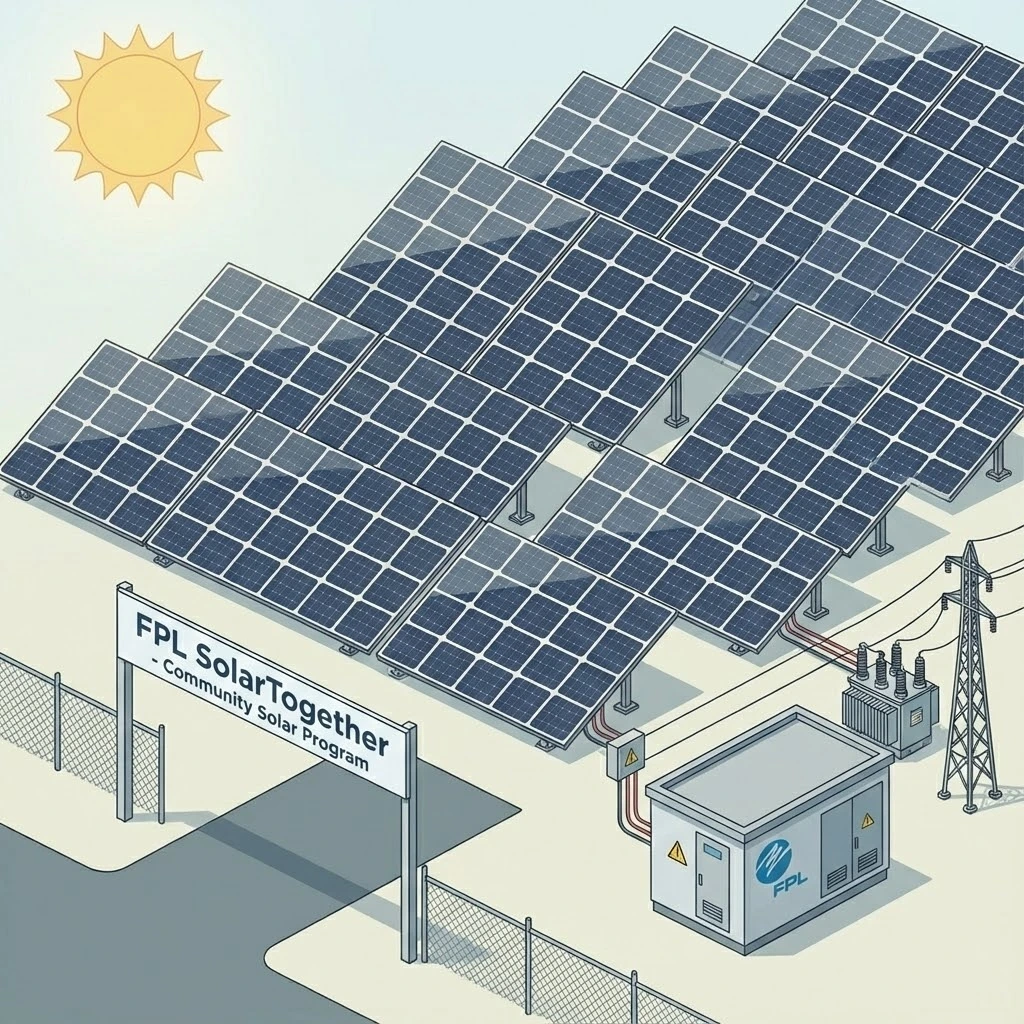
Florida is famously known as the Sunshine State. It is a brand built on bright days, warm beaches, and the kind of weather that makes the rest of the country jealous in January. Yet, for a very long time, Florida presented a confusing paradox to energy observers: despite having an abundance of solar resource—that giant, free fusion reactor in the sky—the state lagged significantly behind places like California, and even cloudy New Jersey or Massachusetts, in solar energy adoption.
For decades, the standard way to power a home in Florida was simple: you bought electricity from a monopoly utility company, likely generated by burning natural gas or coal. If you wanted to go green, your only real option was to buy your own solar panels, bolt them to your roof, and generate your own power. This "rooftop solar" model works well for many, but it is exclusive. It requires a roof you own (sorry, renters), a roof that faces the right way (sorry if you have beautiful shade trees), and a bank account healthy enough to absorb a $20,000 to $40,000 upfront cost.1
This gap between the potential for solar and the reality of access created a massive market inefficiency. Millions of Floridians wanted renewable energy but couldn't get it. They were locked out by high costs, bad roofs, or strict Homeowner Association (HOA) rules.
Enter FPL SolarTogether
In response to this demand—and facing pressure to decarbonize the grid—Florida Power & Light (FPL), the state’s largest utility, launched SolarTogether. This program is marketed as "Community Solar," though as we will explore later, that term is a bit controversial among purists.
The premise is deceptively simple: instead of putting panels on your roof, you subscribe to a share of a massive solar farm located somewhere else in Florida. You pay a monthly fee for this share, and in return, you get credits on your electric bill for the energy that share produces. It is the "Netflix model" applied to solar energy. No equipment to buy, no maintenance to worry about, and the ability to cancel if you move.2
But simple on the surface does not mean simple in the details. The program involves complex regulatory structures, escalating credit rates, and a financial payback period that requires a long‑term view. For the average homeowner, navigating the marketing claims versus the financial reality can be daunting.
Why This Report Exists
This report is designed to be the definitive guide for US homeowners—specifically those in FPL territory—who are curious about SolarTogether. We aren't selling anything. We aren't here to convince you to sign up or to convince you to run away. We are here to unpack the program, bolt by bolt.
We will look at the math (does it actually save money?), the mechanics (how does the billing work?), the user experience (what are real people saying on Reddit?), and the controversy (why do the Sierra Club and consumer advocates have issues with it?). By the end of this document, you will have a nuanced, expert‑level understanding of whether SolarTogether fits your life, your budget, and your values.
---
Chapter 2: How SolarTogether Actually Works
The Concept of Subscription Solar
To understand SolarTogether, you have to stop thinking about "buying" energy and start thinking about "funding" infrastructure. When you sign up for this program, you aren't running a wire from a solar farm directly to your toaster. The electrical grid doesn't work that way.
Think of the power grid like a giant swimming pool.
- Dirty Sources: Traditional power plants (gas, coal) dump "dirty water" into the deep end.
- Clean Sources: Solar farms dump "clean water" into the shallow end.
- Your Home: Your house sucks water out of the pool to run your lights and AC.
Once the water is in the pool, it is all mixed together. You can't separate the solar water from the gas water. When you flip a switch, you get the mix.
FPL SolarTogether allows you to pay FPL to dump more "clean water" into the pool on your behalf. In exchange for your funding, FPL gives you the financial rights to the energy produced by that clean source. You are decoupling the financial benefit of solar from the physical location of the panels.2
The Three Pillars of the Program
The program operates on three main components that appear on your bill and in your contract. Understanding these is the key to understanding if you are winning or losing money.
1. The Subscription Charge (The Cost)
This is the money you pay FPL every month to be part of the club. It is a fixed cost.
- Rate: Currently, for standard residential customers, this is set at $6.76 per kilowatt (kW) of subscription power.3
- Stability: This rate is fixed. It does not go up with inflation. It does not spike if the price of natural gas skyrockets. If you subscribe to 5 kW of power, you pay $33.80 (5 x $6.76) every single month.
- The Anchor: This fixed nature is the program's primary hedge against inflation. In 10 years, $6.76 will likely feel "cheaper" than it does today due to the eroding value of the dollar, but the price tag stays the same.
2. The Subscription Credit (The Benefit)
This is the money FPL gives you back. It appears as a credit (a negative number) on your bill.
- Rate: This is a variable rate based on the amount of energy produced. The base rate starts around 3.4 to 3.6 cents per kilowatt‑hour (kWh).3
- The Variable: Unlike the fixed charge, the amount of credit you get depends on the sun. If it is cloudy for three weeks, your solar share produces less energy, and your credit goes down. If it is a blazing hot July with clear skies, your panels produce more, and your credit goes up.3
- The Escalator: This is the most critical part of the math. The credit rate increases by 1.5% every year.3 This built‑in raise is designed to make the program profitable for you in the long run.
3. The Subscription Size (The Capacity)
You cannot just buy an infinite amount of solar credits. FPL restricts your subscription based on your history.
- The Cap: You can subscribe to offset up to 100% of your previous 12‑month energy usage.2
- The Calculation: If you used 12,000 kWh last year, FPL's engineers calculate that it takes roughly 5 to 6 kW of solar panels to generate that much power. That 5‑6 kW becomes your maximum subscription size.
- Increments: You buy in 1 kW "chunks." You can choose to offset 25%, 50%, or go all‑in at 100%.
The Virtual Connection
It is important to reiterate that FPL is not installing anything on your property. There are no site visits. No guys in hard hats walking on your roof. The solar plants are "large‑scale energy centers" located throughout FPL's service territory—huge fields of glass and silicon often located in rural areas where land is cheaper.1
When you join, you are assigned a "share" of the capacity from these centers. If a hurricane destroys the center you are assigned to, your credits will stop (or drop significantly) until it is fixed. You share in the risk of generation, but you do not carry the risk of equipment ownership.3
---
Chapter 3: The Financial Deep Dive – Is It Worth It?
This is the question that drives every Reddit thread and forum discussion about SolarTogether: "Does this actually save me money?"
The answer is yes, but with a massive asterisk: It takes time.
The Payback Period Analysis
Unlike rooftop solar, which can start saving you money immediately (if bought with cash) or break even quickly depending on financing, SolarTogether was originally designed with a "payback period" model.
The "Seven Year" Rule
When the program launched, the math was structured so that for the first few years, the Subscription Charge ($6.76/kW) was higher than the average Subscription Credit you received.
- Years 1‑3: You are likely paying a "premium" for green energy. Your bill might be $2 to $5 higher per month than if you hadn't joined.
- Years 4‑6: The credit rate (increasing by 1.5% annually) starts to catch up to the fixed charge. You approach a break‑even point.
- Year 7: This is the "crossover" point often cited in FPL documents and independent reviews. The cumulative credits finally exceed the cumulative charges. You have "paid back" your initial investment (the premiums you paid in years 1‑3).7
- Year 8+: You are now in the green. Every month, the credit should theoretically be larger than the charge, lowering your total electric bill.
The New Math (2022‑2025 Updates)
Recent updates to the program (extensions approved by the PSC) have tried to sweeten the deal to encourage more enrollment. The initial credit rate was bumped up (from ~3.4 cents to ~3.6 cents).
- Effect: This reduces the payback period. Some analyses suggest that with the new rates, the "loss" in the first year is minimal—perhaps just a few dollars for the whole year—or potentially even a tiny net gain immediately, depending on how sunny the year is.4
- Reality Check: Even with the better rates, we are talking about saving pennies in the short term. An analysis by SolarReviews showed that in Year 1, a customer might save about $1.24 per kW subscribed. If you have a 5 kW subscription, you saved enough to buy... well, not much. Maybe a candy bar..4
The Long‑Term Wealth View (30 Years)
Solar energy is a long game. Solar panels are warranted for 25‑30 years. If you stay in SolarTogether for the long haul, the 1.5% annual escalator starts to do some heavy lifting.
- Year 10 Savings: By year 10, the gap between the fixed charge and the rising credit widens. You might be saving $10.50 per kW annually.
- Year 20 Savings: The savings jump to $21.94 per kW.
- Year 30 Savings: By the end of the program's lifecycle, you could be saving $34.68 per kW per year.4
Total Lifetime Savings:
For a standard homeowner with an 11 kW subscription (covering a large house with a pool), the total savings over 30 years is estimated to be around $5,645.4
Is $5,000 over 30 years a good investment?
- From an Investment Standpoint: No. If you took the extra money you paid in the first 3 years and invested it in the S&P 500, you might do better.
- From a "No Effort" Standpoint: Yes. Remember, you invested $0 upfront. You took $0 risk. You did zero maintenance. Getting $5,000 back for doing nothing but signing a paper is a decent value proposition for a risk‑averse homeowner.
Weather Variability: The "Bumpy" Bill
One aspect that confuses new users is the monthly fluctuation. Because the credit is tied to actual generation, your bill becomes seasonal.
- Spring/Summer: Florida days are long. Solar generation is high. Your credits will be at their peak (potentially $30‑$40 for a large system). This helps offset the high AC costs of Florida summers.
- Winter: Days are short. The sun is lower in the sky. Generation drops. Your credits shrink (maybe down to $15‑$20), but your subscription fee remains fixed at the high rate.
- The Result: You might feel like you are "losing money" in December and January, but "making money" in May and June. You have to look at the annual average, not just the monthly snapshot.3
Table 1: Estimated Financial Trajectory (Hypothetical 5 kW Subscription)
| Year | Monthly Fixed Charge | Est. Monthly Credit (Avg) | Net Monthly Impact | Annual Impact | Status |
|---|---|---|---|---|---|
| Year 1 | $33.80 | ~$34.00 | +$0.20 | +$2.40 | Break Even |
| Year 5 | $33.80 | ~$36.10 | +$2.30 | +$27.60 | Small Savings |
| Year 10 | $33.80 | ~$38.90 | +$5.10 | +$61.20 | Growing Savings |
| Year 20 | $33.80 | ~$45.10 | +$11.30 | +$135.60 | Solid Savings |
| Year 30 | $33.80 | ~$52.30 | +$18.50 | +$222.00 | Max Savings |
Note: This table is a simplified projection based on the 1.5% escalator and average solar irradiance. Real‑world weather and specific rate adjustments can alter these numbers.
---
Chapter 4: SolarTogether vs. Rooftop Solar – The Heavyweight Fight
For homeowners who can install panels, the decision between SolarTogether and private rooftop solar is the most common dilemma. They represent two completely different philosophies of energy ownership.
The Case for Rooftop Solar (The "Owner" Mindset)
In Florida, private solar benefits from Net Metering. This is the golden rule of solar economics.
- The Mechanism: When your rooftop panels produce excess energy (like when you are at work during the day), that power flows back to FPL. By law, FPL must credit you for that power at the full retail rate (approx. 13‑14 cents/kWh).
- The Difference: SolarTogether credits you at a "wholesale" equivalent rate (~3‑4 cents). Rooftop solar credits you at retail (~13 cents). That is a 3x difference in the value of the energy produced.
Financial Potential:
A purchased rooftop system can eliminate your electric bill entirely (except for a minimal connection fee of ~$25). Over 25 years, a rooftop system can save a homeowner $30,000 to $50,000 after paying off the cost of the system.4
Tax Incentives:
Homeowners who buy panels get the Federal Investment Tax Credit (ITC). This allows you to deduct 30% of the cost of the system from your federal taxes. On a $30,000 system, that is a $9,000 check from the IRS. SolarTogether subscribers get zero tax benefits.4
The Case for SolarTogether (The "Renter/Low‑Risk" Mindset)
If rooftop solar is so much better financially, why does SolarTogether exist? Because rooftop solar is a headache.
1. The Insurance Trap:
In Florida, home insurance is a crisis. Many insurers will drop you if you install panels, or require you to increase your "Tier 2" liability coverage to $1 million if your system is large (over 10 kW). SolarTogether has zero impact on your home insurance.9
2. The Roof Liability:
If your roof is 15 years old, you can't put solar on it. You need a new roof first ($15,000+). If you put solar on a new roof and the roof leaks 5 years later, the solar panels have to be removed and reinstalled (costing thousands) to fix the leak. SolarTogether has zero interaction with your roof.1
3. Mobility:
Americans move on average every 7 years. If you buy a solar system with a 20‑year loan and move in year 5, you have to convince the buyer of your house to take over the loan, or pay it off with your home equity. SolarTogether is fully transferable within FPL territory. If you move from Miami to Sarasota, your subscription comes with you. If you move out of state, you just cancel. No penalties.6
Comparison Table: SolarTogether vs. Private Rooftop
| Feature | FPL SolarTogether | Private Rooftop Solar |
|---|---|---|
| Upfront Cost | $0 | $20k – $50k (Cash/Loan) |
| Savings (25 Years) | Low (~$5,000) | High (~$30,000+) |
| Federal Tax Credit | None | 30% ITC Eligible |
| Maintenance | FPL handles it | Homeowner handles it |
| Insurance Impact | None | High Risk (Policy drops/Rate hikes) |
| Storm Risk | FPL absorbs equipment loss | Homeowner risks damage |
| Transferability | Excellent (Move with you) | Difficult (Must sell with house) |
| Home Value | Neutral | Increases (~4%) |
| Best For | Renters, Condo Owners, Risk‑Averse | Homeowners with cash, Good Roofs |
---
Chapter 5: The "SunAssist" Program – Solar for Low‑Income Households
One of the most significant criticisms of early solar programs was that they were "playthings for the rich." You needed high credit scores and property ownership to participate. FPL addressed this with the SolarTogether SunAssist program, a carve‑out specifically for low‑income families.
How SunAssist Flips the Math
The standard SolarTogether program requires you to wait years to break even. Low‑income households do not have the luxury of "investment horizons." They need cash now.
SunAssist changes the pricing structure to guarantee immediate monthly savings.
- Lower Charge: SunAssist participants pay a reduced subscription rate of $5.57 per kW (compared to the standard $6.76).
- Higher Credit: The credit is structured to virtually guarantee it exceeds the charge. The estimated credit is roughly $6.27 per kW.10
The "Net" Result:
For every kilowatt subscribed, a low‑income household saves about $0.70 per month.
- Typical Subscription (5 kW): Savings of $3.50 per month.
- Annual Savings: ~$42.00 per year.10
Who is Eligible? (The ALICE Threshold)
Eligibility is generally tied to participation in other social safety net programs. If you are already enrolled in:
- LIHEAP (Low‑Income Home Energy Assistance Program)
- EHEAP (Emergency Home Energy Assistance for the Elderly)
- WAP (Weatherization Assistance Program)
...you are likely pre‑approved or instantly eligible.10
However, eligibility also often tracks with the ALICE threshold. ALICE stands for Asset Limited, Income Constrained, Employed. These are households that earn above the Federal Poverty Level (FPL — the other FPL!) but earn less than the basic cost of living in their county.
- In Florida (2025 projections), the ALICE survival budget for a family of four is significantly higher than the federal poverty line, often requiring an income of over $60,000‑$70,000 just to survive without debt.
- The SunAssist program aims to help this demographic, who spend a disproportionate percentage of their income on electricity (energy burden).11
Is It Enough?
Critics, including groups like Solar United Neighbors, point out that saving $3.50 a month on a $200 electric bill is a drop in the bucket. They argue that true energy equity would involve deeper retrofits to homes (insulation, new ACs) that could save families $50‑$100 a month. However, proponents argue that $42 a year is better than $0, and importantly, it allows low‑income residents to participate in the clean energy transition rather than being left behind.14
---
Chapter 6: The Controversy – "Fake" Community Solar?
You cannot research SolarTogether without stumbling upon heated political and regulatory debates. Why are environmental groups fighting a solar program?
The Monopoly Argument
Florida is one of the few states that strictly prohibits Third‑Party Power Purchase Agreements (PPAs).
- What is a PPA? In states like Massachusetts or California, a private company (say, a solar co‑op or a startup) can build a solar farm and sell the power directly to you. This creates competition.
- Florida's Law: In Florida, only the regulated utility (FPL, Duke, TECO) can sell electricity.
- The Critique: Organizations like the Sierra Club and Solar United Neighbors (SUN) call SolarTogether "Fake Community Solar." They argue it reinforces FPL's monopoly. By allowing FPL to capture the "community solar" market, it prevents true community‑owned projects (like a church putting solar on its roof and selling shares to parishioners) from ever taking root.14
The "Cross‑Subsidization" Battle
When FPL first proposed the program, the Office of Public Counsel (OPC)—the state lawyers representing consumers—fought it hard.
- The Fear: They worried that FPL would use money from all customers (including grandmothers who didn't sign up) to build these solar farms, but only give the credits/savings to the subscribers. This is called cross‑subsidization.
- The Settlement: FPL argued that building more solar lowers fuel costs for everyone (sunshine is free; gas is not). Eventually, a settlement was reached. FPL proved that the solar centers would save the entire system money in the long run ($112 million to $249 million in system savings), justifying the program's existence even for non‑participants.15
Greenwashing Allegations
Some cynics argue that since FPL is building these solar plants anyway to meet its "Real Zero" carbon goals, charging customers extra for a "subscription" is just a way to monetize an asset they were going to build regardless. By subscribing, you are essentially "claiming" the green attribute (the REC), but you aren't necessarily causing new solar to be built that wouldn't have been built otherwise. FPL disputes this, stating that the subscriber revenue supports the acceleration of this solar buildout.9
---
Chapter 7: User Reviews and Real‑World Experiences
What is the word on the street? We analyzed discussions from Reddit communities (r/florida, r/solar, r/321) and consumer forums to find the consensus.
The Happy "Green" Customer
Many users are satisfied because they view the program as a consumption choice rather than an investment.
- User Profile: "gjfl" on Reddit notes that they signed up for 100% solar immediately. Even though their credits were small ($5 off the bill), they valued the ability to legally claim their house uses 100% renewable energy. For them, it is the most cost‑effective way to obtain RECs on the market.8
- The Renter's Joy: Renters frequently comment that this is their only option. They express relief at being able to "do something" for the environment without owning property.
The "Rounding Error" Complaint
A common theme in reviews is the underwhelming nature of the financial return.
- The "Big_DDeal" Review: One user noted, "I've been doing it a couple years and it's mostly a rounding error. I probably pay about $5 in winter and get $2 in summer. It's hardly noticeable." 8
- The Expectation Gap: Many users signed up expecting their bills to drop by 50%. When they realized the savings were literally pennies or a few dollars, they felt misled by the marketing of "savings."
The Hurricane Ian Case Study
A fascinating insight emerged regarding resilience.
- The Story: A user named "MJseaham" shared that their house was destroyed by Hurricane Ian. They hit their insurance maximum payout just on the structure. If they had owned a $30,000 solar array on the roof, it would have been a total financial loss (as insurance wouldn't have covered the extra value above the cap).
- The SolarTogether Advantage: Because they were SolarTogether subscribers, they lost nothing. They simply moved their subscription to their new house. They cited this "transferability" and lack of asset risk as a massive hidden benefit of the program in a disaster‑prone state.18
---
Chapter 8: Waitlists, Expansion, and 2025 Status
Is the Program Open?
As of late 2024 and heading into 2025, the program's availability is fluid.
- General Status: The main residential program has frequently been "At Capacity," forcing new applicants onto a waitlist ("Reserved" status).
- Northwest Florida: With FPL's acquisition of Gulf Power, there has been a significant push to build new solar centers in the Panhandle. Availability in Northwest Florida (Pensacola, etc.) has notably been more open as new centers come online.19
The 2025 Buildout
FPL is in the midst of a massive expansion, adding dozens of new solar centers (totaling over 3,000 MW).
- Waitlist Movement: As each new center turns on (usually in chunks throughout the year), FPL moves the next batch of people off the waitlist.
- Notification: If you are on the waitlist, watch your email. You typically have a 14‑day window to confirm your enrollment once a spot opens up. If you miss it, you go to the back of the line.20
---
Chapter 9: Conclusion and Decision Matrix
FPL SolarTogether is neither a scam nor a miracle. It is a utility‑scale financial product designed to democratize access to solar energy, albeit at a very low rate of financial return compared to private ownership.
The Verdict: Who Should Sign Up?
1. The Renter or Condo Owner
Verdict: YES.
This is your best (and likely only) path to solar. It costs you nothing to join, has no cancellation penalty, and moves with you. It is a low‑risk way to support green energy.
2. The Homeowner with a Perfect Roof
Verdict: NO (mostly).
If you have a south‑facing roof, good credit (or cash), and plan to stay in your home for 10+ years, buy your own panels. The financial return of private solar (ROI 10‑15%) crushes SolarTogether (ROI <2%). You are leaving tens of thousands of dollars on the table by choosing the subscription model.
3. The "Risk‑Averse" Retiree
Verdict: YES.
If you don't want a 20‑year loan, don't want to worry about roof leaks, and don't want to fight with your insurance company, SolarTogether is a safe harbor. It offers modest savings without the headaches of asset ownership.
4. The Low‑Income Household
Verdict: YES (SunAssist Only).
Ensure you apply specifically for SunAssist. Do not sign up for the standard program. SunAssist guarantees money in your pocket from Day 1.
Final Thoughts
SolarTogether essentially turns solar energy into a "subscription service." In a world where we subscribe to music, movies, and food delivery, it makes sense that we would subscribe to sunshine. It may not make you rich, but it allows you to participate in the green revolution without needing a power drill or a bank loan. And for millions of Floridians, that accessibility is the most important benefit of all.
Works cited
- How do I get the benefits of solar without rooftop panels? – FPL, accessed December 9, 2025, https://www.fpl.com/northwest/blog/ask-the-expert/go-solar.html
- Energy My Way | SolarTogether | Residential – FPL, accessed December 9, 2025, https://www.fpl.com/energy-my-way/solar/solartogether-res.html
- Energy My Way | SolarTogether | FAQ – FPL, accessed December 9, 2025, https://www.fpl.com/energy-my-way/solar/solartogether-res/faq.html
- The FPL SolarTogether Program: Is It Worth It? – SolarReviews, accessed December 9, 2025, https://www.solarreviews.com/blog/fpl-solartogether-program-explained
- Energy My Way | SolarTogether | FAQ – FPL, accessed December 9, 2025, https://www.fpl.com/energy-my-way/solar/solartogether/faq2.html
- Energy My Way | SolarTogether | FAQ – FPL, accessed December 9, 2025, https://www.fpl.com/energy-my-way/solar/solartogether-business/faq.html
- Energy My Way | SolarTogether | AB Enrolled – FPL, accessed December 9, 2025, https://www.fpl.com/energy-my-way/solar/solartogether-res-ab-enrolled.html
- FPL Solar Together program, is it worth it? : r/florida – Reddit, accessed December 9, 2025, https://www.reddit.com/r/florida/comments/16sv20o/fpl_solar_together_program_is_it_worth_it/
- FPL Solar Together – thoughts? : r/florida – Reddit, accessed December 9, 2025, https://www.reddit.com/r/florida/comments/1civc7a/fpl_solar_together_thoughts/
- Energy My Way | SolarTogether | SunAssist Savings Program | FAQ – FPL, accessed December 9, 2025, https://www.fpl.com/energy-my-way/solar/solartogether-res/sun-assist/faq.html
- alice-essentials-index-2025.pdf, accessed December 9, 2025, https://www.unitedforalice.org/Attachments/ALICEEssentials/alice-essentials-index-2025.pdf
- state-of-alice-report-united-states-2025.pdf, accessed December 9, 2025, https://www.unitedforalice.org/Attachments/AllReports/state-of-alice-report-united-states-2025.pdf
- The State of ALICE in Florida: 2025 Update on Financial Hardship, accessed December 9, 2025, https://www.unitedforalice.org/Attachments/AllReports/state-of-alice-report-florida-2025.pdf
- What is FPL's SolarTogether? Don't be fooled. – Solar United Neighbors, accessed December 9, 2025, https://solarunitedneighbors.org/news/dont-be-fooled-by-fpls-fake-community-solar/
- Major FPL Solar Plan Sparks Controversy – CBS Miami, accessed December 9, 2025, https://www.cbsnews.com/miami/news/major-fpl-solar-plan-sparks-controversy/
- Petition for Approval of FPL SolarTogether Program and Tariff, by Florida, accessed December 9, 2025, https://www.psc.state.fl.us/library/filings/2020/00056-2020/00056-2020.pdf
- What do you think of FPL's Solar Together program? – Reddit, accessed December 9, 2025, https://www.reddit.com/r/solar/comments/1njoe9e/what_do_you_think_of_fpls_solar_together_program/
- FPL Solar Together : r/solar – Reddit, accessed December 9, 2025, https://www.reddit.com/r/solar/comments/10n357u/fpl_solar_together/
- Energy My Way | SolarTogether – FPL, accessed December 9, 2025, https://www.fpl.com/energy-my-way/solar/solartogether.html
- FPL Northwest FL | Energy My Way | Solar | SolarTogether Business, accessed December 9, 2025, https://www.fpl.com/northwest/energy-my-way/solar/solartogether-business.html