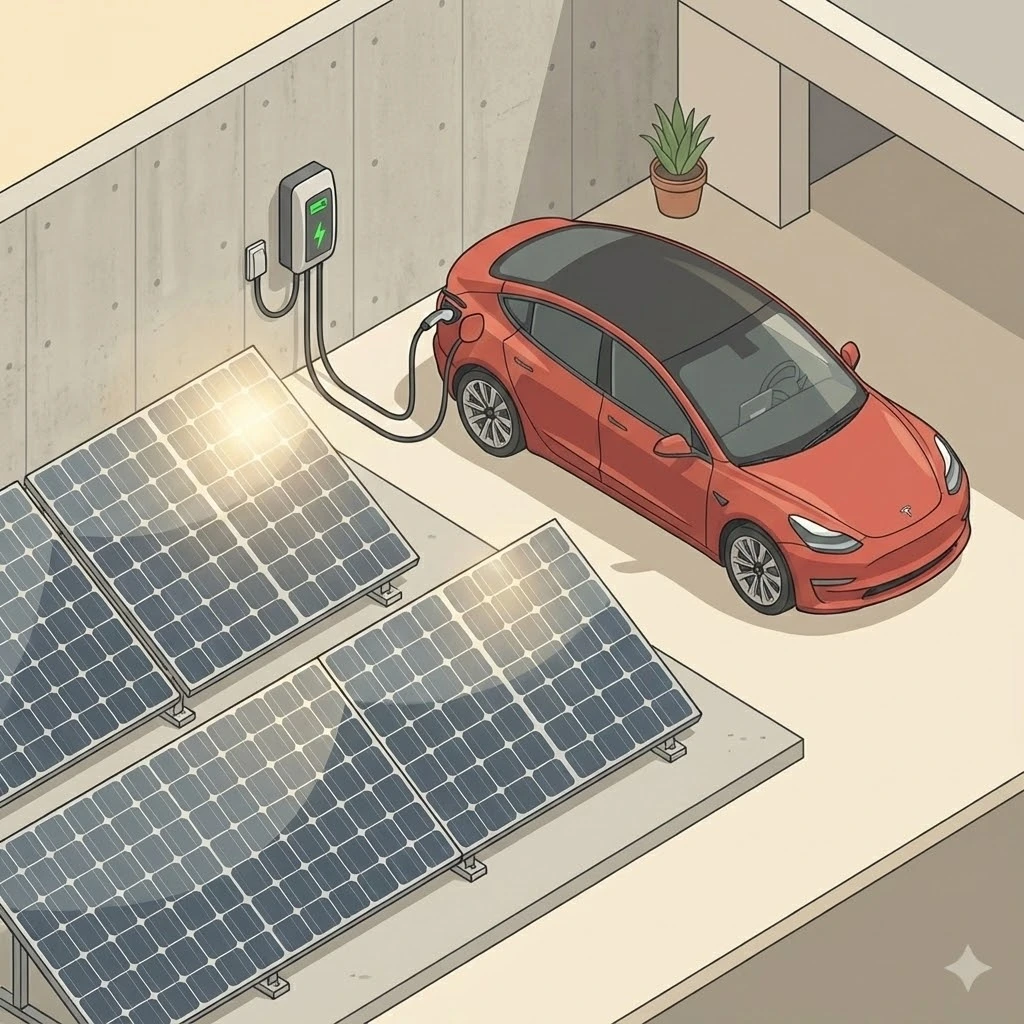
The vision is a powerful one: a high-performance Tesla silently parked in the driveway, its battery replenishing with pure, emissions-free energy. This energy, captured from the sun by sleek solar panels on the roof, represents the ultimate goal for the modern consumer—a truly zero-carbon, zero-cost transportation‑fuel. It is the confluence of high‑end technology and environmental stewardship, the dream of driving on pure sunshine.
This dream, however, is not a single, one‑size‑fits‑all solution. Achieving it is a practical and financial decision that branches into three distinct paths. The path a homeowner chooses will depend on their budget, their tolerance for complexity, and their ultimate goal—whether that is simple financial savings, total energy independence, or a complex engineering challenge.
This guide provides an exhaustive, expert‑level analysis of all three scenarios. It will demystify the technology, hardware, and financials required to turn the dream into a reality. The three paths to solar‑powered driving are:
- The "Financial" Path (Holistic): This is the most common scenario, utilizing a standard grid‑tied solar system to offset the home's total electricity bill, including the Tesla's consumption, through a financial mechanism called net metering.
- The "Ecosystem" Path (Direct): This is the fully integrated Tesla solution, integrating a Powerwall home battery to store excess solar energy and physically charge the vehicle, even at night or during a grid outage.
- The "Homesteader" Path (Dedicated): This is the most complex path, involving the construction of a completely separate, off‑grid solar charging station dedicated solely to the vehicle.
This report will explore the hardware, process, costs, and critical financial incentives for each path, providing a definitive guide for the US consumer.
Section 1: The Standard Scenario — Charging from a Solar‑Powered Home
This section details the "holistic" scenario, which is the most common, cost‑effective, and financially straightforward path for the vast majority of US homeowners.
The Big Misconception vs. The Financial Reality
The most common misconception about charging a car with solar is one of simple physics: that the electrons generated by the solar panels travel directly from the roof into the car's battery.
In a standard, grid‑connected solar installation, this is not what happens. The reality is a far more elegant and practical solution, best understood as a financial arbitrage mechanism rather than a direct physical connection. This system relies on a utility billing policy called "net metering".
Here is the process:
- Daytime (Peak Sun): The solar panels on the home's roof are generating a large amount of electricity, often far more than the home is consuming. This excess, unused power is not stored; instead, it is exported to the utility grid. The home's electric meter, which is now a bi‑directional or "net" meter, literally spins backward. The utility "banks" every kilowatt‑hour (kWh) sent to the grid as a credit for the homeowner.
- Nighttime (Peak Charging): The homeowner returns from work and plugs in their Tesla. The solar panels are, by definition, not producing any power. The Tesla charger draws its power—which can be a significant amount—directly from the utility grid. As the car charges, the home's electric meter spins forward, recording the electricity consumed.
- The "Net": At the end of the billing cycle, the utility examines the meter. It subtracts the amount of energy the home "exported" during the day from the amount of energy the home "imported" at night and for general use. The homeowner is only billed for the "net" difference.
In this scenario, the homeowner is, in effect, using the entire utility grid as a massive, 100% efficient "virtual battery". This is a critical concept, as the optimal time to charge an EV is overnight, securing a full battery for the next day's commute. This "holistic" scenario is a brilliant financial hack: the system sells high‑value solar energy to the grid during the day and uses the resulting credits to "pay" for the grid electricity used to charge the car at night.
Essential Hardware for a Solar‑Powered Home
To enable this financial scenario, two distinct hardware systems are required: the solar generation system and the vehicle charging system.
The Solar System
A standard grid‑tied solar system consists of three core components:
- Solar Panels: These are the "engine" of the system. Composed of photovoltaic cells, they convert sunlight directly into Direct Current (DC) electricity.
- Inverter(s): This is the "brain." The DC electricity from the panels is not usable by household appliances or EV chargers, which run on Alternating Current (AC). The inverter converts DC to AC, and also routes the flow of electricity, sending it to the home's appliances first, and then exporting any excess to the grid.
- Racking and Mounting: This is the foundational structure that secures the solar panels to the roof or a ground‑mount frame.
The Charging Connection (Level 2 is Non‑Negotiable)
For a homeowner who has invested in both a Tesla and a solar array, using the right charger is critical.
- Why Level 1 (120V) Fails: A Tesla can be charged from a standard 120‑volt wall outlet using the included Mobile Connector. This is known as Level 1 charging. However, this method is so slow it is not a viable primary solution. Level 1 charging provides only "up to 3 miles of range per hour". For a Tesla Model Y Long Range, which has a battery capacity of approximately 89.4 kWh, a full charge from empty would take several days.
- The Level 2 (240V) Solution: This is the required setup for any serious EV owner. A licensed electrician must install a 240‑volt NEMA 14‑50 outlet, the same type used for an electric clothes dryer or oven. The cost for this installation typically ranges from $750 to $1,500. This 240‑volt circuit unlocks the fast, efficient overnight charging that makes EV ownership practical.
Choosing Your Level 2 Charger
Once the 240‑volt outlet is in place, the homeowner has two primary choices for their Tesla charging equipment.
Option 1: The Mobile Connector (The "Good" Option)
This is the portable‑but‑powerful solution that comes with the vehicle or is available for purchase. By using the NEMA 14‑50 adapter, the Mobile Connector plugs directly into the 240‑volt outlet.
- Performance: It delivers "up to 30 miles of range per hour" (at 7.6 kW or 32A). This is more than enough to fully recharge the battery overnight.
- Pros: It is the lower‑cost option and is highly portable, allowing the owner to unplug it and take it on road trips for charging at RV parks or other 240V sources.
- Cons: It is slower than the dedicated Wall Connector. Its cable is shorter (20 feet). Most importantly, it is a "dumb" charger; it has no Wi‑Fi connectivity, no smart features, and no ability to receive over‑the‑air firmware updates.
Option 2: The Wall Connector (The "Best" Option)
This is Tesla's dedicated, permanently‑mounted home charging station. It is hardwired directly into the home's electrical panel by an electrician, often on a dedicated circuit that can handle higher amperage.
- Performance: It delivers "up to 44 miles of range per hour" (at 11.5 kW or 48A). This is the fastest possible charging speed available in a residential setting. It should be noted, however, that some Tesla models, like the Model 3 Rear‑Wheel Drive and Model Y Rear‑Wheel Drive, have their maximum charge rate limited to 32A (7.7 kW), in which case their charging speed would be identical to the Mobile Connector at ~30 miles of range per hour.
- Pros: It provides the fastest possible home charge for Long Range models. It features a longer, 24‑foot cable that is easier to manage. It is Wi‑Fi enabled, receiving over‑the‑air updates to improve functionality over time. It also enables "power sharing" (allowing two Wall Connectors to intelligently share one circuit) and "access control" (letting the owner restrict charging to only their own vehicles).
- Cons: It is a fixed installation and not portable.
| Feature | Mobile Connector (w/ 240V adapter) | Wall Connector |
|---|---|---|
| Max Charge Speed | Up to 30 miles of range per hour | Up to 44 miles of range per hour |
| Max Power | 7.6 kW (32A) | 11.5 kW (48A) |
| Cable Length | 20 feet | 24 feet |
| Installation | Plug‑and‑play (once 240V outlet is installed) | Professional electrician required |
| Portability | Highly portable | Fixed, permanent installation |
| Wi‑Fi Features | No | Yes (updates, power sharing, access control) |
| Approx. Cost | ~$300 | ~$420 – $650 (plus installation) |
The Critical Caveat: The Power Outage "Gotcha"
This "holistic" scenario, while financially brilliant, has one massive vulnerability: it offers zero resilience.
For the safety of utility line workers, all grid‑tied solar systems are required by US law to have a feature called "anti‑islanding" protection.1 This feature is built into the solar inverter. In the event of a power outage, the inverter detects that the grid is down and immediately and automatically shuts down the entire solar array. This is to prevent the solar system from sending electricity back onto the grid and electrocuting a worker who is attempting to make repairs.
The consequence for the homeowner is blunt: the moment the grid goes down, their house goes dark. Their multi‑thousand‑dollar solar system becomes inert, producing zero power. And, critically, the Tesla charger will not work.
Without a home battery, a grid‑tied solar system provides no power or resilience during an outage. This single fact is the primary motivator for upgrading to the "Ecosystem" path.
Section 2: The Ultimate Ecosystem — Full Integration with Tesla Powerwall
This section details the "direct" and "specifically configured" scenarios, showing how Tesla's ecosystem of hardware—solar panels, Powerwall, Wall Connector, and vehicle—creates a single, intelligent, and resilient system.
The Missing Link — The Powerwall Home Battery
The Tesla Powerwall is a compact, rechargeable lithium‑ion home battery. Its primary function is to store energy. In the context of a solar system, its job is to be "charged by solar during the day, when solar panels are producing more electricity than the home is consuming".
This stored energy is then used later, when the home needs it, such as at night when solar is not producing, or when the utility grid is offline.
The Powerwall is the "missing link" that solves the grid‑tied system's primary failure. When paired with a Tesla Backup Gateway, the Powerwall can safely "island" the home from the grid during an outage. It disconnects from the public utility and creates its own stable, private "microgrid".2 Because the home is no longer connected to the grid, the "anti‑islanding" safety protocol is not triggered. The solar panels continue to operate, generating electricity to power the home and, importantly, to recharge the Powerwall.
This integration unlocks three distinct "direct" solar charging scenarios.
Scenario 1: True "Solar‑Powered" Nighttime Charging
This is the first and most common "direct" charging method. The process is simple:
- Day: The sun shines. The solar panels power the home's loads. All excess solar energy is used to charge the Powerwall.
- Night: The sun sets. The homeowner plugs in their Tesla. The Tesla app, which provides integrated control over the entire ecosystem, is set to "Self‑Powered" mode or "Time‑Based Control". In this mode, the Powerwall begins to discharge its stored solar energy to power the home. This includes sending power to the Wall Connector to charge the vehicle.
This is the first time the user is physically charging their car with the sun's energy, just on a time‑delay. Instead of pulling expensive, (often fossil‑fuel‑generated) grid power during peak or mid‑peak evening hours, the car is running on the clean energy captured and stored hours earlier.
Scenario 2: The "Charge on Solar" Feature
This is the most "specifically configured" scenario and represents a sophisticated, software‑driven energy management solution.
- Requirements: This feature is proprietary to the Tesla ecosystem. It requires the homeowner to have Tesla solar, a Powerwall, and a Tesla vehicle.
- How it Works: The user selects the "Charge on Solar" feature within the Tesla app. The system's "brain" (the Tesla Gateway) then begins to monitor the home's energy flow in real‑time. It calculates the exact amount of excess solar generation—that is, the power being generated that is not being used by the home's appliances or to charge the Powerwall.
The system will only send this surplus power to the car. This is not a simple on/off switch. Solar production and home loads are "spiky" and variable—a cloud passes, solar output dips; the air conditioner kicks on, home load spikes. The "Charge on Solar" feature is a sophisticated software solution that manages this "spiky" energy flow. It is a "complex dance," as described by one user, between the Powerwall gateway, the charger, and the car. The system will constantly adjust, or "modulate," the car's charging rate, ramping it up and down approximately every 10 seconds to perfectly match the available surplus.3 There is a minimum threshold, (e.g., 1.2 kW to 1.5 kW of stable excess solar) required for the system to even begin charging, to maximize efficiency.3
The true purpose of this feature is to maximize self‑consumption. In some utility markets, the credit received for selling a kWh back to the grid (net metering) is less than the price of buying a kWh. In this case, it is far more valuable to use that solar electron on‑site. "Charge on Solar" ensures that every possible solar‑generated electron is used to charge the car, minimizing or eliminating any power import from the grid. This proprietary "walled garden" feature, which requires all components to be in constant communication, is a key benefit of the all‑Tesla ecosystem.
Scenario 3: The Resilience Payoff: Charging During an Outage
This is the ultimate function of the Tesla ecosystem: true energy independence.
The process is as follows:
- Grid Outage: A storm or utility failure causes a blackout. The Tesla Backup Gateway instantly detects the failure, disconnects the home from the grid, and signals the Powerwall to take over. The home's power (and solar array) stay on, often so seamlessly the homeowner doesn't even notice the grid is down.
- Backup Reserve: The homeowner, through the Tesla app, has set a "Backup Reserve" percentage for their Powerwall (e.g., 30%, 50%, etc.). This setting tells the system, "Do not let the battery's charge level fall below this percentage, save it for essential home functions."
- Charging the Car: The Powerwall will coordinate with the Tesla vehicle and charge it, but it will stop charging once the Powerwall's stored energy level drops to the set reserve threshold.
- The Next Day: This is the most critical part. When the sun rises, the solar panels, (which are still active), begin generating power. This power is first used to run the home, and second, to recharge the Powerwall. After the Powerwall has been recharged back above its reserve level, all excess solar generation is automatically diverted to the Tesla vehicle to continue charging it.
This creates a self‑sustaining, clean, renewable energy cycle, even when the rest of the neighborhood is dark. The homeowner can run their home and "refuel" their car indefinitely, powered only by the sun.
| Feature | Scenario 1: Grid‑Tied (Holistic) | Scenario 2: Powerwall‑Integrated (Ecosystem) | Scenario 3: Off‑Grid (Dedicated) |
|---|---|---|---|
| Primary Goal | Financial Savings | Resilience & Self‑Consumption | Total Independence (No Grid) |
| How it Works | Sells solar to grid (credits); buys grid power at night to charge. | Stores excess solar in battery; uses stored solar to charge car. | Generates and stores solar in a 100% separate, private system. |
| Charges During Outage? | No. System shuts down by law. | Yes. Forms a microgrid; solar recharges battery and car. | Yes. System is not connected to the grid by design. |
| Directly Uses Solar? | No. It's a financial offset. | Yes. Either time‑shifted (at night) or in real‑time ("Charge on Solar"). | Yes. It's the only source of power. |
| Estimated Cost (System) | Medium | High | Very High (for its function) |
| Best For… | Most homeowners in areas with good net metering policies. | Homeowners seeking resilience, high self‑consumption, and the "full Tesla" experience. | Remote properties (cabins, barns) or dedicated hobbyists. |
Section 3: The Off‑Grid Option — A Dedicated Solar Charging Station
This section addresses the final "direct" scenario: a system completely disconnected from the grid, built for the sole purpose of charging a Tesla. This is the "homesteader" path, an advanced, complex, and expensive solution for specific use cases.
Feasibility and Use Case
An off‑grid solar EV charger is a self‑contained power plant, capturing, storing, and delivering energy without any connection to the utility. The primary use case for such a system is not a suburban home, but a remote location: a cabin, a barn, or an outbuilding far from the main electrical panel where trenching a 240V line would be prohibitively expensive.
While technically feasible, the economics are challenging. For a system that requires nighttime charging, a large battery bank is essential. Academic and technical studies have shown that off‑grid systems with large battery storage components often have negative net present values and long (or infinite) investment return periods when compared to their grid‑tied counterparts. This solution is driven by necessity (no grid access) or passion (the hobbyist challenge), not by financial return.
The DIY Challenge: Sizing for a Tesla
This is not a simple "buy a kit" project; it requires significant engineering and careful sizing to meet the massive energy demands of a Level 2 EV charger.
A sample calculation demonstrates the scale:
- Target Energy: A homeowner drives an average of 50 miles per day.
- Vehicle Efficiency: A Tesla Model Y or Model 3 gets approximately 3‑4 miles per kWh. Using a conservative 3.5 miles/kWh, the daily energy requirement is:
- $50 \text{ miles} / 3.5 \text{ miles/kWh} = \mathbf{14.3 \text{ kWh}}$
- System Sizing: This 14.3 kWh is the energy needed inside the car's battery. The off‑grid system must be oversized to account for all system inefficiencies. Furthermore, it must be sized to run a Level 2 charger, which requires a minimum stable power draw of 1.5 kW just to turn on, and ideally 2.4 kW to 4.8 kW for a meaningful charge rate.
- Array and Battery: A DIY forum discussion for a user needing ~22 kWh per day resulted in a suggestion of a 3.5 kW solar array and a 7.5 kWh battery. Another, more robust estimate for 30 kWh per day suggested a 6 kW to 8 kW solar array would be necessary to reliably produce the 2.4‑4.8 kW of continuous power needed for Level 2 charging during sunlight hours. A battery bank large enough to store multiple days of energy (to account for cloudy weather) would need to be 30‑40 kWh or more.
Required Off‑Grid Components
An off‑grid system uses a different set of core components than a grid‑tied system:
- Solar Panels: The power source.
- Solar Charge Controller (MPPT): This is a crucial component not always used in grid‑tied systems. It manages the flow of DC power from the panels to the battery bank, optimizing the voltage and preventing overcharging, which can destroy the batteries.
- Battery Bank: The heart of the system. This is a large bank of deep‑cycle batteries, typically a 48V system using advanced LiFePO4 (lithium‑iron‑phosphate) chemistry. This is the most expensive single component of the build.
- Hybrid Inverter: The muscle. This powerful inverter is responsible for taking the 48V DC power from the battery bank and "creating" a stable 120/240V AC split‑phase signal. This AC signal mimics the grid, providing the high‑power, clean electricity necessary to run a sensitive Level 2 EV charger like the Tesla Wall Connector.
The "DC‑AC‑DC" Inefficiency Problem
This "direct" off‑grid solution is, intriguingly, the least efficient method of charging a Tesla with solar. The problem lies in the multiple, "lossy" energy conversions required:
- Solar panels create DC power.
- The charge controller stores that DC power in the batteries.
- To power the Tesla charger, the hybrid inverter must convert the battery's DC power into AC (240V) power. This DC‑to‑AC conversion is not 100% efficient and wastes 5‑15% of the energy.
- The Tesla Wall Connector (or Mobile Connector) takes that AC power.
- The Tesla vehicle's on‑board charger must then convert the AC power back into DC power to store it in the car's high‑voltage battery. This AC‑to‑DC conversion wastes another 5‑10% of the energy.
This DC‑AC‑DC conversion chain means that a significant portion of the solar energy captured by the panels is wasted as heat before it ever reaches the car's battery. This inefficiency requires the entire system to be oversized—more panels, more battery capacity—just to compensate for its own wastefulness. This further balloons the cost, cementing the off‑grid solution as a "brute force" method of last resort, suitable only for hobbyists with deep pockets or locations where no utility grid is available.
Section 4: The Bottom Line — Costs, Incentives, and Payback
This section provides the essential financial analysis a US consumer needs to make an informed decision. This analysis is framed by the extreme urgency of a major federal incentive deadline in 2025.
What Does a Solar + Tesla Setup Cost in 2025?
The total cost of a system depends on the chosen path and components.
- The Solar System:
- Traditional Panels: The national average cost for traditional solar panels is approximately $3.03 per watt. A typical 10 kW system (sized to cover a home and EV charging) would cost around $30,300 before incentives.
- Tesla Solar Roof: This is a premium, aesthetic‑first roofing product that also generates electricity. It is dramatically more expensive, at an estimated $16 per watt.4 A 10 kW Solar Roof could cost $160,000 or more.
- The Battery:
- Tesla Powerwall: The cost for a single 13.5 kWh Tesla Powerwall, including installation and the required Backup Gateway, varies by installer and location. The national average is around $17,000, with a typical range between $11,000 and $30,000. Tesla's website suggests a pre‑incentive cost of approximately $15,400.
- The Charger:
- Hardware: The Tesla Mobile Connector costs ~$300, while the Wall Connector costs between $420 and $650.
- Installation: The professional installation of the 240V NEMA 14‑50 outlet is a key cost, averaging $750 to $1,500.
| System Configuration | Estimated Cost Range (Pre‑Incentive) |
|---|---|
| Good: 10kW Traditional Panels (Grid‑Tied) | $30,000 – $35,000 |
| Better: 10kW Traditional Panels + 1 Powerwall (13.5 kWh) | $45,000 – $52,000 |
| Best (Aesthetic): 10kW Tesla Solar Roof + 1 Powerwall | $170,000 – $180,000+ |
URGENT — The 30% Federal Tax Credit Expires in 2025
This is the single most critical, time‑sensitive financial fact in this entire report.
- The Old Rule (Inflation Reduction Act): When the Inflation Reduction Act (IRA) was passed in 2022, it was celebrated for extending the 30% Residential Clean Energy Credit (Section 25D) for a full decade. The phase‑down of the credit was not scheduled to begin until 2033.
- The New Rule (The "OBBBA" of 2025): Recent federal legislation in 2025, commonly known as the "One Big Beautiful Bill" (OBBBA), has dramatically accelerated the termination dates for many of these energy credits.
The impact is unambiguous: The 30% Residential Clean Energy Credit will now expire on December 31, 2025.
This 30% credit applies to the total cost of all qualified clean energy property, including solar panels, the Tesla Solar Roof, and, (critically), battery storage technology with a capacity over 3 kWh, such as the Powerwall.
This is not a "phase‑down." It is a hard stop. To qualify for the 30% credit, the system must be fully "placed in service"—that is, installed and operational—by the December 31, 2025 deadline. A partially installed system will not qualify.
This deadline fundamentally changes the return‑on‑investment (ROI) calculation. A 30% credit on a $50,000 system (Panels + Powerwall) is $15,000. All positive payback models, which typically project a 5‑8 year ROI, are implicitly based on factoring in this massive credit.
A system installed on January 1, 2026, will have a 30% higher net cost, extending the payback period by 3, 5, or even 7 years, potentially making the project financially unviable for many. Given that permitting, utility interconnection, and installation queues can take months, any consumer considering this investment must act with extreme urgency.
State and Local Incentives — The "Value Stacking"
The federal credit is only the base layer of savings. The key to a strong ROI is "stacking" additional incentives from states, local governments, and utilities.
The single most comprehensive resource for this is the DSIRE database (Database of State Incentives for Renewables & Efficiency). Homeowners should check this database immediately for their specific zip code.
Incentives vary wildly by state. For example:
- California: This is the gold standard for battery incentives. The Self‑Generation Incentive Program (SGIP) offers substantial rebates for installing battery storage. For low‑income or medically vulnerable customers in high‑fire‑threat areas, the "Equity Resiliency" rebate can cover 80% to 100% of the cost of a solar‑plus‑storage system.
- Texas: Incentives are often managed at the utility level. Austin Energy, for example, offers its residential customers a $2,500 rebate for installing a qualifying solar system. This is in addition to its "Value of Solar" bill credit, which pays customers for the solar energy they produce.
- Florida: Florida's incentives are tax‑based, not rebate‑based. The state offers a 100% property tax exemption, meaning a $50,000 solar installation will not increase the homeowner's property tax bill. It also offers a 100% sales tax exemption on the solar equipment itself.
Calculating Your Payback: Is It Worth It?
The payback calculation is straightforward:
$Net \text{ Cost} / \text{Annual Savings} = \text{Payback Period}$
- Net Cost: (Total System Cost) – (30% Federal Credit) – (State/Local Rebates)
- Annual Savings: This is a "stack" of two different savings streams:
- Electricity Savings: The $1,150 to $1,480 per year the average US home saves on its electricity bill by generating its own power.
- "Fuel" Savings: The $2,200 (or more) per year the average American driver saves by not buying gasoline, and instead "fueling" their EV with solar.
- Total Annual Savings: $3,350+ per year.
The Verdict:
With a net cost of $17,500 to $28,000 for a typical system (after factoring in the 2025 federal tax credit), the payback period is estimated to be 5‑8 years.
After that 5‑8 year mark, the system—which is typically warrantied for 10‑25 years—is generating pure profit for the homeowner, all while increasing the home's resale value.
Conclusion: Your Path to Energy Independence
The dream of "driving on sunshine" is not only possible but is a practical and, (for now), an extremely sound financial decision. The path, however, is a personal one.
- The Grid‑Tied Path is the smartest financial choice for most people. It uses the grid as a "virtual battery" and offers the fastest, most secure payback period, but provides no resilience.
- The Ecosystem Path is the ultimate resilience choice. Integrating a Tesla Powerwall unlocks true energy independence, advanced "Charge on Solar" features, and the peace of mind that comes from being able to power both the home and the car during a blackout.
- The Off‑Grid Path is the hobbyist choice. It is a complex, expensive, and inefficient (though fascinating) engineering challenge, suitable only for remote locations where the grid is not an option.
Underpinning all of this is one critical, time‑sensitive reality: the financial cornerstone of this entire project, the 30% Residential Clean Energy Tax Credit, is set to expire permanently on December 31, 2025. The dream of energy independence is within reach, but for those who want to secure the best possible financial return, the window to act is closing.
Works cited
- Grid-Connected Renewable Energy Systems | Department of Energy, accessed November 17, 2025, https://www.energy.gov/energysaver/grid-connected-renewable-energy-systems
- How Powerwall Works | Tesla Support, accessed November 17, 2025, https://www.tesla.com/support/energy/powerwall/learn/how-powerwall-works
- Tesla adds a 'Charge on Solar' feature to its Powerwall batteries ..., accessed November 17, 2025, https://pv-magazine-usa.com/2023/07/20/tesla-adds-a-charge-on-solar-feature-to-its-powerwall-batteries/
- 2025 Expert Review: Tesla Solar Roof Costs More than Ever, accessed November 17, 2025, https://www.solarreviews.com/blog/how-much-does-the-tesla-solar-roof-cost-compared-to-conventional-solar