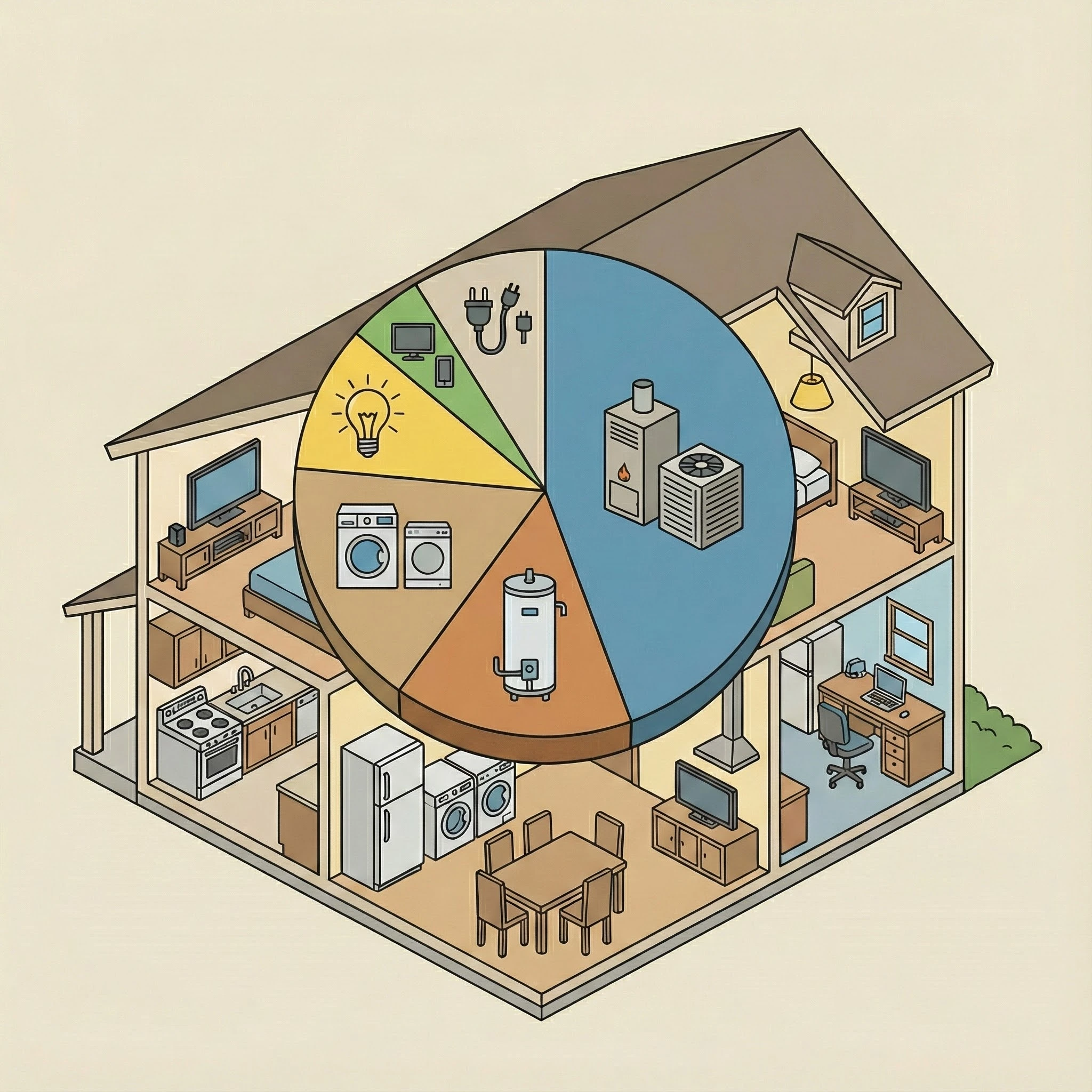
For homeowners looking for the fast answer before diving into the details, here is the breakdown of residential energy usage in the United States.
- The Big Number: The average U.S. home uses about 10,791 kilowatt-hours (kWh) of electricity per year.1
- Monthly Average: This works out to roughly 899 kWh per month.2
- Daily Average: Expect to use about 30 kWh per day.3
- Instant Power (The "Load"): At any given moment, the average house pulls about 1,200 watts (1.2 kW) of power continuously.4
- The Peak Surge: During busy times (like cooking dinner while the AC is running), power usage can spike to 10,000 watts (10 kW) or more.4
Top 5 Energy Hogs in the Home:
- HVAC (Heating & Cooling): 35-50% of the total bill.5
- Water Heater: 12-18% of usage.5
- Washer & Dryer: High power usage for short bursts.4
- Lighting: 10% (though dropping fast with LEDs).6
- Refrigeration: Runs 24/7, eating up steady power.3
Why Geography Matters:
A home in Louisiana might use 14,774 kWh a year because of air conditioning, while a home in Hawaii might use only 6,036 kWh because of the mild climate and high energy costs.2
---
1. Introduction: Unlocking the Mystery of Home Energy
Understanding how much energy a house uses is the first step toward lower bills, energy independence, and a successful solar installation. For many homeowners, the electricity bill is just a monthly mystery—a number that goes up in the summer and down in the spring. But inside that number lies a complex story of habits, appliances, weather, and technology.
The question "how many watts does a house use" actually has two answers. One answer is about the total amount of electricity consumed over a month or a year. The other answer is about power, or how much electricity is needed at a single specific moment to keep everything running. Confusing these two concepts is the most common mistake people make when buying solar panels or backup batteries.
This report explores every corner of residential energy usage. It breaks down the difference between a "kilowatt" and a "kilowatt-hour," explores which appliances are secretly driving up costs, and looks at how location changes everything. By the end, the distinction between "energy" and "power" will be clear, providing the tools needed to size a solar system correctly or simply trim a few dollars off the monthly budget.
---
2. The Language of Power: Watts vs. Kilowatt-Hours
Before looking at the data, one must speak the language. The world of electricity uses specific terms that sound similar but mean very different things. The two most important terms for a homeowner are the Kilowatt (kW) and the Kilowatt-hour (kWh).
2.1 The Speed vs. Distance Analogy
The easiest way to understand electricity is to compare it to driving a car.
- Kilowatts (kW) are like Speed (MPH):
Imagine a car's speedometer. It tells the driver how fast the car is moving right now. In a house, Kilowatts measure how much electrical "pressure" is being used right now. If a homeowner turns on the microwave, the "speed" (kW) goes up. If they turn it off, the "speed" (kW) goes down. This is called Power.7 - Kilowatt-hours (kWh) are like Distance (Miles):
The odometer in a car tells the driver how far they have traveled. It doesn't matter if they drove fast or slow; it just measures the total distance covered. In a house, Kilowatt-hours measure the total amount of electricity "traveled" or used over time. This is what the electric company bills for at the end of the month. This is called Energy.9
Putting it together:
If a homeowner runs a big air conditioner that requires 4 kW of power (Speed) for 2 hours (Time), they have used 8 kWh of energy (Distance).
$$4 \text{ kW} \times 2 \text{ Hours} = 8 \text{ kWh}$$
2.2 Why the Difference Matters
This distinction is critical for solar and batteries.
- Solar panels are sold based on how much Energy (kWh) they can produce over a year to lower the bill.
- Batteries and Inverters must be sized based on Power (kW) to handle the "speed" of the house. If a house tries to go "too fast" (using too many appliances at once), it will crash the battery system, even if the battery has plenty of energy left in the tank.11
2.3 The Role of Amps and Volts
Sometimes, equipment labels list "Amps" instead of Watts. The relationship is simple math.
- Volts (V): The pressure pushing the electricity. In the US, most plugs are 120 Volts, and big appliance plugs (like for dryers) are 240 Volts.
- Amps (A): The amount of electricity flowing through the wire.
- Watts (W): The total work being done.
The formula is:
$$\text{Watts} = \text{Volts} \times \text{Amps}$$
For example, a standard phone charger might use 120 Volts and 0.5 Amps.
$$120 \times 0.5 = 60 \text{ Watts}$$
A large clothes dryer might use 240 Volts and 30 Amps.
$$240 \times 30 = 7,200 \text{ Watts (or 7.2 kW)}$$4
---
3. The National Average: Benchmarking the American Home
When asking "what is normal," the data points to a very specific figure. The U.S. Energy Information Administration (EIA) tracks millions of utility customers to find the average.
3.1 The Magic Number: 10,791 kWh
As of the most recent major reports, the average US residential utility customer uses 10,791 kWh per year.1 This number has remained relatively steady over the last few years, creeping up slowly as homeowners add more electronics, but also leveling off as appliances become more efficient.
Breaking it Down:
- Monthly: ~899 kWh
- Daily: ~30 kWh
- Hourly: ~1.2 kW
This means that if a generic "average" house was running on a steady generator, that generator would need to produce about 1,200 watts continuously, 24 hours a day, 365 days a year, to keep up.4
3.2 The Reality of "Average"
- 3:00 AM: The house is asleep. Only the fridge, router, and maybe a phone charger are running. Usage might drop to 400 watts (0.4 kW).
- 5:00 PM: Everyone comes home. The air conditioner kicks on. The oven is preheating. The TV is on. Usage spikes to 6,000 watts (6.0 kW).
This "Peak" usage is what strains the electrical grid and what determines if a solar battery system can actually run the house.14
---
4. Geography is Destiny: State-by-State Energy Profiles
The single biggest factor determining how many watts a house uses is not the size of the TV or the efficiency of the lightbulbs—it is the zip code. The United States spans multiple climate zones, from the tropical humidity of the Southeast to the frozen winters of the North.
4.1 The High-Usage South (The Cooling Belt)
States in the South consistently use the most electricity. The reason is simple: Air Conditioning. In states like Louisiana, Florida, and Mississippi, keeping a home cool and dehumidified is a survival necessity for much of the year. Additionally, many homes in the South use electric resistance heating for the short winter, which is less efficient than gas or heat pumps.
Top Consumers (Annual Average):
- Louisiana: 14,774 kWh
- Tennessee: 14,220 kWh
- Mississippi: 14,062 kWh
- Florida: 13,990 kWh
- Alabama: 13,810 kWh
In these states, the "average" house is much hungrier than the national average. A solar system designed for a home in Ohio would be woefully inadequate for a home in Louisiana.2
4.2 The Efficient West and Northeast
Surprisingly, some of the most populous states use the least amount of electricity per household. This is driven by three factors: mild weather, high electricity prices (which encourage conservation), and the use of natural gas or oil for heating instead of electricity.
Lowest Consumers (Annual Average):
- Hawaii: 6,036 kWh. Hawaii has the most expensive electricity in the nation (often over $0.40/kWh). Residents are extremely careful with usage, and the trade winds provide natural cooling.5
- California: ~6,000-7,000 kWh. California has strict building codes (Title 24) that require efficient windows and insulation. The coastal climate also reduces the need for AC in many areas.
- New York: ~6,800 kWh. While New York gets very cold, most heating is done with natural gas or heating oil. The electric bill only reflects lights and appliances, keeping the kWh number low.5
4.3 The Comparison Table
| State | Avg Monthly kWh | Avg Monthly Bill ($) | Why? |
|---|---|---|---|
| Louisiana | 1,232 | ~$142 | Hot, humid summers; electric heat. |
| Texas | 1,120 | ~$165 | Large homes; heavy AC usage. |
| Ohio | 857 | ~$143 | Moderate climate; gas heating common. |
| California | 540 | ~$185 | Mild climate; high efficiency; expensive rates. |
| Hawaii | 665 | ~$293 | Very expensive power forces conservation. |
| 3 |
---
5. The Great Energy Hogs: What Uses the Most Watts?
To manage energy, a homeowner must know where it is going. A home's energy profile is not a democracy; a few big appliances make up the majority of the "vote."
5.1 HVAC: The Heavyweight Champion
Heating, Ventilation, and Air Conditioning (HVAC) is responsible for 35% to 50% of the energy use in a typical US home.5 It is the engine that fights the weather.
-
Central Air Conditioning:
- Running Watts: 3,000 – 4,000 Watts.
- The "Kick": When an AC unit first turns on, it needs a massive surge of power to start the compressor. This can be 10,000 to 15,000 Watts for a split second. This is called "Locked Rotor Amps" (LRA).
- Cost: In a hot summer month, the AC alone can consume 500-800 kWh, costing $75-$150 just for cooling.4
-
Electric Space Heaters:
- Watts: 1,500 Watts (standard setting).
- The Trap: Space heaters look small, but they are energy gluttons. Running one space heater is roughly equivalent to running a large window AC unit. Running three of them draws more power than a central furnace.16
-
Furnace Fans:
- Even if a home heats with gas, electricity is needed to spin the blower fan that moves the air. This uses 400 to 800 Watts.17
5.2 Water Heating: The Silent Consumer
-
Electric Tank Water Heater:
- Watts: 4,500 Watts.
- Behavior: It cycles on and off all day to keep water hot. It is a "high power, intermittent" load.
-
Heat Pump Water Heater (Hybrid):
- Watts: ~500 Watts (in efficiency mode).
- Savings: These new units move heat from the air into the water rather than creating heat from scratch. They can cut water heating bills by 60-70%.18
5.3 The Laundry Room
-
Electric Clothes Dryer:
- Watts: 3,000 – 5,000 Watts.
- Impact: The dryer is one of the most power-hungry appliances per hour. Drying a load of clothes is like turning on 500 LED lightbulbs for an hour.
-
Washing Machine:
- Watts: 500 – 1,000 Watts. Most of the energy goes into the motor. If washing with cold water, the machine is very efficient. If washing with hot water, the water heater does the heavy lifting.4
5.4 The Kitchen
-
Refrigerator:
- Watts: 150 – 400 Watts.
- Why it matters: It never turns off. Even though the wattage is low, it runs 24/7/365. An old fridge from the 1990s can use 3x the energy of a modern Energy Star model.3
-
Electric Oven/Stove:
- Watts: 2,000 – 5,000 Watts.
- Impact: A major contributor to "peak demand" at dinnertime.4
-
Dishwasher:
- Watts: 1,200 – 1,500 Watts. Most of this power is used by the internal heater to dry the dishes. Skipping the "Heat Dry" cycle saves significant energy.17
---
6. The "Vampire" Load: Power That Never Sleeps
6.1 How Much Does it Add Up?
For the average home, vampire power accounts for 200 to 500 Watts of continuous usage.
- The Math: 300 Watts × 24 Hours = 7.2 kWh per day.
- Annual Impact: 7.2 kWh × 365 Days = 2,628 kWh per year.
- The Cost: At average electricity rates ($0.16/kWh), this wasted power costs over $400 a year.19
6.2 Common Culprits
- Cable Boxes/DVRs:
- Game Consoles:
- Smart Speakers & Wi-Fi:
---
7. Solar System Sizing: Matching Watts to Watts
7.1 The Sizing Formula
To size a solar system, one doesn't look at the size of the house (square footage); one looks at the electric bill (kWh history).
The Basic Formula:
$$\text{System Size (kW)} = \frac{\text{Annual kWh Usage}}{365 \text{ Days} \times \text{Sun Hours} \times \text{Efficiency Factor (0.82)}}$$
Let's break this down with an example.
- Scenario: A home in Arizona uses the national average of 11,000 kWh per year.
- Sun Hours: Arizona gets a lot of sun, roughly 5.5 peak sun hours per day.
- Math: $11,000 / (365 \times 5.5 \times 0.82) = 6.68$
- Result: This homeowner needs a 6.7 kW solar system (roughly 16-17 panels of 400 Watts each).20
Scenario 2: The Cloudy North
- Scenario: A home in Seattle uses the same 11,000 kWh.
- Sun Hours: Seattle gets fewer sun hours, averaging about 3.5 peak sun hours per day.
- Math: $11,000 / (365 \times 3.5 \times 0.82) = 10.5$
- Result: The Seattle homeowner needs a 10.5 kW solar system to get the same results. They need nearly double the panels to do the same job because the "fuel" (sunlight) is weaker.20
7.2 Inverter Sizing: The Funnel
The Ratio: Installers often put a smaller inverter on a larger array of panels. For example, a 6 kW inverter on a 7.5 kW array. Why? Panels rarely produce 100% of their rating. Dust, heat, and angles reduce output. A slightly smaller inverter runs more efficiently. This is called the "DC-to-AC Ratio." Clipping: On the rare perfect spring day when the panels do produce 7.5 kW, the inverter will limit (or "clip") the output to 6 kW. This small loss is usually worth the money saved on a smaller inverter.22
---
8. Battery Backup: The Challenge of Peak Power
8.1 The "Whole Home" Myth
The Limit: Most standard batteries can output roughly 5 kW continuous power. The Problem: If a homeowner tries to run the AC (4 kW), the electric oven (3 kW), and the hair dryer (1.5 kW) at the same time, the total load is 8.5 kW. The Result: The battery shuts down immediately to protect itself. It doesn't matter if the battery is 100% full; the pipe wasn't big enough for the flow.12
8.2 Dealing with the Surge (LRA)
Motors are tricky. When an AC compressor or a well pump tries to start, it needs a massive kick of power to get moving. This "Locked Rotor Amps" (LRA) surge can be 3 to 5 times the running wattage.
Running Watts: 3,500 W. Surge Watts: 12,000 W. If the battery inverter cannot handle a 12,000-watt split-second surge, the AC will not start, or the house will lose power. The Solution: A "Soft Starter." This is a device installed on the AC unit that ramps up the power slowly, reducing the surge by up to 70%, allowing batteries to run the AC safely.23
8.3 Critical Load Panels
Because running a whole house is expensive (requiring 3 or 4 batteries), most homeowners choose a "Critical Load" backup. They move only the essential circuits to a special sub-panel.
---
9. Room-by-Room Wattage Guide
9.1 The Living Room
- TV (55" LED): 60 - 100 Watts. New TVs are very efficient.
- TV (Plasma - Old): 300 - 500 Watts. Plasma TVs are heaters that also show movies. Replacing an old plasma can save noticeable money.
- Cable Box: 20 - 40 Watts (often 24/7).
- Ceiling Fan: 30 - 75 Watts. Very efficient way to feel cool without AC.17
9.2 The Home Office
- Laptop: 30 - 60 Watts (charging). 15 Watts (running).
- Desktop PC: 100 - 200 Watts.
- Gaming PC: 400 - 800 Watts. High-end graphics cards consume massive power.
- Wi‑Fi Router: 10 - 20 Watts.4
9.3 The Bathroom
- Hair Dryer: 1,500 - 1,800 Watts. It uses a lot of power, but only for 5 minutes, so the total energy (kWh) cost is low.
- Curling Iron: 150 Watts.
- Vent Fan: 20 - 50 Watts.4
9.4 The Garage / Exterior
- Garage Door Opener: 500 - 1,000 Watts (only while lifting).
- EV Charger (Level 1 – Standard Plug): 1,400 Watts. Adds roughly 4‑5 miles of range per hour.
- EV Charger (Level 2 – Dryer Plug): 7,200 Watts. Adds roughly 25‑30 miles of range per hour. This is a massive load, equal to running an entire second house.4
---
10. Future Trends: The Electrification of Everything
10.1 The Electric Vehicle (EV) Effect
Adding an electric car is the single biggest change a homeowner can make to their energy profile.
10.2 Heat Pumps Replacing Gas
10.3 Induction Cooking
Induction cooktops can draw 2,000 to 3,000 Watts per burner. They are extremely fast and efficient, putting energy directly into the pot, but they represent another high‑power electric load replacing a gas appliance.28
---
11. Practical Tips for Homeowners
11.1 The $20 Audit
How to use it: Plug the refrigerator or the old TV into the monitor, then plug the monitor into the wall. Leave it for 24 hours.
11.2 Understanding "Time of Use" (TOU)
The Trap: Electricity is cheap in the morning and expensive in the evening (4 PM – 9 PM). The Strategy: Do not run the dryer or dishwasher between 4 PM and 9 PM. A load of laundry at 5:00 PM might cost $1.50, while the same load at 9:00 PM might cost $0.75. Smart Thermostats: Use a Nest or Ecobee to "pre‑cool" the house. Run the AC hard until 3:30 PM, then let the temperature drift up during the expensive peak hours.29
11.3 Insulation is the Best Battery
Before buying a $10,000 battery, buy $1,000 of insulation.
---
12. Conclusion: Empowering the Homeowner
So, how many watts does the average house use? The technical answer is "about 1,200 watts continuous, with surges to 10,000 watts." The practical answer is "it depends on how you live."
The average American home is a machine that consumes nearly 11,000 kWh of energy a year. It is a machine dominated by the need to change temperature—heating air, cooling air, heating water, and refrigerating food. By understanding the difference between the "speed" of power (kW) and the "distance" of energy (kWh), homeowners can make smarter decisions.
Whether the goal is to size a solar array that wipes out the bill, choose a battery that won't fail during a blackout, or simply stop paying for "vampire" electronics that aren't being used, the power is literally in the homeowner's hands. The meter is running—now you know how to read it.
---
Appendix A: Appliance Wattage Cheat Sheet
For quick reference, here is a list of common household items and their typical power requirements.
| Appliance | Running Watts (Approx) | Surge Watts (Starting) | Notes |
|---|---|---|---|
| Central AC (3 Ton) | 3,500 W | 10,000+ W | The biggest load in summer. |
| Water Heater | 4,500 W | 4,500 W | Cycles on and off frequently. |
| Clothes Dryer | 3,000 – 5,000 W | 5,000 W | High energy use per hour. |
| Oven (Surface Burner) | 1,000 – 2,500 W | 2,500 W | Varies by setting (High/Low). |
| Dishwasher | 1,200 – 1,500 W | 1,500 W | Mostly for the heater. |
| Coffee Maker | 1,000 W | 1,000 W | Uses power only while brewing. |
| Refrigerator | 150 – 400 W | 1,200 W | Runs 24/7. |
| Gaming PC | 300 – 600 W | 600 W | Depends on graphics card load. |
| TV (55" LED) | 60 – 100 W | 100 W | Very efficient. |
| Laptop Charger | 50 W | 50 W | Uses less when battery is full. |
| LED Lightbulb | 9 – 15 W | 15 W | Replaces 60‑100 W old bulbs. |
| Ceiling Fan | 50 W | 50 W | Cheaper than AC. |
| EV Charger (L2) | 7,200 W | 7,200 W | The new heavy hitter. |
Works cited
- Electricity use in homes – U.S. Energy Information Administration (EIA), accessed December 10, 2025, https://www.eia.gov/energyexplained/use-of-energy/electricity-use-in-homes.php
- How much electricity does an American home use? – Frequently Asked Questions (FAQs) – U.S. Energy Information Administration (EIA), accessed December 10, 2025, https://www.eia.gov/tools/faqs/faq.php?id=97&t=3
- How Many kWh Does a House Use? – Constellation, accessed December 10, 2025, https://www.constellation.com/energy-101/energy-education/average-home-power-usage.html
- How Many Watts Does it Take to Run a House? | EnergySage, accessed December 10, 2025, https://www.energysage.com/electricity/house-watts/
- Average Energy Consumption per Household [2024 U.S Study] – EnergyBot, accessed December 10, 2025, https://www.energybot.com/blog/average-energy-consumption.html
- What is the Average kWh Per Day in American Households? – Agway Energy Services, accessed December 10, 2025, https://www.agwayenergy.com/blog/average-kwh-per-day/
- accessed December 10, 2025, https://odoo.renucompany.com/blog/resources-1/understanding-your-proposal-kw-vs-kwh-8#:~:text=It's%20helpful%20to%20think%20of,be%20traveled%20in%20an%20hour.
- Understanding kW and kWh: Solar Energy Basics for Alberta Homeowners, accessed December 10, 2025, https://solaryyc.ca/understanding-kw-and-kwh-solar-energy-basics-for-alberta-homeowners/
- kW vs. kWh: Do You Know the Difference? (It's not hard) – BLUETTI, accessed December 10, 2025, https://www.bluettipower.com/blogs/news/kw-vs-kwh
- UNDERSTANDING YOUR PROPOSAL: kW vs. kWh – ReNu‑Solar, accessed December 10, 2025, https://odoo.renucompany.com/blog/resources-1/understanding-your-proposal-kw-vs-kwh-8
- Myth vs Reality: kW vs kWh and Why It Matters for Homes – Anern Store, accessed December 10, 2025, https://www.anernstore.com/blogs/diy-solar-guides/kw-vs-kwh-homes
- How to translate peak watts to battery and inverter size safely – Anern Store, accessed December 10, 2025, https://www.anernstore.com/blogs/portable-solar-power/peak-watts-battery-inverter-sizing
- Residential Electrical Service Amps: Unlock 200‑Amp Safety, accessed December 10, 2025, https://sartellelectrical.com/residential-electrical-service-amps-complete-guide/
- Daily energy demand curve | energymag, accessed December 10, 2025, https://energymag.net/daily-energy-demand-curve/
- How Much Electricity Does The Average House Use? 2025 Guide – SolarTech, accessed December 10, 2025, https://solartechonline.com/blog/how-much-electricity-does-average-house-use/
- How Much Electricity Your Household Items Use (14 Common Items) (2025) – EcoWatch, accessed December 10, 2025, https://www.ecowatch.com/electricity/how-many-kwh-does-a-house-use
- Usage Chart: How Many Watts Do You Need? – DonRowe.com, accessed December 10, 2025, https://www.donrowe.com/usage-chart-a/259.htm
- A Comprehensive Survey of Electrical Panel Capacities in US Single‑Family Homes and Implications for Nationwide Electrification – ACEEE, accessed December 10, 2025, https://www.aceee.org/sites/default/files/proceedings/ssb24/pdfs/A%20Comprehensive%20Survey%20of%20Electrical%20Panel%20Capacities%20in%20U.S.%20Single‑Family%20Homes%20and%20Implications%20for%20Nationwide%20Electrification.pdf
- How Much kWh Does a House Use per Day? – EcoFlow, accessed December 10, 2025, https://www.ecoflow.com/us/blog/how-much-kwh-does-an-average-house-use
- Sizing Your System – Solaris‑shop.com, accessed December 10, 2025, https://www.solaris-shop.com/sizing-your-system/
- How to size a PV system from an electricity bill – Aurora Solar, accessed December 10, 2025, https://aurorasolar.com/blog/how-to-size-a-pv-system-from-an-electricity-bill/
- How to Match Solar Panel Inverter Size to Your System Output – EcoFlow, accessed December 10, 2025, https://www.ecoflow.com/us/blog/solar-inverter-sizing-choosing-guide
- Whole house battery for peak demand : r/SolarDIY – Reddit, accessed December 10, 2025, https://www.reddit.com/r/SolarDIY/comments/1n1t9ia/whole_house_battery_for_peak_demand/
- Inverter Basics and Selecting the Right Model – NAZ Solar Electric, accessed December 10, 2025, https://www.solar‑electric.com/learning‑center/inverter‑basics‑selection.html/
- How to Size Your Home Battery Backup – EcoFlow, accessed December 10, 2025, https://www.ecoflow.com/us/blog/size-home-battery-backup-guide
- Appliance Energy Use Chart – Silicon Valley Power, accessed December 10, 2025, https://www.siliconvalleypower.com/residents/save-energy/appliance-energy-use-chart
- Average Household Power Consumption: Complete 2025 Guide & Stats – SolarTech, accessed December 10, 2025, https://solartechonline.com/blog/average-household-power-consumption-guide-2025/
- Appliance Wattage Chart: What Size of Jackery Do I Need? – Jackery, accessed December 10, 2025, https://www.jackery.com/blogs/knowledge/appliance-wattage-chart
- Shave the Peak End‑of‑Summer Trends – Consumers for Climate, accessed December 10, 2025, https://blog.greenenergyconsumers.org/blog/shave-the-peak-end-of-summer-data-trends
- What is Residential Demand? – Incorporated County of Los Alamos, NM, accessed December 10, 2025, https://www.losalamosnm.us/Services/Public-Utilities/Rates-and-Fees/Time-of-Use-and-Residential-Demand/What-is-Residential-Demand