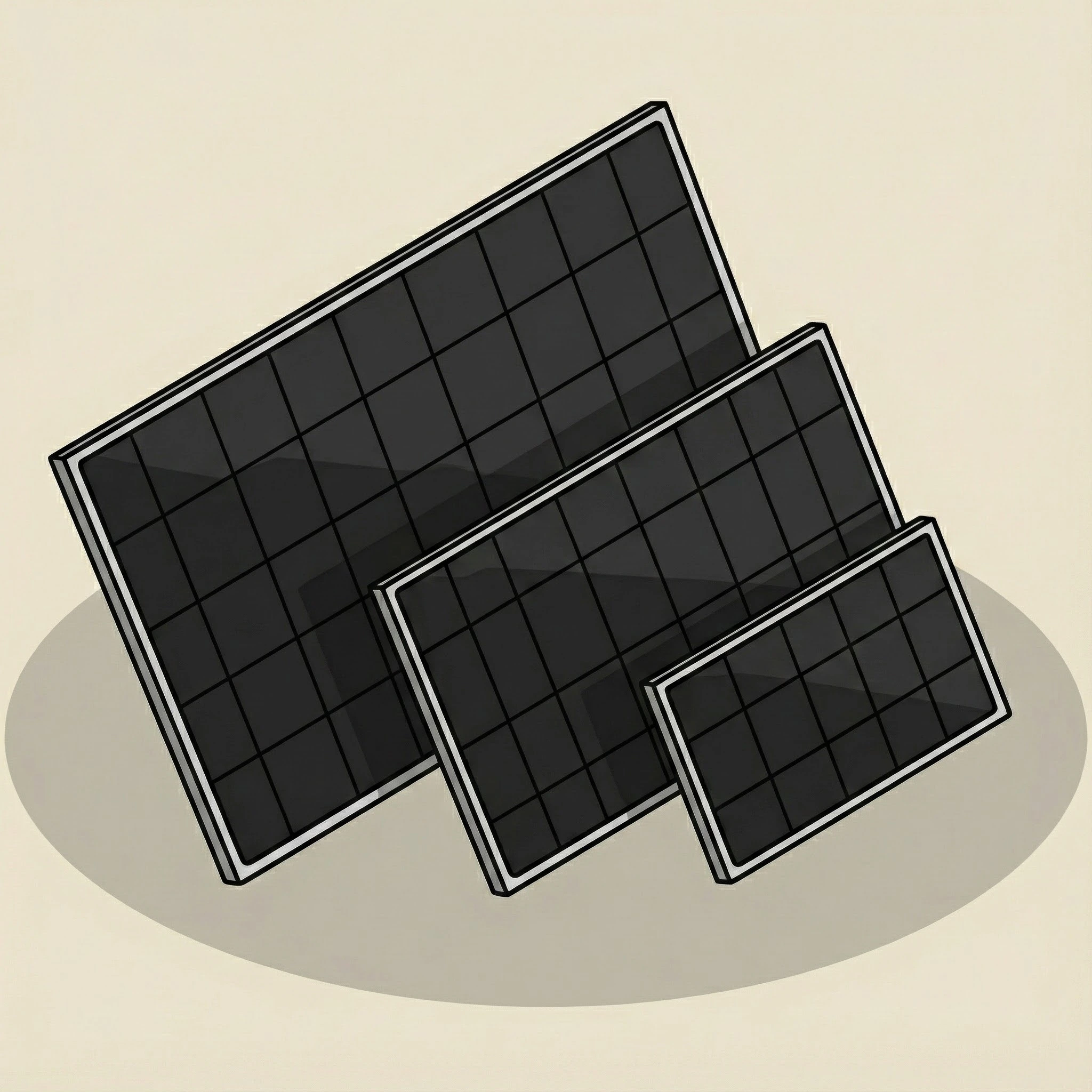
When most people decide to go solar, they usually start with a single number in mind: Watts. You might have heard your neighbor bragging about their "400-watt panels" or seen an ad for a "high-output" system. It is natural to think that power is the only thing that matters. After all, you are buying electricity, so why wouldn't you just want the most powerful panel you can buy?
However, there is a catch that often trips up excited homeowners. Your roof is not an infinite blank canvas. It is a complex landscape of ridges, valleys, plumbing vents, chimneys, skylights, and mandatory fire safety pathways. You can buy the most powerful, high‑tech solar panel on the market, but if it is three inches too wide to fit two rows on your sunniest roof slope, you might actually end up with less total energy than if you had chosen a slightly smaller, less powerful panel.1
In 2025, the solar industry is going through a bit of a growth spurt. Solar panels are physically getting larger, heavier, and more varied in shape than ever before. The "standard" size that installers used for twenty years is slowly disappearing, replaced by new, wider formats designed to squeeze every last drop of energy out of the sun.2
This guide is written for you—the homeowner. We are going to skip the dry textbook definitions and talk straight about what these sizes mean for your house, your wallet, and your roof’s structural health. We will look at why panels are growing, how much weight your roof can actually handle, and which brands offer the best fit for the unique puzzle that is your roof.
---
TLDR: The Quick Summary for Busy Homeowners
If you don’t have time to read the full deep dive right now, here is the "Too Long; Didn't Read" cheat sheet. These are the critical numbers you need to know when looking at quotes in 2025.
The Main Takeaways:
- The New "Normal" Size: The classic small panel is fading away. The new standard for residential solar (often called "108‑cell" or "54‑cell") is roughly 67 to 68 inches tall and 44 to 45 inches wide.4
- Average Weight: Expect each panel to weigh between 40 and 50 pounds. This sounds heavy, but once distributed across your roof, it is usually very safe.6
- Roof Safety: Solar panels typically add about 3 to 4 pounds per square foot to your roof. Most homes built after 1970 are designed to handle much more than this (usually 20+ pounds per square foot for snow and workers), so structural reinforcement is rarely needed unless your roof is very old or damaged.8
- Commercial vs. Residential: Be careful if an installer quotes you "72‑cell" or "144‑cell" panels. These are "commercial" sized panels. They are very tall (often 78+ inches) and can be awkward to fit on complicated residential roofs. They are great for big, open barns, but tricky for a suburban home with dormers.10
- The Trend: Panels are getting wider. Older panels were about 39 inches wide; new ones are pushing 45 inches. This creates more power but changes the math on how many can fit on your roof.5
Quick Reference: Solar Panel Sizes at a Glance
| Panel Type | Approx. Dimensions (Inches) | Approx. Weight (lbs) | Best Use Case |
|---|---|---|---|
| Standard Residential (Modern) | ~67" x 44" | 45 – 50 lbs | Most standard home roofs in 2025. |
| Compact / Legacy | ~65" x 39" | 40 – 42 lbs | Small roofs, complex layouts, dormers. |
| Commercial / Large Format | ~78‑90" x 40‑45" | 50 – 65+ lbs | Ground mounts, large flat roofs, barns. |
---
Part 1: The Anatomy of a Solar Panel (Why Are They This Size?)
To understand why solar panels are the size they are, we have to look under the hood—or rather, under the glass. A solar panel isn't just one giant sheet of material. It is actually a frame holding together a grid of smaller squares called "solar cells." The size of the panel is directly determined by how many of these cells are used and how big each cell is.
The Building Blocks: Silicon Wafers
For a very long time—basically the entire 2000s and 2010s—solar panels were built using silicon squares that were roughly 6 inches by 6 inches (156 mm). This was the industry standard. Manufacturers would take 60 of these squares, solder them together in a grid (6 cells wide by 10 cells tall), and frame them up.
This created the legendary "60‑cell panel."
- Width: 6 cells × ~6 inches = ~39 inches wide (roughly 1 meter).
- Height: 10 cells × ~6 inches = ~65 inches tall (roughly 1.6 meters).
This size became the "Goldilocks" form factor for residential solar.6
The "Wafer Wars": Why Panels Are Getting Wider
Around 2020, solar manufacturers hit a wall. They squeezed as much efficiency as they could out of those standard 6‑inch cells. To get more power (to reach 400 watts and beyond), they decided they needed more surface area. They needed bigger cells.
This started what insiders call the "Wafer Wars." Manufacturers began cutting larger squares of silicon.
- M6 Wafers: 166 mm (a little bigger).
- M10 Wafers: 182 mm (the current residential favorite).
- G12 Wafers: 210 mm (massive, mostly for utility farms).
When you use wider cells, the panel must get wider. You can't cheat geometry. This is why if you look at a quote for a modern 2025 panel (like a Qcells Q.TRON or a Canadian Solar HiKu6), you will notice the width has jumped from 39 inches to roughly 44 or 45 inches.3
The Shift to "Half‑Cut" Cells
If you look closely at a modern solar panel, it often looks like the cells are split down the middle. That is because they are! This is called Half‑Cut Cell Technology.
Engineers discovered that if you take a full square cell and cut it in half with a laser, it actually performs better.
- Less Resistance: Electricity flows more easily through smaller pieces.
- Less Heat: The panel stays cooler, which keeps efficiency high.
- Shade Tolerance: If a leaf falls on the bottom half of the panel, the top half can keep working independently.
Confusing Terminology Alert:
Because of this technology, you will see spec sheets listed with weird numbers like "108 cells" or "120 cells" or "132 cells." Do not panic.
- A 120‑cell panel is just a classic 60‑cell panel with the cells cut in half. It is physically the same size.12
- A 108‑cell panel is just a 54‑cell panel with the cells cut in half.
Basically, if you see a high number like 108 or 120 or 144, just divide by two to get the "real" equivalent size category.
The Frame and Glass
The other two things that dictate size and weight are the exoskeleton of the panel.
- The Glass: This is the heavy part. Almost all panels use tempered safety glass, usually about 3.2 mm thick. It is designed to withstand hail, snow, and wind. In 2025, we are seeing more "Glass‑Glass" panels, which have a sheet of glass on the front and the back. These are incredibly durable but significantly heavier.13
- The Frame: This is usually anodized aluminum (often black for aesthetics). It holds the glass sandwich together and gives the installers something to bolt onto the roof. To save weight and cost, frames are getting thinner. A few years ago, frames were 40 mm thick. Now, 30 mm (1.18 inches) is the industry standard.4
---
Part 2: The Three Main Sizes of Solar Panels
When you are shopping for a home solar system in 2025, you are almost certainly going to be looking at one of three distinct size categories. Understanding the difference between these can help you understand why one quote might be cheaper than another, or why one installer says they can fit more power on your roof.
The Modern Residential Standard (108‑Cell / 54‑Cell)
This is the new heavyweight champion of the residential market. If you get a quote from a major installer in 2025, there is a very high chance it will be for this format. Brands like Qcells, Jinko, and Canadian Solar have moved almost exclusively to this size for homes.
- Physical Size: Roughly 67 to 68 inches tall by 44 to 45 inches wide.
- Wattage Range: Typically 400 W to 440 W.
- Weight: 45 to 50 lbs.
- Why It Is Popular: It hits the "sweet spot." It is short enough to handle easily and fit on most roofs, but wide enough to use the new high‑efficiency large wafers. It offers a great balance of power per square foot and installation ease.4
** The Legacy / Compact Format (120‑Cell / 60‑Cell)**
This is the "classic" size we discussed earlier. While it is becoming less common as manufacturers chase higher wattage, some premium brands (like REC or Maxeon/SunPower) still make panels that stick close to these dimensions because they are so easy to work with.
- Physical Size: Roughly 65 to 66 inches tall by 39 to 40 inches wide.
- Wattage Range: Typically 360 W to 420 W.
- Weight: 40 to 44 lbs.
- Why You Might Want It: If you have a very tricky roof with lots of dormers, skylights, or hips (triangular sections), these smaller panels are easier to "play Tetris" with. You can often squeeze them into tight corners where the wider 108‑cell panels just won't fit.15
The Commercial Giant (144‑Cell / 72‑Cell)
You will often see these advertised as "Commercial" panels, but some installers will use them on homes to lower the cost per watt. They are essentially taller versions of the residential panels.
- Physical Size: Roughly 78 to 90 inches tall by 40 to 45 inches wide.
- Wattage Range: Typically 500 W to 600 W+.
- Weight: 55 to 70 lbs.
- The Pros: You need fewer panels to hit your energy goal. Fewer panels mean fewer rail attachments and less wiring labor.
- The Cons: They are huge. A 7.5‑foot tall panel is very difficult to fit on a standard residential roof. They can look overwhelming and aesthetically displeasing. Also, carrying a 60‑pound, 7‑foot sheet of glass up a ladder is tough work, and some residential crews may charge extra for the difficulty.6
---
Part 3: Will My Roof Collapse? (Weight and Structure)
This is the number one fear we hear from homeowners. You are paying someone to bolt thousands of pounds of glass and metal onto the thing that protects your family from the rain. It is a reasonable thing to worry about!
However, the good news is that for 99% of homes, the weight of solar panels is negligible compared to what the roof was built to handle.
Understanding "Dead Load" vs. "Live Load"
Engineers divide weight on a roof into two categories:
- Dead Load: This is the weight of things that are permanently attached to the house. This includes the wood framing, the plywood decking, the shingles, and yes, the solar panels.
- Live Load: This is temporary weight. This includes snow, rain, wind pressure, and the weight of workers walking on the roof.17
The Math of Solar Weight
Let’s do the math. A typical solar panel weighs about 45 pounds and covers about 20 square feet.
- 45 lbs ÷ 20 sq ft = 2.25 pounds per square foot (PSF).
When you add in the mounting rails, the clamps, and the wiring, the total added weight of a solar system is generally between 3 and 4 PSF.8
Is Your Roof Strong Enough?
Most residential roofs in the US are built to withstand a combined load of at least 20 PSF just for "Live Loads" (like workers). In snowy areas, that requirement can jump to 50, 60, or even 100 PSF to handle heavy snow accumulation. When you compare the solar load (3 PSF) to the capacity of the roof (20‑100+ PSF), you can see that solar is a very small fraction of the total strength. It is roughly equivalent to adding a second layer of asphalt shingles to your roof—something roofers do all the time without needing structural reinforcement.9
When Should You Worry?
While most roofs are fine, there are exceptions where you should absolutely have a structural engineer take a look:
- Very Old Homes: If your home was built before the 1970s (and especially before the 1950s), the rafters might be made of smaller timber (like 2×4s) spaced far apart. These older structures might not meet modern code requirements even without solar.
- Truss Spacing: Standard rafters are spaced 16 or 24 inches apart. If yours are spaced wider (like 36 or 48 inches), the roof deck might sag under the weight of the panels over time.
- Visible Damage: If you have rot, termite damage, or sagging rooflines, do not install solar until that is fixed. Solar panels can actually protect a roof, but they cannot fix a broken one.17
The Real Enemy: Wind Uplift
Ironically, the biggest structural challenge for solar panels isn't gravity pulling them down; it is the wind trying to rip them up.
Solar panels act like sails. If wind gets underneath them during a storm, it creates a massive lifting force (uplift). This is why commercial panels (the big 72‑cell ones) can be risky on homes in hurricane zones like Florida. Their larger surface area catches more wind, putting massive stress on the mounting lag bolts. Smaller residential panels shed wind loads better and are generally safer in high‑wind areas.19
---
Part 4: Installation Logistics (The Human Element)
We often think about panels as just "specs on a page," but actual human beings have to lift, carry, and install them. The size and weight of the panels play a huge role in how smoothly your installation day goes—and sometimes, how much it costs.
The "One‑Person Lift" Rule
For decades, the standard 40‑pound panel was designed to be a "one‑person lift." A single installer could carry a panel up a ladder on their shoulder, maneuver it across the roof, and clamp it down. It was efficient and fast.
With the new generation of panels pushing 50+ pounds and getting wider, that dynamic is changing.
- Wider Arm Span: A panel that is 45 inches wide is much harder to grip comfortably under your arm than one that is 39 inches wide. The center of gravity is further away from the installer's body.
- Fatigue: Lifting 50 pounds once is fine. Lifting it 20 or 30 times in a row, while balancing on a sloped roof in the summer heat, is a recipe for fatigue.
- Safety: Many installation companies now mandate "two‑person lifts" for any panel over 50 pounds or above a certain size. This means two installers have to coordinate moving every single panel. This is safer, but it is slower. It might mean the crew spends an extra few hours on your roof, which is a hidden labor cost.10
**Shipping Logistics for DIYers
If you are one of the brave homeowners planning a DIY solar installation, pay very close attention to panel dimensions.
- Residential Panels (< 75 inches): These usually fit on a standard shipping pallet. They can be delivered by a regular freight truck with a liftgate. You can move the pallet around with a pallet jack.
- Commercial Panels (> 80 inches): These often require "oversized" shipping. They might come on extra‑long custom pallets that do not fit on a standard liftgate. You might need a forklift on site to unload them, or you might have to hand‑unload them from the back of a semi‑truck. It can be a logistical nightmare for a residential driveway.1
---
Part 5: Brand‑by‑Brand Size Comparison (2025 Market)
Let’s get specific. If you are getting quotes right now, you are likely seeing names like Qcells, REC, and Silfab. Here is how their physical sizes compare in the current market.
Qcells (The Market Leader)
Qcells has become the Toyota of the US solar market—reliable, affordable, and everywhere. Their focus for 2025 is squarely on the "Modern Standard" 108‑cell format.
- Popular Model: Q.TRON BLK M‑G2+ Series.
- The Size: 67.8" x 44.6" (1722 mm × 1134 mm).
- Weight: 46.7 lbs.
- The Vibe: This is the quintessential modern residential panel. It is wide (44.6 inches), sleek (all black), and hits a solid power output (425‑440 W). Note the frame is 30 mm thin, which helps keep the weight down despite the larger size.4
REC Solar (The Premium Efficiency Choice)
REC is famous for their "Alpha" series, which uses ultra‑efficient Heterojunction (HJT) cells. They have taken a unique approach to size.
- Popular Model: REC Alpha Pure‑RX.
- The Size: 68.0" x 47.4" (1728 mm × 1205 mm).
- Weight: 50.0 lbs.
- The Vibe: Look at that width—47.4 inches! These are some of the widest residential panels on the market. They do this to pack in maximum power (470 W) without making the panel too tall. If you have a roof that is short top‑to‑bottom but wide side‑to‑side, these are fantastic powerhouses. However, make sure your installer is comfortable handling that 50‑lb weight.14
Maxeon / SunPower (The Efficiency King)
Maxeon (formerly SunPower) has always marched to the beat of its own drum. Their "interdigitated back contact" (IBC) cells are the most efficient in the world.
- Popular Model: Maxeon 6 / Maxeon 7.
- The Size: ~70.4" x 40.8" (varies slightly by sub‑model).
- Weight: ~48 lbs.
- The Vibe: Notice the width is much narrower (40.8 inches) compared to REC or Qcells. Maxeon has stuck closer to the legacy width. This makes their panels slightly longer (taller) but narrower. This "slim fit" can be a lifesaver on narrow roof sections or tight spaces between dormers.21
Canadian Solar (The Value Hybrid)
Canadian Solar makes panels for both giant solar farms and suburban homes.
- Popular Model: HiKu6 (CS6R).
- The Size: 67.8" x 44.6".
- Weight: ~47 lbs.
- The Vibe: Virtually identical in size to the Qcells Q.TRON. This makes them a great "drop‑in" alternative if you are designing a system. They offer a great balance of cost and performance in the standard modern size.13
Silfab (The North American Option)
Silfab manufactures in the US and Canada and is popular for homeowners who want domestic products.
- Popular Model: Silfab Prime (SIL‑410).
- The Size: 73.4" x 40.5".
- Weight: 45.8 lbs.
- The Vibe: These are distinct. They are a "66‑cell" format. Notice they are significantly taller (73.4 inches) but narrow (40.5 inches). This long‑and‑lean shape is unique. It might fit perfectly on a roof where the squat Qcells panel is just a few inches too wide.24
---
Part 6: How to Measure Your Roof (Without a Ladder)
You do not need to climb onto your roof to figure out if solar will fit. (Please, stay off the ladder!) But doing some "napkin math" can help you understand what is possible before a salesperson arrives.
The "Fire Code" Setback Rules
This is the most common surprise for homeowners. You cannot pave your entire roof with solar panels. By law (International Fire Code), you must leave clear pathways for firefighters to walk on your roof in case of a fire.
- The Ridge Setback: You generally need 18 to 36 inches of clear space at the very peak of the roof to allow firefighters to cut smoke ventilation holes.
- The Side/Eave Setback: You often need 18 to 36 inches of clear walking space on the sides or bottom, depending on your local jurisdiction.
Real World Example:
Let’s say the sunny side of your roof is 15 feet tall (from gutter to peak).
- Subtract a 3‑foot setback at the top for fire safety.
- You now have 12 feet of usable vertical space.
Now, let’s look at panels:
- Option A (Residential Qcells): 68 inches = 5.6 feet. Two rows stacked vertically = 11.2 feet.
- Result: It Fits! You can have two rows of panels.
- Option B (Commercial 72‑cell): 85 inches = 7.1 feet. Two rows stacked vertically = 14.2 feet.
- Result: It Doesn't Fit. You would only be able to fit one row.
In this scenario, choosing the "smaller" residential panel allows you to install twice as many panels and generate way more energy, even though the individual panel is less powerful. This is why playing "Roof Tetris" with dimensions is so important.
Landscape vs. Portrait Orientation
Installers have two ways to mount panels:
- Portrait: The panels stand up tall (short edge at the bottom). This is the most common method because it uses less mounting rail and is cheaper to install.
- Landscape: The panels lay on their side (long edge at the bottom). This uses more rail and labor, but it is a great trick for fitting panels on roofs that are wide but short.
Pro Tip: If an installer tells you they can't fit enough solar on your roof, ask if they tried a "Landscape Design." Sometimes, simply rotating the panels 90° unlocks enough space for 3‑4 extra panels!
---
Part 7: Aesthetics – The "All‑Black" Look
In the United States, we care about curb appeal. Unlike in Europe or Australia where silver‑framed panels with white backsheets are common, US homeowners overwhelmingly prefer the "All‑Black" aesthetic.
- What is it? An all‑black panel has black solar cells, a black plastic backsheet (instead of white), and a black anodized aluminum frame.
- Why does it matter for size? Because homeowners want their solar array to look like a single, unified block of glass. This drives installers to use panels that are all the same size and shape. You generally cannot mix‑and‑match sizes on the same roof plane. Mixing a 60‑cell panel with a 72‑cell panel looks messy, like a bad jigsaw puzzle, and creates wiring headaches.
- The "Gap" Issue: Because panels are getting wider, the gaps between them (where the clamps go) can become more visible. High‑end installers will use "skirt" accessories to hide the mounting hardware and gaps, making the wider array look seamless.
- Efficiency Trade‑off: Physics tells us that black absorbs heat. Hot solar panels are slightly less efficient. An all‑black panel might run 1‑2% less efficient than a panel with a white backsheet because it gets hotter. Most homeowners are happy to trade that 1% of power for a system that looks sleek and beautiful on their home.16
---
Part 8: Future Trends – What’s Coming Next?
If you are planning a system for late 2025 or beyond, here is what is happening on the cutting edge of solar technology.
**N‑Type TOPCon and HJT: Power Without Growth
The industry is currently shifting from "P‑Type" silicon (the old standard) to "N‑Type" silicon (TOPCon and HJT technology).
- What it means for you: N‑Type cells are significantly more efficient. This means manufacturers can squeeze 20 to 30 more watts out of the same size panel.
- The Size Impact: This is great news! It means panels might stop getting bigger. We have likely reached "Peak Size" for residential solar (around 22 square feet) because humans simply cannot lift anything bigger safely. Future power gains will come from better tech, not bigger glass.3
Bifacial Everywhere
"Bifacial" panels can absorb light from the front and the back. Originally designed for ground mounts (where light reflects off the snow/grass behind the panel), they are now appearing on residential roofs.
- Why on a roof? Even though the back of the panel is facing a dark roof deck, bifacial panels are often built with Glass on the Front AND Back. This makes them incredibly durable. They don't crack as easily as panels with plastic backsheets, and they are practically hail‑proof.
- The Weight Cost: Replacing the plastic backsheet with a second pane of glass adds weight. Expect these premium durable panels to weigh 50+ pounds, pushing the limits of what is easy to install.13
Perovskites: The Wild Card
Scientists are working on a new material called Perovskites that can be printed like ink. In the future, "solar panels" might not be rigid glass rectangles at all. They could be flexible sheets glued to your roof or integrated directly into shingles.
- Timeline: While there is a lot of hype, stable commercial Perovskite panels are still a few years away from dominating the residential market. For 2025, rigid silicon glass panels are still the king.2
---
Conclusion: How to Choose the Right Size
When you are sitting at your kitchen table with three different solar quotes in front of you, the numbers can get dizzying. One quote has 400 W panels, one has 425 W panels, and one has 450 W panels. How do you choose?
- Don't Obsess Over "Watts Per Panel": A system with twenty 400‑W panels produces the exact same energy as a system with sixteen 500‑W panels (both are 8,000 W total). The total system size matters more than the individual panel size.
- Trust the Design: If a reputable installer recommends a smaller, lower‑wattage panel, ask them why. It is likely because that specific size fits your roof geometry better. Two rows of smaller panels beats one row of big panels every time.
- Check the Weight: If you have an older home, ask if the installer has included a structural review. It is a small price to pay for peace of mind.
- Standard is Safe: Sticking to the "Modern Standard" size (108‑cell / ~67" × 44") is a safe bet. Because it is the most common size, finding replacement parts in 10 or 15 years will be much easier than if you choose a weird, niche sized panel.
Solar is a long‑term investment. These panels are going to be sitting on your roof for 25 to 30 years. By understanding the physical reality of these products—their bulk, their weight, and their dimensions—you can make sure your solar system is not just powerful, but a perfect fit for your home.
---
Deep Dive Appendix: Detailed Specs for the Data‑Hungry
For those who want to compare the exact numbers, here is a breakdown of the leading residential panels available in 2025.
Comparison of Top Residential Panels (2025 Data)
| Brand | Model | Format | Length (in) | Width (in) | Weight (lbs) | Efficiency |
|---|---|---|---|---|---|---|
| Qcells | Q.TRON BLK M‑G2+ | 108 Half‑Cell | 67.8 | 44.6 | 46.7 | ~22.5% |
| REC | Alpha Pure‑RX | 88 Half‑Cell | 68.0 | 47.4 | 50.0 | ~22.6% |
| Maxeon | Maxeon 7 | 112 Cell | 70.4 | 40.8 | 48.0 | ~24.1% |
| Canadian Solar | HiKu6 (CS6R) | 108 Half‑Cell | 67.8 | 44.6 | 47.0 | ~21.5% |
| Silfab | Prime SIL‑410 | 66 Half‑Cell | 73.4 | 40.5 | 45.8 | ~21.0% |
| Generic Commercial | 144 Half‑Cell | 144 Half‑Cell | ~89.0 | ~44.0 | ~65.0 | ~21‑23% |
(Note: Dimensions are approximate and can vary by ± 0.5 inches depending on frame variance. Always check the specific datasheet from your installer.)
Disclaimer: This article provides general market information for educational purposes. Always consult with a licensed professional engineer or certified solar installer to verify structural calculations and code compliance for your specific home.
Works cited
- Are Higher Wattage Solar Panels Better?, accessed December 10, 2025, https://odoo.renucompany.com/blog/resources-1/are-higher-wattage-solar-panels-better-87
- 7 New Solar Panel Technology Trends for 2026 – GreenLancer, accessed December 10, 2025, https://www.greenlancer.com/post/solar-panel-technology-trends
- Solar Panel Technology Trends for 2025: What's New, What's Next, and Why It Matters, accessed December 10, 2025, https://electnology.com/solar-panel-technology-trends-for-2025-whats-new-whats-next-and-why-it-matters/
- Q.TRON BLK M‑G2+/AC – Qcells, accessed December 10, 2025, https://us.qcells.com/q-tron-blk-m-g2-ac/
- We Analyzed 100 Solar Panels: Dimensions, Efficiency, & Load, accessed December 10, 2025, https://www.solarinsure.com/solar-panel-dimensions-efficiency
- Complete Guide to Solar Panel Size – SolarReviews, accessed December 10, 2025, https://www.solarreviews.com/blog/complete-guide-to-solar-panel-size
- How Big Are Solar Panels? Solar Panel Size and Weight – EnergySage, accessed December 10, 2025, https://www.energysage.com/solar/average-solar-panel-size-weight/
- accessed December 10, 2025, https://wolfriverelectric.com/faq-items/how-much-weight-do-solar-panels-add-to-a-roof/
- How Much do Solar Panels Weigh? – Greentech Renewables, accessed December 10, 2025, https://www.greentechrenewables.com/article/how-much-do-solar-panels-weigh/
- 60 Cell vs. 72 Cell Solar Panels: Which is Right For You? | EnergySage, accessed December 10, 2025, https://www.energysage.com/solar/solar-photovoltaic-cells/60-vs-72-cell-solar-panels-which-is-right/
- How the Number of Cells in Solar Panels Affects Efficiency-News – Neexgent, accessed December 10, 2025, https://www.neexgent.com/article/how-the-number-of-cells-in-solar-panels-affects-efficiency.html
- What Are the Standard Sizes of Solar Panels? | NC SOLAR NOW, accessed December 10, 2025, https://ncsolarnow.com/blog/what-are-the-standard-sizes-of-solar-panels/
- CS-Datasheet-TOPBiHiKu6 (TOPCon)_CS6.2-66TB_Bifacial – CSI Solar, accessed December 10, 2025, https://static.csisolar.com/wp-content/uploads/sites/2/2025/01/24183245/CS-Datasheet-TOPBiHiKu6_CS6.2-66TB_v1.4C2_AU_BNPI-635-640W.pdf
- REC Alpha Pure‑RX Review – NRG Clean Power, accessed December 10, 2025, https://nrgcleanpower.com/learning-center/rec-alpha-pure-rx-review/
- Solar Panel Size & Dimensions Guide 2025 | Complete Specs – SolarTech, accessed December 10, 2025, https://solartechonline.com/blog/solar-panel-size-dimensions-guide/
- What's the Difference Between 60 Cell and 72 Cell Solar Panels? – Maine Energy Experts, accessed December 10, 2025, https://maineenergyexperts.com/difference-between-60-cell-and-72-cell-solar-panels/
- Understanding Roof Load Capacity for Solar Panels | KPost Company, accessed December 10, 2025, https://kpostcompany.com/understanding-roof-load-capacity-for-solar-panels/
- How Much Do Solar Panels Weigh? – Average Solar Panel Weight – Solar Melon, accessed December 10, 2025, https://www.solarmelon.com/faqs/how-much-do-solar-panels-weigh/
- The Innovative N‑Type Solar Module, Powered by Q.ANTUM NEO Technology – Qcells, accessed December 10, 2025, https://us.qcells.com/q-tron-blk-m-g2/
- REC Solar REC460AA‑PURE‑RX Alpha Series 460 Watt Module, accessed December 10, 2025, https://www.solar-electric.com/rec-solar-rec460aa-pure-rx-alpha-series-460-watt-module.html
- SunPower Maxeon 7 475W solar panel review – Federation of Master Builders, accessed December 10, 2025, https://www.fmb.org.uk/homepicks/solar-panels/sunpower-solar-panels-review/
- SunPower Maxeon 7 – Clean Energy Reviews, accessed December 10, 2025, https://clean-energy-reviews.squarespace.com/s/Sunpower_maxeon_7_112c_PT_435-445_res_dc_en_a4_551184A_v2.pdf
- Canadian Solar CS6.2‑66TB‑615 – Best price – SolarTraders, accessed December 10, 2025, https://www.solartraders.com/en/products/modules/canadian-solar-cs6-2-66tb-615-bif-dg
- Silfab Solar – Search results :: PLATT ELECTRIC SUPPLY, accessed December 10, 2025, https://www.platt.com/s/products?mfr=qms9o4
- Silfab Solar Prime NTC Series SIL‑430‑QD 430Watt 108 1/2 Cells Black Backsheet Monocrystalline 35mm Black Frame Solar Panel – Solarflexion, accessed December 10, 2025, https://www.solarflexion.com/product-p/sil-430-qd.htm
- Top Solar Panel Technologies in 2025: What's Powering the Future of Clean Energy?, accessed December 10, 2025, https://ea-global.us/top-solar-panel-technologies/
- The Best Solar Panels You Can Buy In 2025, According To The Experts – SlashGear, accessed December 10, 2025, https://www.slashgear.com/1998591/best-solar-panels-can-buy-according-to-experts/