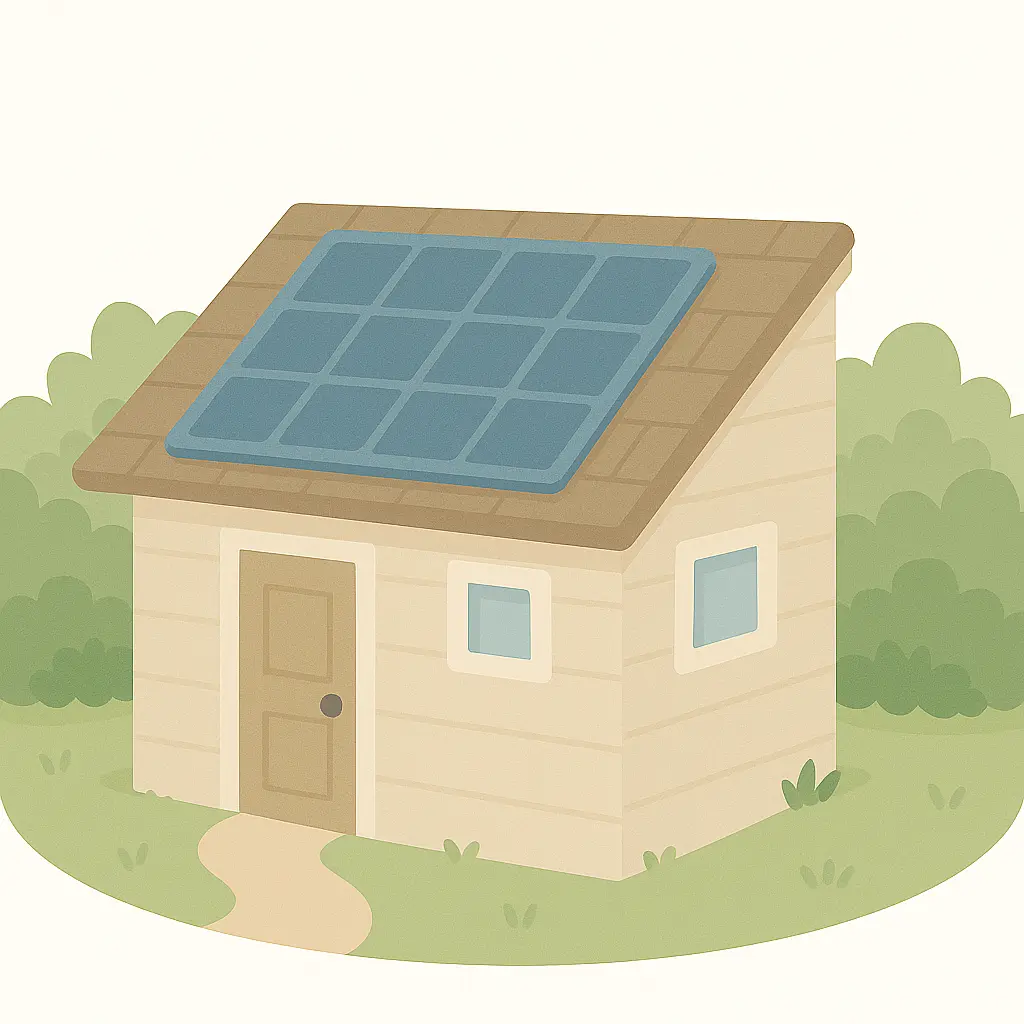
A backyard shed, once a simple structure for storage, is increasingly being transformed into a high-function space: a detached home office, a creator's workshop, a charging hub for electric tools, or a quiet studio. Powering this transformation, however, presents a significant hurdle. This guide provides a comprehensive, expert-level analysis for the DIY-focused consumer interested in using off-grid solar to power a shed, from initial motivations and system sizing to component selection and safe installation.
New Motivations for Powering Your Shed
The growing interest in shed solar is driven by a convergence of economic, practical, and personal factors.
The Primary Driver
For most, the primary motivation for shed solar is not environmentalism, but economics and convenience.1 The alternative—running grid power—is often prohibitively expensive and complex.
Hiring an electrician to dig a trench, lay conduit, pull heavy-gauge wire over a long distance, and install a dedicated sub-panel can cost thousands of dollars.2 The cost increases with every foot the shed is from the main house, as longer distances require more materials and labor.2
In this context, an off-grid solar system is not an added expense but a cheaper alternative.1 A small-to-medium-sized DIY solar setup can often be acquired for a fraction of the cost of trenching.3 Furthermore, many shed solar systems are based on Extra-Low Voltage (ELV) DC architectures (such as $12 \text{V}$, $24 \text{V}$, or $48 \text{V}$). In many jurisdictions, this type of wiring does not require a licensed electrician ("sparky"), representing a significant additional cost saving for the DIYer.4
The Shed as a Modern Extension of the Home
Once powered, the "dark, damp storage space" is fundamentally redefined, becoming a "haven for work, creativity, and relaxation".1 This newfound power unlocks several modern use cases:
- The Home Office/Studio: The pandemic and the rise of remote work have made quiet, detached workspaces highly desirable.5 A solar-powered shed can reliably run computers, monitors, printers, a coffee machine, and crucial internet/Wi-Fi relays.4 A system for this use is typically estimated to require $3000 \text{W}$ to $4000 \text{W}$.6
- The Workshop: This is the most power-intensive application, demanding a system that can handle the high-surge loads of power tools. A robust solar setup can power table saws, miter saws, drills, and orbital sanders.6 Sizing for a workshop often necessitates a $4000 \text{W}$ to $5000 \text{W}$ system.6
- The Gardener's Hub & Charging Station: A powered shed becomes a centralized and secure charging station for a growing fleet of battery-powered lawn equipment, from mowers to hedge trimmers and weed cutters.6
- The Utility & Security Outpost: Even a small solar setup can power essential, low-draw devices like automatic gates, security cameras, and security lights, enhancing a property's utility and safety.4
The Ultimate Sandbox: The Shed as a DIY Solar "Learning Lab"
A crucial, often-overlooked motivation is the shed's role as a low-stakes "sandbox." A homeowner might be understandably intimidated by the cost and complexity of a 6kW solar install on their primary house.4 A 1.2kW system for a shed, however, feels far more achievable.4
For the individual "serious about DIY solar," the shed is the perfect environment to "build, expand, and master" a system on a budget.3 It provides a practical, hands-on education in sourcing components, designing for efficiency, and avoiding "common (and expensive) mistakes".3 This "homestead extra power solution" serves as a working proof-of-concept, building the skills and confidence needed for larger future projects.3
Sizing Your System
A common mistake is to buy components first. A successful off-grid system is sized based on a cascade of dependencies. You must "assess your energy needs" before you can select a single panel or battery.11
Conduct Energy Audit
Your first and most critical task is to create a power budget. This involves listing every single device you plan to power in your shed.11
For each device, you need three pieces of data:
- Running Watts: The continuous power the device uses.
- Starting/Surge Watts: The momentary spike in power many motor-based tools require to start. This can be 2-3 times the running wattage.13
- Run Time: The number of hours you estimate using it per day.14
The core calculation is:
$$(\text{Running Watts}) \times (\text{Hours per day}) = \text{Daily Watt-Hours (Wh)}$$
This Watt-Hour value is the "currency" of your solar system. To assist in this audit, the table below provides common estimates.
Table 1: Common Shed Appliance & Tool Wattage
| Device | Estimated Running Watts | Estimated Starting/Surge Watts | Source(s) |
|---|---|---|---|
| Lights | |||
| LED Bulb (60W equiv.) | $10\text{W} - 18\text{W}$ | $0\text{W}$ | 16 |
| Office | |||
| Laptop | $100\text{W}$ | $0\text{W}$ | 18 |
| Internet Router | $7\text{W}$ | $0\text{W}$ | 18 |
| Printer (Inkjet) | $100\text{W}$ | $0\text{W}$ | 18 |
| Workshop Tools | |||
| 7.25" Circular Saw | $1500\text{W}$ | $3000\text{W}$ | 13 |
| 10" Table Saw | $1800\text{W}$ | $4000\text{W} - 4500\text{W}$ | 13 |
| Shop Vac (6.5 hp) | $1440\text{W}$ | $2500\text{W}$ | 13 |
| 1/4" Drill | $300\text{W}$ | $300\text{W}$ | 13 |
| General/Utility | |||
| Small Fan | $50\text{W}$ | $120\text{W}$ | 19 |
| Portable Heater | $1500\text{W}$ | $0\text{W}$ | 17 |
Warning: Note the 1500W load of a portable heater. Resistive heating elements are "killer" loads that will drain a battery bank with extreme speed. It is highly impractical to power them with a small solar system.
To simplify this process, you can use the (/calculators/inverter-size), an off-grid tool designed to help you list your electrical devices and calculate your power requirements.20 For an even more detailed analysis, free online tools like the EXPLORIST.life Power Audit Calculator allow you to input duty cycles and simultaneous loads.14
Step 2: Choose Your System Voltage
This is a decision many beginners miss, but it is the central pivot around which your system is designed. You must choose to build your system on a $12 \text{V}$, $24 \text{V}$, or $48 \text{V}$ DC architecture.
For a shed with only a few LED lights and a security camera, a $12 \text{V}$ system is fine.10 For any workshop or office, $12 \text{V}$ is impractical and costly.
The reason is Amperage. The formula for power is $P = V \times I$ (Watts = Volts x Amps). This means for a given wattage, a lower system voltage results in a dangerously high current (Amps).
-
Example: A 1800W table saw 19 on a $12 \text{V}$ system pulls:
$$1800 \text{W} \div 12 \text{V} = 150 \text{A}$$
-
That same saw on a $48 \text{V}$ system pulls:
$$1800 \text{W} \div 48 \text{V} = 37.5 \text{A}$$
That 150A of current is massive. It generates immense heat, increases fire risk, and requires thick, incredibly expensive 4/0 copper cables.11 By choosing a $48 \text{V}$ system, you "drastically reduce system costs" because you can use "thinner cables and cheaper fuses".11 Forum experts consistently recommend $24 \text{V}$ or $48 \text{V}$ systems for any serious application.4
Size Your Battery Bank
Your battery bank size is calculated in Amp-Hours (Ah). This calculation determines how much energy you can store.
-
Find Total Daily Watt-Hours (Wh): From your Step 1 audit (e.g., $1,800 \text{ Wh/day}$).
-
Add Days of Autonomy: How many cloudy/stormy days do you need power for? (e.g., 2 days).15
$$1,800 \text{ Wh/day} \times 2 \text{ days} = 3,600 \text{ Wh}$$ -
Factor in Depth of Discharge (DoD): You cannot drain a battery to 0%. This is the most critical factor in battery sizing.24
-
Calculate Total Required Capacity (Wh):
- Lead-Acid: $3,600 \text{ Wh} \div 0.50 \text{ DoD} = \text{7,200 Wh of rated capacity}$
- LiFePO4: $3,600 \text{ Wh} \div 0.90 \text{ DoD} = \text{4,000 Wh of rated capacity}$
- This math demonstrates the "false economy" of lead-acid: you must buy nearly twice the rated capacity (and weight/space) to get the same usable energy as lithium.
-
Convert to Amp-Hours (Ah):
$$\text{Ah} = \text{Total Wh} \div \text{System Voltage}$$
- Example (LiFePO4 on 24V): $4,000 \text{ Wh} \div 24 \text{ V} = 167 \text{ Ah}$
Result: You would need a 24V battery bank with at least 167 Ah of capacity.24
Size Your Solar Array
Now you must calculate the solar panel Wattage required to recharge your battery bank each day.
-
Find Daily Energy Use (Wh): From Step 1 (e.g., $1,800 \text{ Wh/day}$).
-
Factor in Inefficiencies: Your system is not 100% efficient. You will lose some power in wires, the controller, and the inverter. A standard 1.15x to 1.2x inefficiency factor is used.26
$$1,800 \text{ Wh} \times 1.2 = 2,160 \text{ Wh}$$ -
Find "Peak Sun Hours": This is not "hours of daylight." It is a standardized value representing the number of hours your location would need to receive full, peak-intensity sun to produce the same amount of energy as it does over a full day of variable sun.
-
Calculate Array Size (Watts):
$$\text{Array Size (W)} = \text{Daily Wh Need} \div \text{Peak Sun Hours}$$
- Example: $2,160 \text{ Wh} \div 4.5 \text{ Peak Sun Hours} = 480 \text{ W}$
Result: You would need at least 480W of solar panels.
The simplest way to find your location's Peak Sun Hours is to use the industry-standard PVWatts Calculator from NREL (National Renewable Energy Laboratory).28 To maximize the power from your array, you must also orient it correctly. Use a tool like the (/calculators/solar-panel-angle-calculator) to find the optimal tilt for your ZIP code.29
Size Your Core Components
With the above numbers, you can now size your final two components.
- Inverter: The inverter is sized based on two values from your Step 1 audit.15
- Continuous Watts: Must be higher than your total simultaneous running loads (e.g., $100 \text{W}$ light + $100 \text{W}$ laptop = $200 \text{W}$).
- Surge Watts: Must be higher than your single highest surge load (e.g., $4,000 \text{W}$ table saw).
- Result: You would need an inverter rated for at least 200W continuous and 4000W surge. This is why workshop inverters are typically large, 2000W-3000W models.7
- Charge Controller: The controller is sized in Amps to handle the full output of your solar array.15
- Amperage: $(\text{Total Panel Watts}) \div (\text{System Voltage})$
- Example: $480 \text{W} \div 24 \text{V} = 20 \text{A}$
- Apply Safety Factor: Always multiply by 1.25x.15
- Example: $20 \text{A} \times 1.25 = 25 \text{A}$
- Result: You must buy a charge controller rated for at least 25A at 24V.
- Amperage: $(\text{Total Panel Watts}) \div (\text{System Voltage})$
The 5 Components
Sizing is the "what"; component selection is the "why." Choosing the wrong technology can waste money and compromise your system.
LiFePO4 is the New Standard
While traditional flooded lead-acid (FLA) or sealed lead-acid (AGM) batteries are cheap upfront 30, they are a "false economy." The modern standard for any serious off-grid build is Lithium Iron Phosphate (LiFePO4).25
The long-term Return on Investment (ROI) for LiFePO4 is significantly higher for several key reasons 25:
- Lifespan: LiFePO4 batteries offer $3,000 - 5,000+$ charge cycles and can last 10-15 years.25 Lead-acid batteries may only last 2-5 years, requiring multiple replacements in the same period.23
- Usable Capacity (DoD): As seen in the sizing step, LiFePO4 has 80-100% usable DoD, versus 50% for lead-acid.24 You buy less rated capacity to get the same usable power.
- Efficiency & Maintenance: LiFePO4 is lighter, charges faster, and is 100% maintenance-free. Lead-acid batteries are heavy, charge slowly, and (in the case of FLA) require ventilation and regular distilled water top-offs.31
Charge Controller: MPPT vs PWM
This is a critical technical choice.
- PWM (Pulse Width Modulation): This is an older, simple switch-based technology.32 It is cheap but inefficient. PWM controllers are only suitable for tiny, low-wattage systems (e.g., a single 10W-50W panel).21
- MPPT (Maximum Power Point Tracking): This is a modern, smart DC-to-DC converter.34 It costs more but is the superior choice for two reasons:
- Efficiency: MPPT controllers are up to 30% more efficient at harvesting power, especially in cold weather, on overcast days, or in partial shade.32
- Voltage Conversion: This is the "pro" feature. An MPPT controller can take high-voltage input from (cheaper, more common) 60-cell/72-cell grid-tie panels and convert it to the low voltage needed for your 12V or 24V battery bank. A PWM controller cannot do this; it simply throws the extra voltage away as heat.33
As forum users note, MPPT prices have "dropped so much, go that way".37 A PWM controller wastes the potential of your expensive solar panels.
Inverter: Pure Sine Wave vs. Modified Sine Wave
The inverter converts your battery's DC power to 120V AC for your outlets. The quality of this AC power is crucial.
- Modified Sine Wave (MSW): These are cheap inverters that produce a "stepped-square wave".38 While marketed as an affordable option, they are a "waste of money" 39 that can damage or fail to run many common devices, including:
- Pure Sine Wave (PSW): This type of inverter produces a clean, smooth electrical wave identical to or better than grid power.41 It "can be used by all home appliances" and is the only choice for a functional workshop or office.40
Do not compromise here. A Modified Sine Wave inverter is "pure marketing BS" 39 and is not suitable for a modern shed.
Solar Panels & Mounting
The choice between monocrystalline or polycrystalline panels can impact efficiency, especially in limited roof space. For a deeper analysis, consult the (/learn/about/16/types-of-solar-panels).42
You have two main mounting options:
- Roof Mount: Attaching rails or mini-rails directly to the shed's roof.10
- Ground Mount: Building a simple wood or metal frame on the ground.10 This is an excellent solution if your shed roof is shaded, at a bad angle, or too small.4 It allows you to orient the panels for perfect solar exposure. For more on this, see the (/learn/about/7/ground-mount-solar).44
Balance of System (BOS): Wires, Fuses, and Breakers
This is the "glue" that holds your system together—and the most critical part for safety. Do not cut corners here.
- Wire Sizing: You must use the correct American Wire Gauge (AWG) for your system's voltage and amperage. Undersized wires cause voltage drop (wasting power) and can overheat, creating a serious fire hazard.11
- Overcurrent Protection (OCP): Every positive wire must be protected by a fuse or a circuit breaker. This is not optional.21 A fuse is designed to be the "weak link" that blows and cuts the circuit in case of a dangerous short circuit, preventing a battery fire.
Assembly Pathways
There are three main paths to acquiring your components, each with clear trade-offs.
Path 1: Solar Generator Approach
This path involves buying a "portable power station" from a brand like EcoFlow, Bluetti, or Jackery.1 These units contain the battery, inverter, and charge controller in one "plug-and-play" box.1
- Pros: Extreme simplicity. Smallest footprint.49
- Cons: This is a "black box." If one component (like the inverter) fails, the entire unit is dead.49 It is the most expensive path per-watt and offers no flexibility for upgrading individual parts.49
- Best For: Users who prioritize convenience over all else. To find compatible panels for a specific unit, you can use the (/calculators/solar-panel-matcher), which lists compatible panels for most EcoFlow, Bluetti, and Jackery models.50
Component Kit Approach
This involves buying a pre-packaged kit from a solar vendor like Signature Solar or Renogy.51
- Pros: A good middle ground. Kits "include the little things like fuses, breakers... and proper wire sizes," saving you from multiple shipping orders and guesswork.51
- Cons: You must "research the inverter to make sure its not junk".51 Some brands included in kits have a poor reputation for warranty service, according to forum users.31
Full DIY Component Build
This is the path for the true DIY enthusiast, involving buying each of the "Big 5" components separately from various vendors (e.g., a Victron inverter, LiTime batteries, panels from Amazon).31
- Pros: Lowest possible cost (often "save 1/2 or so").31 Allows you to hand-pick the best-in-class component for each job.49 Infinitely modular, flexible, and upgradable.49 It is the ultimate "learning experience".31
- Cons: Highest complexity and highest risk. A mistake in component matching can be expensive. As one user warned, "I bought things piecemeal and it cost me an extra 2K".51
Safety-First Wiring Guide
Wiring an off-grid system is straightforward, but it must be done with meticulous attention to safety and sequence.
CRITICAL SAFETY DISCLAIMER
This information is for educational purposes only. Working with high-voltage solar panels and high-amperage batteries can be extremely dangerous. A mistake can cause equipment damage, electrocution, or fire.11 This guide is not a substitute for professional advice. As one DIYer states, "All electrical work should be performed by qualified individuals according to local electrical codes".54
Critical Wiring Order
There is a non-negotiable connection sequence to prevent equipment damage.
- Step 1: Connect Charge Controller to Battery.52
- Step 2: Connect Solar Panels to Charge Controller.52
- Safety: Do this last. For safety, keep your solar panels covered with a blanket or cardboard (or work at night) to ensure they are not producing voltage.52 If you have a PV disconnect breaker between the panels and controller (which is highly recommended), you can make the connection with the breaker in the "OFF" position.48
- Step 3: Connect Inverter to Battery.52
- Why: This is the final high-amperage connection.
- Managing the Spark: You will see a large spark when you make the final positive connection.48 This is normal. It is the inverter's internal capacitors charging. To manage it: connect the negative cable first, then firmly and quickly connect the positive cable (with its fuse) to the battery terminal. Do not "tap" the terminal, as this can damage the threads.48
When wiring your solar panels, you will be connecting them in Series (to increase voltage) or Parallel (to increase amperage). Use the (/calculators/series-parallel) to model your array's final voltage and current to ensure it matches your charge controller's specifications.57
A Simple 12V Shed Wiring Diagram
A clear wiring diagram is the most valuable tool for a DIY build.46 While component brands vary, a safe system always includes the following:
- A PV Array (panels) connected to a PV Disconnect/Breaker.
- The breaker connects to the MPPT Charge Controller's "PV" terminals.
- The Charge Controller's "Battery" terminals connect (via another fuse) to the main Battery Bank.
- The Inverter connects (via a large, catastrophic fuse) directly to the Battery Bank.
- (Optional) A DC Fuse Block can be connected to the battery (or the controller's "Load" output) to run 12V lights and other DC loads.21
The most critical part is the Overcurrent Protection. The following table outlines the mandatory safety components.
Table 2: Key Fuses & Breakers for a Safe System
| Location | Component | Purpose | Source(s) |
|---|---|---|---|
| Between PV Array and Charge Controller | DC Circuit Breaker | Allows panels to be "turned off" for safe connection/maintenance. | 48 |
| Between Charge Controller and Battery+ | ANL or MIDI Fuse | Protects the controller and wiring from a battery short circuit. | 46 |
| Between Battery+ and Inverter | Class T or ANL Fuse | The most important fuse. This is a high-amperage "catastrophic" fuse that protects against a high-amperage inverter short, preventing a battery fire. | 47 |
| Between Battery+ and DC Fuse Block | MIDI Fuse or Fuse Block | Protects the smaller DC wiring for lights, fans, etc. | 21 |
Mounting Your Panels
Once your system is designed, the final step is physical installation.
- Roof Mount: If mounting on the shed roof, use appropriate mini-rails or mounting feet.10 Critically, you must drill holes and seal them with a high-quality roof sealant to prevent leaks.58
- Ground Mount: A ground mount 10 may require trenching a wire from the mount to the shed, but it allows for perfect orientation and easy cleaning.10
When to Call a Professional Installer
The DIY spirit is central to the shed-solar movement, but it is vital to recognize your limits.
The "Red Flags" for DIY
You should call a professional if you are:
- Unsafe at Heights: Not comfortable working on a ladder or a sloped roof.53
- Uncomfortable with Wiring: Not 100% confident in your ability to safely handle high-amperage DC wiring.53
- Needing a Permit: A small, off-grid shed system often falls outside permit requirements. However, a large system, a system tied to your main house, or any grid-tied system always requires permits and a licensed professional.59
- Lacking Time: A pro saves you dozens of hours of research, sourcing, and labor.59
- Wanting a Warranty: Professional installations typically come with a labor warranty, which a DIY project does not.61
How to Find a Qualified Pro
Even for a consultation or a small job, you want an installer with experience.
- Look for professionals with NABCEP (North American Board of Certified Energy Practitioners) certification.
- Check state-run programs, such as NY-Sun's "Quality Solar Installer" (QSI) list, which vets installers for quality.62
- Always get multiple quotes, and check for licensure, experience, and a strong local reputation.44
- You can start your search for local installers using (/learn/about/7/ground-mount-solar) 64 and review resources like the U.S. Department of Energy's **
Conclusion
Powering a shed with off-grid solar has never been more accessible or practical. It is a project that scales perfectly to your needs, from a simple "solar generator" setup 1 to run lights, to a robust, component-built "learning lab" 3 capable of running a full workshop.
By beginning with a meticulous energy audit, making informed decisions on system voltage and components, and prioritizing safety in all wiring and fusing, you can successfully and affordably cut the "Tyranny of the Trench" and bring your shed into the 21st century.
Finally, a solar installation is a significant financial investment. The Federal Residential Clean Energy Credit allows homeowners to deduct 30% of the total system cost (including panels, batteries, and labor) from their federal taxes, dramatically improving the project's economics.42 To see how state and local incentives stack up, explore our (/learn/about/3/solar-financing-options) 67 and use our (/calculators) to model your long-term return on investment.20
Works cited
1. Solar Panels for Sheds: Everything You Need to Know - EcoFlow, accessed November 7, 2025, https://www.ecoflow.com/us/blog/solar-panels-for-sheds-guide
2. Solar Powered Shed: Can Solar Generator Run Your Shed - Jackery, accessed November 7, 2025, https://www.jackery.com/blogs/buying-advice/solar-powered-shed
3. How I Built a 7KWh Solar Shed for Just $180! w/Extended Content - YouTube, accessed November 7, 2025, https://www.youtube.com/watch?v=w5t9gMxsfhE
4. DIY small solar for remote shed - possible? : r/diynz - Reddit, accessed November 7, 2025, https://www.reddit.com/r/diynz/comments/1kp88ks/diy_small_solar_for_remote_shed_possible/
5. Solar system for detached shed/office : r/SolarDIY - Reddit, accessed November 7, 2025, https://www.reddit.com/r/SolarDIY/comments/ul8r6q/solar_system_for_detached_shedoffice/
6. Solar Power for Shed - Nature's Generator, accessed November 7, 2025, https://naturesgenerator.com/blogs/news/solar-power-for-shed
7. Lean-to Shed Solar Power for Year Round Use, accessed November 7, 2025, https://diysolarforum.com/threads/lean-to-shed-solar-power-for-year-round-use.25482/
8. Off-Grid Solar for my Shed: What and how much? : r/SolarDIY - Reddit, accessed November 7, 2025, https://www.reddit.com/r/SolarDIY/comments/g4rn6s/offgrid_solar_for_my_shed_what_and_how_much/
9. How to Solar Power a Shed? - EcoMENA, accessed November 7, 2025, https://www.ecomena.org/how-to-solar-power-a-shed/
10. Ultimate DIY Project: Solar Shed from Scratch! - YouTube, accessed November 7, 2025, https://www.youtube.com/watch?v=53mRZQK3g8g
11. How To Size Your Off-Grid Solar Power System (2025) | Today's Homeowner, accessed November 7, 2025, https://todayshomeowner.com/solar/guides/off-grid-solar-system-sizing/
12. New shed setup, sanity check | DIY Solar Power Forum, accessed November 7, 2025, https://diysolarforum.com/threads/new-shed-setup-sanity-check.27180/
13. Power Consumption Chart - Generator Source, accessed November 7, 2025, https://generatorsource.com/tools-info/power-consumption-chart/
14. Power Audit Calculator - EXPLORIST.life, accessed November 7, 2025, https://explorist.life/power-audit-calculator/
15. How to Size Your Off-Grid Solar Batteries - Instructables, accessed November 7, 2025, https://www.instructables.com/How-to-Size-Your-Off-Grid-Solar-Batteries-1/
16. Appliance Wattage Chart: What Size of Jackery Do I Need?, accessed November 7, 2025, https://www.jackery.com/blogs/knowledge/appliance-wattage-chart
17. Appliance Energy Use Chart - Silicon Valley Power, accessed November 7, 2025, https://www.siliconvalleypower.com/residents/save-energy/appliance-energy-use-chart
18. Home Appliances Power Consumption Table - Unbound Solar, accessed November 7, 2025, https://unboundsolar.com/solar-information/power-table
19. Usage Chart: How Many Watts Do You Need? - DonRowe.com, accessed November 7, 2025, https://www.donrowe.com/usage-chart-a/259.htm
20. Calculators - WattBuild, accessed November 7, 2025, https://www.wattbuild.com/calculators
21. Shed 12v Solar Lighting System : 5 Steps (with Pictures) - Instructables, accessed November 7, 2025, https://www.instructables.com/Shed-12v-Solar-Lighting-System/
22. Off Grid Solar Power System Battery Bank Sizing! You MUST Do This! - YouTube, accessed November 7, 2025, https://www.youtube.com/watch?v=gJGqtL8UlT8
23. Solar Battery Bank Sizing Calculator for Off-Grid - Unbound Solar, accessed November 7, 2025, https://unboundsolar.com/solar-information/battery-bank-sizing
24. How to size your battery bank to extend your solar batteries' lifespan | Renogy US, accessed November 7, 2025, https://www.renogy.com/blogs/buyers-guide/how-to-size-your-battery-bank-to-extend-your-solar-batteries-lifespan
25. How To Connect Solar Panels To Battery: Complete 2025 Safety Guide - SolarTech, accessed November 7, 2025, https://solartechonline.com/blog/how-to-connect-solar-panels-to-battery-guide/
26. DIY Solar Power for Shed - Calculating Guide, accessed November 7, 2025, https://www.autonomous.ai/ourblog/diy-solar-power-for-shed-calculating-guide
27. Estimating the Size of Your Solar Electric System | Ohioline, accessed November 7, 2025, https://ohioline.osu.edu/factsheet/CDFS-4102
28. PVWatts Calculator, accessed November 7, 2025, https://pvwatts.nrel.gov/
29. Solar Panel Angle Calculator - WattBuild, accessed November 7, 2025, https://www.wattbuild.com/calculators/solar-panel-angle-calculator
30. Using Solar panels for shed - DoItYourself.com Community Forums, accessed November 7, 2025, https://www.doityourself.com/forum/electrical-ac-dc/596903-using-solar-panels-shed.html
31. Plug and play kit - shed | DIY Solar Power Forum, accessed November 7, 2025, https://diysolarforum.com/threads/plug-and-play-kit-shed.84295/
32. PWM vs MPPT Solar Controllers: Which Is Best For You - eco-worthy-uk, accessed November 7, 2025, https://uk.eco-worthy.com/blogs/news/pwm-vs-mppt-solar-controllers
33. What Are the Differences Between MPPT vs. PWM Solar Charge Controllers? - EcoFlow, accessed November 7, 2025, https://www.ecoflow.com/us/blog/differences-between-mppt-vs-pwm-charge-controllers
34. How to connect solar panels to battery bank, charge controller and inverter: wiring diagrams, accessed November 7, 2025, https://a1solarstore.com/blog/wiring-solar-panels-charge-controller-and-battery-together.html
35. Which solar charge controller: PWM or MPPT? - Victron Energy, accessed November 7, 2025, https://www.victronenergy.com/upload/documents/Technical-Information-Which-solar-charge-controller-PWM-or-MPPT.pdf
36. MPPT vs PWM | Different Types of Solar Charge Controllers - Morningstar Corporation, accessed November 7, 2025, https://www.morningstarcorp.com/faq/what-are-the-different-types-of-solar-charge-controllers/
37. Pwm vs MPPT charge controller on a small scale | DIY Solar Power Forum, accessed November 7, 2025, https://diysolarforum.com/threads/pwm-vs-mppt-charge-controller-on-a-small-scale.78266/
38. Pure vs Modified Sine Wave Inverters - What's the Difference? - Go Power! Fleet, accessed November 7, 2025, https://gopowerfleet.com/pure-vs-modified-sine-wave-inverters-whatss-difference/
39. Use cases for modified sine wave inverter? : r/diySolar - Reddit, accessed November 7, 2025, https://www.reddit.com/r/diySolar/comments/z4qjun/use_cases_for_modified_sine_wave_inverter/
40. Benefits of Pure Sine Wave vs. Modified Sine Wave Inverters | Renogy US, accessed November 7, 2025, https://www.renogy.com/blogs/buyers-guide/benefits-of-pure-sine-wave-vs-modified-sine-wave-inverters
41. PURE SINE WAVE VS MODIFIED SINE WAVE INVERTERS - Nature's Generator, accessed November 7, 2025, https://naturesgenerator.com/blogs/news/pure-sine-wave-vs-modified-sine-wave-inverters
42. What types of solar panels are there? - WattBuild, accessed November 7, 2025, https://www.wattbuild.com/learn/about/16/types-of-solar-panels
43. What are bifacial solar panels? - WattBuild, accessed November 7, 2025, https://www.wattbuild.com/learn/about/19/bifacial-solar-panels
44. Ground-mount solar vs rooftop solar - WattBuild, accessed November 7, 2025, https://www.wattbuild.com/learn/about/7/ground-mount-solar
45. Safety Tips for DIY Solar Panel Installation | Renogy US, accessed November 7, 2025, https://www.renogy.com/blogs/learn-center/solar-panel-diy-installation-safety-tips
46. Solar shed setup | DIY Solar Power Forum, accessed November 7, 2025, https://diysolarforum.com/threads/solar-shed-setup.110102/
47. 12v Solar System Diagram : r/SolarDIY - Reddit, accessed November 7, 2025, https://www.reddit.com/r/SolarDIY/comments/14cx4t8/12v_solar_system_diagram/
48. Correct Order to Safely Connect System | DIY Solar Power Forum, accessed November 7, 2025, https://diysolarforum.com/threads/correct-order-to-safely-connect-system.3895/
49. All in One vs separate units | DIY Solar Power Forum, accessed November 7, 2025, https://diysolarforum.com/threads/all-in-one-vs-separate-units.55210/
50. Solar Panel Matcher - WattBuild, accessed November 7, 2025, https://www.wattbuild.com/calculators/solar-panel-matcher
51. Is a solar kit worth it? Or better to buy everything separately? : r/SolarDIY - Reddit, accessed November 7, 2025, https://www.reddit.com/r/SolarDIY/comments/1e0qfua/is_a_solar_kit_worth_it_or_better_to_buy/
52. General Solar System Setup Guide - Renogy, accessed November 7, 2025, https://www.renogy.com/blogs/learn-center/learn-system-setup
53. 6 Reasons to Hire a Professional Solar Installer | IWS, accessed November 7, 2025, https://www.intermtnwindandsolar.com/6-reasons-to-hire-a-professional-solar-installer/
54. DIY Off-Grid Solar Power System for Homestead - Installation ..., accessed November 7, 2025, https://tinyshinyhome.com/diy-off-grid-solar-system
55. How to connect solar panels to inverter - A1 SolarStore Magazine, accessed November 7, 2025, https://a1solarstore.com/blog/how-to-connect-solar-panels-to-inverter-and-battery-in-3-steps.html
56. Basic Wiring Diagram | DIY Solar Power Forum, accessed November 7, 2025, https://diysolarforum.com/threads/basic-wiring-diagram.102195/
57. Series parallel calculator - WattBuild, accessed November 7, 2025, https://www.wattbuild.com/calculators/series-parallel
58. Run Your Shed Off Grid! : 7 Steps (with Pictures) - Instructables, accessed November 7, 2025, https://www.instructables.com/Run-your-Shed-from-a-Solar-Panel/
59. Solar Sheds Explained: Do They Make Sense? - EnergySage, accessed November 7, 2025, https://www.energysage.com/solar/alternatives-to-rooftop-solar/solar-sheds-what-you-need-to-know/
60. Pros and Cons: Professional Solar Installation vs. DIY | Seattle, WA - Sun Path Electric, accessed November 7, 2025, https://sunpathelectric.com/blogs/sun-path/pros-and-cons-professional-solar-installation-vs-diy
61. DIY Solar Panels: Are They Worth It? - This Old House, accessed November 7, 2025, https://www.thisoldhouse.com/solar-alternative-energy/diy-solar-panels
62. Choosing a Contractor - nyserda - NY.Gov, accessed November 7, 2025, https://www.nyserda.ny.gov/All-Programs/NY-Sun/On-site-Solar/Homes/Choosing-a-Contractor
63. 10 Things to Check Before Hiring Solar System Installers, accessed November 7, 2025, https://www.sunvalleysolar.com/blog/questions-to-ask-a-solar-panel-installer-before-hiring-them
64. WattBuild - explore solar, battery & home energy, accessed November 7, 2025, https://www.wattbuild.com/
65. Solar tax credit in 2025 - WattBuild, accessed November 7, 2025, https://www.wattbuild.com/learn/about/18/solar-tax-credit-2025
66. Virginia solar incentives and policies - WattBuild, accessed November 7, 2025, https://www.wattbuild.com/learn/about/6/virginia-solar-incentives
67. What are my solar financing options? - WattBuild, accessed November 7, 2025, https://www.wattbuild.com/learn/about/3/solar-financing-options
68. Maryland solar incentives and policies - WattBuild, accessed November 7, 2025, https://www.wattbuild.com/learn/about/9/maryland-solar-incentives