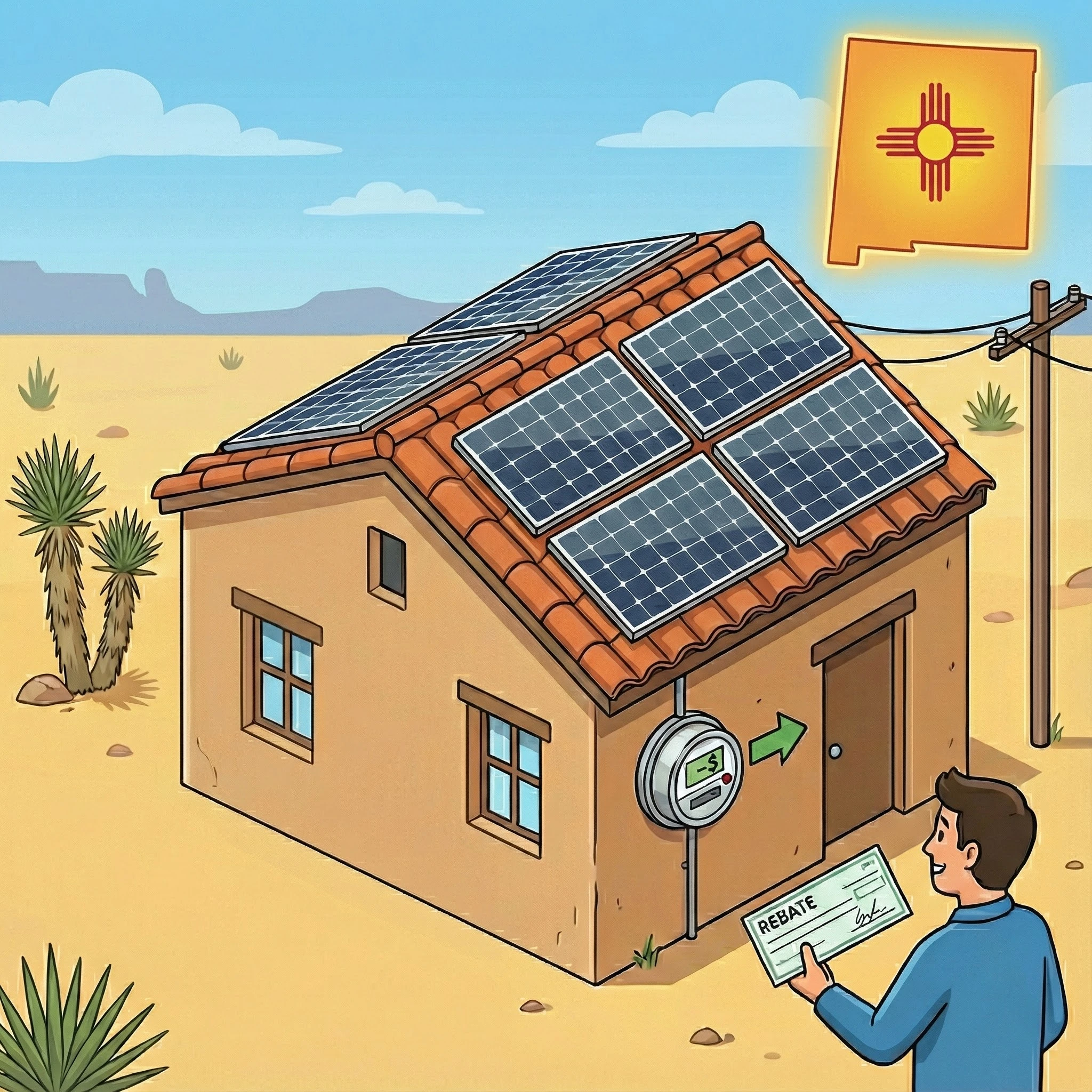
If you live in New Mexico, you already know we have something most of the world envies: an abundance of sunshine. From the high deserts of Taos to the organ mountains of Las Cruces, our state is bathed in solar potential almost every day of the year. But recently, something has changed. It’s not just about the weather anymore; it’s about the wallet.
You might be noticing more of your neighbors putting shiny blue or black panels on their roofs. You might have seen ads in your social media feed promising "zero cost" energy. And if you are like most sensible homeowners, you are probably skeptical. You should be. The world of solar energy is filled with confusing jargon, aggressive sales pitches, and complex government rules that seem to change every time you blink.
This guide is different. We aren't selling you panels. We are here to map out the terrain. The truth is, New Mexico is currently sitting in a "golden window" for solar energy. We have a unique combination of federal tax breaks, state-level rebates, and legal protections that make going solar financially smarter here than almost anywhere else in the country. But—and this is a big "but"—there are deadlines looming in 2025 that could slam that window shut for unprepared homeowners.
We have combed through thousands of pages of utility rate cases, state statutes, and tax forms so you don't have to. We are going to break it all down in plain English, aiming to help you understand exactly what you can claim, what you need to avoid, and how to get the system you deserve without getting ripped off.
TL;DR: The "Too Long; Didn't Read" Summary
We know you are busy. If you don't have time to read this entire deep-dive report right now, here are the five critical takeaways you need to know immediately to protect your wallet in 2025.
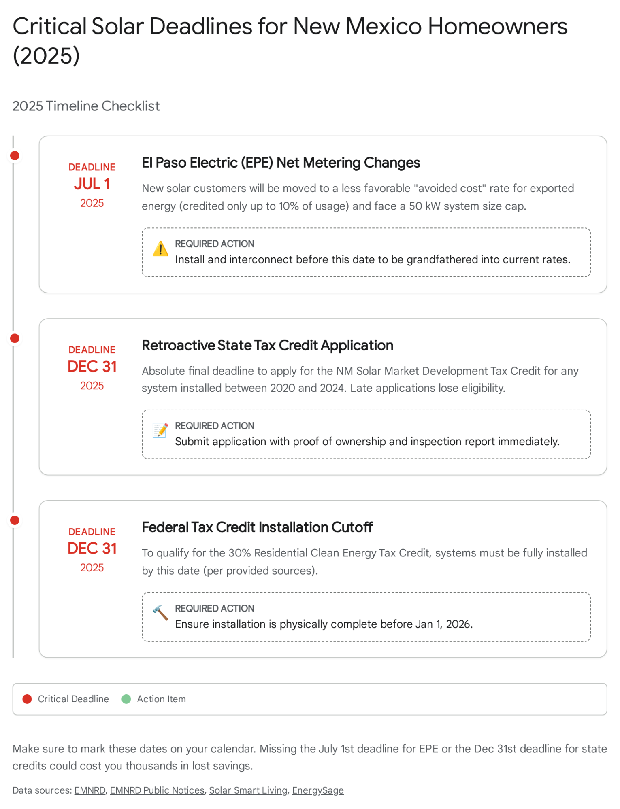
- The "Use It or Lose It" Deadline: If you installed solar panels in New Mexico between 2020 and 2024 but haven't claimed your state tax credit yet, the clock is ticking. You must submit your application to the state energy department by December 31, 2025. If you miss this date, you could lose up to $6,000 in refunds. No exceptions.1
- Southern New Mexico Emergency (El Paso Electric): If you are an El Paso Electric customer (Las Cruces, Hatch, etc.), the rules for selling power back to the grid are getting significantly worse on July 1, 2025.3 You need to have your system installed and approved before that date to be "grandfathered" into the current, better rates. Waiting until August could double your payback period.
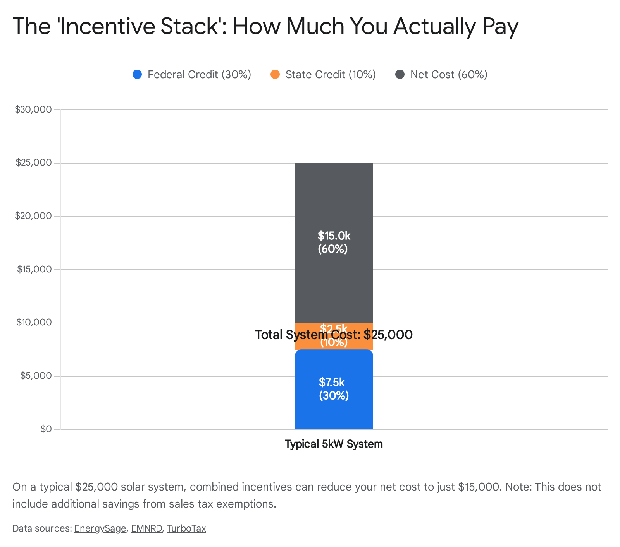
- The Incentive Stack: You can combine ("stack") the 30% Federal Tax Credit with the 10% New Mexico State Tax Credit. On a typical home system, this covers roughly 40% of the upfront cost.
- Tax Free: You do not pay New Mexico Gross Receipts Tax (sales tax) on solar equipment, and your property taxes will not go up just because your home value increased due to the solar installation.4
- Help for Low-Income Households: A massive new program called "Solar for All," funded by a $156 million EPA grant, is launching in late 2025.6 If you qualify as low-income, do not sign a loan today—wait for this program, which could cover nearly 100% of the cost.
---
Section 2: The Foundation – The Federal Investment Tax Credit (ITC)
Before we get into the New Mexico-specific rules, we have to start with the biggest piece of the financial puzzle: the United States Federal Government. The primary driver of solar adoption across the country is the Residential Clean Energy Credit, which you will often hear referred to as the "ITC" (Investment Tax Credit).
This isn't just a small coupon; it is a massive financial tool designed to make renewable energy affordable for the average family. Understanding exactly how it works is the first step in your solar journey.
The Magic Number: 30%
As of right now, and locked in through the year 2032, the federal government offers a tax credit equal to 30% of your total gross system cost.
What does "gross system cost" mean? It means the price on the sticker before any other rebates or incentives are applied. It includes almost everything required to get the power from the sun into your toaster:
- The Solar Panels: The photovoltaic modules themselves.
- The Inverter: The box that converts the DC power from the panels into the AC power your house uses.
- Racking and Mounting: The metal rails that hold the panels to your roof.
- Wiring and Electrical: All the copper and conduit needed to connect the system to your main breaker panel.
- Labor: The cost of the crew who installs the system, handles the permitting, and prepares the site.
- Battery Storage: If you choose to add a battery (like a Tesla Powerwall or Enphase battery), this is also eligible for the 30% credit, provided it has a capacity of at least 3 kilowatt-hours (kWh).7
Let’s Do the Math
Imagine you get a quote for a solar system that costs $24,000.
To calculate your federal credit, you simply multiply that number by 0.30.
$24,000 x 0.30 = $7,200.
When you file your federal taxes for the year you installed the system, you get a $7,200 credit.
Credit vs. Deduction: A crucial Distinction
It is vital to understand the difference between a tax deduction and a tax credit.
- A Deduction lowers the amount of income you are taxed on. If you make $50,000 and get a $1,000 deduction, the IRS treats you as if you made $49,000. It saves you a little bit, depending on your tax bracket.
- A Credit is a dollar-for-dollar reduction of the actual tax bill you owe. It is much more powerful.
If you calculate your taxes at the end of the year and discover you owe the IRS exactly $7,200, and you have a $7,200 solar tax credit, your bill becomes zero. The credit wipes it out completely.
The "Rollover" Safety Net
A common fear homeowners have is: "What if I don't owe enough taxes to use the whole credit?"
Let's say you are retired or have a moderate income, and your total federal tax liability for the year is only $3,000. But you earned that big $7,200 solar credit. Do you lose the difference?
No.
The IRS allows you to "carry forward" the unused portion of the credit to the next tax year.
- Year 1: You use $3,000 of the credit to wipe out your tax bill. You pay $0.
- Remaining Credit: You still have $4,200 left.
- Year 2: You apply that remaining $4,200 to next year's taxes.
You can keep rolling it over until the credit is fully used, as long as the credit program remains active.7
Who is Eligible? (And Who isn't)
To claim the Federal ITC, you must meet a few specific criteria:
- Ownership is Key: You must own the system. This can be a cash purchase or a loan. If you sign a "lease" or a "PPA" (Power Purchase Agreement) where a third-party company owns the panels on your roof and just sells you the electricity, they get the tax credit, not you. Be very clear about this when signing contracts.9
- Residency: The system must be installed at a residence of yours in the United States.
- New Equipment: The gear must be new or being used for the first time. You can't buy used panels from a neighbor and claim the credit.
Can I claim it on a vacation home?
Yes! If you have a second home in Taos or Ruidoso that you live in for part of the year, you can claim the credit for a solar system installed there. However, it cannot be a property that is used exclusively as a rental. If you live there for two weeks and rent it out for 50 weeks, strict IRS rules apply, and you should consult a tax pro. But for a true second home, you are generally in the clear.7
The Long-Term Outlook
You don't need to panic about the federal credit disappearing tomorrow, but you should know the schedule. Congress passed the Inflation Reduction Act, which locked in these rates for a decade:
- 2022 through 2032: 30%
- 2033: The credit drops to 26%
- 2034: The credit drops to 22%
- 2035: The credit expires for residential systems.7
While 2032 seems far off, the state incentives we are about to discuss have much tighter deadlines. The smart money moves when both federal and state incentives align, which is happening right now in 2025.
---
Section 3: The New Mexico State Advantage – The "Double Dip"
Here is where living in New Mexico really pays off. While Texans or Arizonans might get the federal credit, they don't get what we get: The New Solar Market Development Tax Credit (NSMDTC).
This is a state-level incentive that you can add on top of the federal credit. It is essentially a "double dip" of savings that drastically lowers the real cost of your system.
How the State Credit Works
The State of New Mexico offers a tax credit worth 10% of the total cost of your solar system.
- The Cap: The maximum credit you can receive is $6,000 per taxpayer per year.11
- The Scope: Like the federal credit, this covers equipment, materials, and labor.
Example Scenario:
Let's go back to our $24,000 system example.
- Federal Credit (30%): $7,200.
- NM State Credit (10%): $2,400.
- Total Incentives: $9,600.
- Net Cost: Your $24,000 system actually costs you $14,400.
Because of the $6,000 cap, the 10% calculation works fully for any system up to $60,000 in value. Since most residential home systems cost between $20,000 and $40,000, almost everyone gets the full 10% back.
The "Funding Cap" History (And the Fix)
To understand why 2025 is such a critical year, you need a little history lesson. In the past, this program was a victim of its own success. The state legislature would allocate a certain amount of money—usually around $12 million—to fund these credits each year.
Because solar is so popular in New Mexico, that pot of money would run dry quickly. Homeowners would apply in September or October, only to receive a rejection letter saying, "Sorry, funds are exhausted for this year." It was frustrating and discouraged people from going solar.
The Great Fix of 2024:
Recognizing this problem, the state government passed legislation (Senate Bill 121) to fix the funding bottleneck.
- More Money: Starting in the 2024 tax year, the annual cap was raised to $30 million.13 This more than doubles the available funds, making it much more likely that everyone who applies will get approved.
- Retroactive Funding: The state also allocated extra money specifically to pay back those homeowners who were rejected in 2020, 2021, 2022, and 2023. If you were one of those unlucky people, you can now re-apply
The Critical Deadlines You Cannot Miss
This is the most important logistical part of this report. New Mexico runs a tight ship regarding deadlines.
1. The "Retroactive" Deadline: December 31, 2025
If you installed your solar system in 2020, 2021, 2022, 2023, or 2024, you have a hard deadline. You MUST submit your application for the state tax credit by December 31, 2025.1
If you forget and try to apply on January 2, 2026, for a system you bought in 2023, you will be denied. The money will be lost forever. Do not procrastinate.
2. The 2025 Installation Deadline
If you install your system during the calendar year 2025, you generally have until December 31, 2026, to apply.11 The rule of thumb is that you have the tax year of installation plus one full calendar year to get your paperwork in. But given the history of funding caps, our advice is always: Apply as soon as your system passes inspection. Why wait?
How to Apply: A Step-by-Step Guide
Applying for the NSMDTC is not automatic. Your tax guy can't just click a button. You have to get a certificate from the state first. Here is the process:
Step 1: Installation and Inspection
Your installer builds the system. Then, a city or county inspector comes out to verify it meets building codes. Once you pass, you get a "final inspection report" or a "green tag." Save this document. It is your golden ticket.
Step 2: Gather Your Paperwork
You will need digital copies (PDFs or clear photos) of:
- Proof of Ownership: A current property tax bill or a deed recorded in your name.2
- Itemized Invoice: This must show the breakdown of costs—how much for panels, how much for labor, how much for the inverter. A lump sum "Total: $20,000" invoice might be rejected. Ask your installer for an itemized version.2
- The Inspection Report: The proof that you passed inspection.2
- Photos: Sometimes the portal requires a photo of the physical panels on your roof and the inverter.
Step 3: The EMNRD Portal
Go to the New Mexico Energy, Minerals and Natural Resources Department (EMNRD) website. They have an online application portal. You will create an account, fill in your system details (size in kilowatts, installer name, date of operation), and upload your documents.
Step 4: The Certificate
The department reviews your application. This can take anywhere from a few weeks to a few months. Once approved, they will issue you a Certificate of Eligibility.
Step 5: File Your Taxes
When you file your New Mexico state income tax return (Form PIT-1), you will attach this certificate or enter the certificate number. This effectively turns that piece of paper into cash on your tax refund.
---
Section 4: Keeping the Tax Man Away (Exemptions)
We've talked about putting money in your pocket. Now let’s talk about stopping the government from taking money out of your pocket. New Mexico offers two powerful exemptions that often fly under the radar but save you thousands over the life of your system.
1. The Solar Sales Tax Exemption (Gross Receipts Tax)
In New Mexico, we don't technically have a "sales tax." We have a "Gross Receipts Tax" (GRT). It functions similarly—it is a percentage added to almost every purchase you make. The rate varies by city, but in places like Albuquerque or Santa Fe, it can be close to 8%.
The Perk: The state law is clear: The sale and installation of solar energy systems are 100% exempt from Gross Receipts Tax.4
The Math:
If you buy a $25,000 car, you might pay nearly $2,000 in tax.
If you buy a $25,000 solar system, you pay $0 in tax.
This is an immediate, upfront savings of roughly $1,500 to $2,000 that you don't have to apply for—it just shouldn't be on your bill. Check your quote. If you see a line item for "Sales Tax" or "GRT," point it out to your installer immediately. They should not be charging it.
2. The Property Tax Exemption
This is a huge long-term benefit. Generally, home improvements increase your property taxes. If you build a fancy new deck or add a guest room, the county assessor comes by, says "Nice house, it's worth more now," and raises your annual tax bill.
Solar panels undoubtedly increase the value of your home. Studies show buyers are willing to pay a premium for homes with $0 electric bills. But in New Mexico, you don't get punished for that added value.
The Rule: New Mexico law (NMSA Section 3-18-32 and related property tax codes) dictates that the value added by a solar energy system is exempt from property tax assessments.5
How it works:
- Market Value: Your home might sell for $20,000 more because of the solar.
- Assessed Value: The tax assessor ignores that extra $20,000. They tax you as if the panels weren't there.
- The Savings: Over 10 or 20 years, avoiding that extra tax assessment saves you thousands of dollars in annual payments.
- Duration: The exemption is valid for as long as you own the system. While some older sources might reference a 10-year limit, the current framework is designed to prevent solar from becoming a tax burden for homeowners.5
3. The Sustainable Building Tax Credit (SBTC)
You might hear about another credit called the "Sustainable Building Tax Credit." It is important not to confuse this with the solar tax credit.
- What it is: A tax credit for building or renovating a home to achieve high-level "green" certifications, like LEED Silver, Gold, or Platinum.16
- The Reward: It pays out based on square footage—up to $6.50 per square foot for the highest efficiency tiers.
- The Catch: Getting a home LEED certified is difficult and expensive. It involves insulation, windows, HVAC, water conservation, and more. While solar panels help you get there, adding solar alone usually isn't enough to qualify for the SBTC.
- Stackable? Yes, technically you can claim both if you meet the rigorous standards for the SBTC. But for 95% of homeowners, the New Solar Market Development Tax Credit is the primary, accessible incentive to focus on.11
---
Section 5: The Utility Landscape – A Tale of Three Regions
Up until now, we've discussed incentives that apply to everyone in the state equally. But when it comes to your monthly electric bill, New Mexico is divided into three distinct "kingdoms," each with its own rules. Your zip code determines your utility provider, and your utility provider determines your financial destiny.
The three major players are:
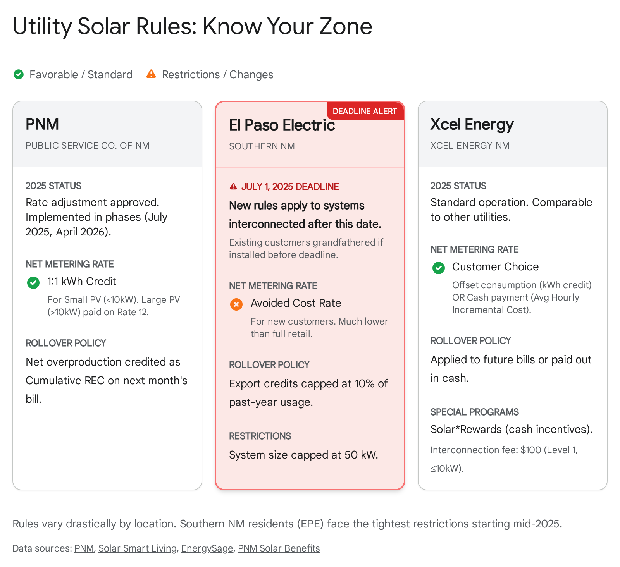
- PNM (Public Service Company of New Mexico): Serving Albuquerque, Santa Fe, and central NM.
- EPE (El Paso Electric): Serving Las Cruces and the southern border.
- Xcel Energy (SPS): Serving Roswell, Carlsbad, and the eastern plains.
The rules for 2025 are wildly different depending on which kingdom you live in.
---
Region 1: The North & Central (PNM Territory)
If you pay your bill to PNM, you are in the largest solar market in the state.
The 2025 Rate Hike
PNM is currently undergoing a major rate adjustment that will hit your wallet soon. A rate case settlement approved by the Public Regulation Commission (PRC) means electricity prices are going up.
- Phase 1: Rates increase in July 2025.
- Phase 2: Rates increase again in April 2026.
- Impact: The average residential bill is expected to rise by about $6.23 per month.18
The Solar Silver Lining: Ironically, rate hikes are good news for solar owners. Every time PNM raises the price of a kilowatt-hour (kWh), the value of the energy you produce on your roof goes up. You are avoiding a more expensive bill.
Net Metering: The "Banking" System
PNM offers a favorable Net Metering program for residential customers (systems under 10 kW, which covers most homes).
- The Mechanism: When your panels produce more energy than your house needs (like at noon on a Tuesday), that excess power flows back into the grid. PNM credits your account for this energy.
- The Rate: You are credited at the full retail rate for the energy offset. It’s a 1-to-1 swap.
- The Rollover: If you generate more credits than you use in a month (common in May or June), those credits roll over to the next month. You can build up a "bank" of credits in the summer to use up in the winter when days are shorter and you are using your heater more.19
- The Payout: If you ever cancel service (move house), PNM will pay you for your remaining banked credits. However, they pay this out at the "Avoided Cost" rate (a low wholesale rate), not the retail rate. So, it is better to use your credits than to hoard them for a cashout.20
REC Purchase Program (Small PV vs Large PV)
PNM separates systems into "Small" (under 10kW) and "Large" (10kW to 100kW).
- Small PV: You get the net metering benefits described above. Simple and effective.
- REC Sales: You technically own the "Renewable Energy Certificates" (RECs) your system creates. PNM has a program to buy these from you for $0.0025 per kWh.
- Reality Check: For a typical home producing 10,000 kWh a year, that’s only $25 a year. There is often an application fee to join this program, so for many homeowners, the math doesn't make it worth the hassle. You are better off just enjoying the net metering savings.21
Time of Use (TOU) Mandates
Be aware that PNM is pushing more customers toward "Time of Use" plans, where electricity is more expensive in the evening (5 PM – 8 PM) and cheaper during the day. Solar works well with this if you are at home to use power during the day, or if you have a battery to store cheap solar power and use it during the expensive evening hours.22
---
Region 2: The South (El Paso Electric Territory) – URGENT ALERT
If you live in Las Cruces, Anthony, or Hatch, pay close attention. You are facing the most critical deadline in the entire state.
The July 1, 2025 "Cliff"
El Paso Electric (EPE) is drastically changing its solar rules. This is not a drill.
- Before July 1, 2025: If you apply for interconnection and get your system approved before this date, you are "grandfathered" into the current net metering rules. These rules are generally favorable and allow you to save significant money.
- After July 1, 2025: The rules change, and they are much less friendly to solar owners.3
The New Rules (Post-July 1)
If you miss the deadline, here is the new reality you will face:
- Export Limits: EPE will limit the amount of power you can export to the grid. You will typically only be credited for exports up to 10% of your historical consumption.3
- Avoided Cost Credits: Any energy you export beyond that tiny limit will not be credited at the retail rate (what you pay). It will be credited at the "Avoided Cost" rate.
- Retail Rate: ~12-14 cents/kWh.
- Avoided Cost: ~2-3 cents/kWh.
- The Result: Sending power to the grid becomes almost worthless. You are selling your gold for the price of copper.
- System Sizing Caps: New systems will be capped at 50 kW or must be strictly sized to match your past 12 months of usage history. You can't oversize a system to account for a future EV purchase as easily as before.3
Strategic Advice for EPE Customers:
If you are reading this in early 2025, sign a contract immediately. Solar projects can take 3-4 months from signature to interconnection. You need to be in the queue well before July 1st to ensure you secure the legacy rates. If you miss the window, your Return on Investment (ROI) will take significantly longer, and you will almost certainly need to buy a battery to store your power instead of selling it for pennies.
---
Region 3: The East (Xcel Energy / SPS Territory)
Customers in Roswell, Carlsbad, and Clovis are served by Southwestern Public Service (SPS), a subsidiary of Xcel Energy.
Solar*Rewards Program
Xcel offers a structured incentive program known as Solar*Rewards.24
- Performance Incentive: Unlike PNM, Xcel has historically offered a "performance-based incentive" (PBI) where they pay you a small cash amount for every kWh your system generates, in exchange for your RECs.
- Net Metering: They also offer net metering. You bank your excess credits.
- Cash Out Option: You can choose to have your net metering credits rolled over indefinitely or be paid out annually at the "average hourly incremental cost" (similar to avoided cost).
- Application Fees: Be aware of the fees.
- Systems <10 kW: $100 application fee.
- Systems 10-250 kW: $1,000 application fee.24
---
Section 6: Net Metering Deep Dive – How the "Bank" Works
We have used the term "Net Metering" a lot. It is the most important financial concept in solar, so let’s make sure you understand it fully.
The Water Tank Analogy
Think of the electricity grid like a giant municipal water tank, and your home is connected to it by a pipe.
- Consumption: When you turn on your TV or A/C at night, you are pulling water out of the tank. Your meter spins forward, counting the gallons you take.
- Production: When the sun is high and your panels are cranking out power, you are pumping water back into the tank. Your meter spins backward, counting the gallons you give.
The "Net" in Net Metering
At the end of the month, the utility looks at the "Net" result.
- You took 500 units.
- You gave 400 units.
- Net: You pay for 100 units.
But what if you gave more than you took?
- You took 400 units.
- You gave 600 units.
- Net: -200 units.
You don't pay for electricity. Instead, those 200 units are added to your "Bank."
The Seasonal Rhythm
Solar is seasonal. In June, days are long and sunny. You will produce way more power than you use. Your "Bank" will grow huge.
In December, days are short and you might run electric heaters. You will use more than you produce.
This is the magic: In December, you don't pay the utility cash. You pay them with the credits you banked in June. A perfectly sized system reaches "Net Zero" over the course of a year, meaning your summer surplus perfectly covers your winter deficit.
The "Avoided Cost" Trap
This is the danger zone (and the future for EPE customers).
"Retail Rate" is what you pay—say, 14 cents per unit.
"Avoided Cost" is what the utility pays to generate power at a wholesale plant—say, 3 cents per unit.
True Net Metering swaps power at the Retail Rate (1-for-1).
If a utility switches to Avoided Cost for your exports, the math breaks.
- You give them a unit at noon (worth 3 cents).
- You take a unit back at night (costing 14 cents).
- Even though you gave 1 and took 1, you still owe them 11 cents.
This destroys the value of solar unless you have a battery to store your own power so you never have to give it to them in the first place.
---
Section 7: Solar for All & Low-Income Programs
For years, solar has been criticized as a luxury for the wealthy—people with high credit scores and cash for down payments. New Mexico is about to change that narrative dramatically with the Solar for All program.
The $156 Million Windfall
In 2024, the EPA awarded the State of New Mexico a staggering $156,120,000 grant under the Greenhouse Gas Reduction Fund's "Solar for All" competition.26
This is not a loan; it is grant money designed to bring solar to low-income and disadvantaged households.
Who is it for?
The program targets specific groups who have historically been left out:
- Low-Income Households: Families earning below a certain percentage of the Area Median Income.
- Disadvantaged Communities: Neighborhoods identified as having high pollution burdens or high energy costs.
- Tribal Lands: A significant portion of the funding is earmarked for Native American communities, including off-grid solar solutions for homes that have never been connected to the power grid.6
What will it offer?
The specific details are currently being designed by the EMNRD, but the program is expected to launch to the public in late 2025.6 Anticipated benefits include:
- Zero-Upfront-Cost Solar: Subsidies that cover the entire cost of the installation, meaning no loans and no liens on the home.
- Battery Storage: Funding for batteries to provide resilience during outages.
- Roof Repairs: Often, low-income homes have older roofs that can't support solar. This program may include funds to fix the roof first.27
Strategic Advice: If you qualify as a low-income household, do not sign a commercial solar lease or loan right now. You are potentially months away from a program that could give you a system for free or at a deeply subsidized rate. Wait for the official "Solar for All" application portal to open in late 2025.
---
Section 8: Community Solar – Solar for Renters
What if you rent your apartment? What if your roof is shaded by a beautiful, 100-year-old cottonwood tree? What if you just don't want construction workers on your house?
You can still go solar through Community Solar.
How it Works
Community Solar allows you to "subscribe" to a large solar farm located somewhere else in your utility's territory. You don't own the panels, but you buy the rights to the energy they produce.
- Subscription: You sign up with a "Subscriber Organization" for a specific amount of energy (e.g., 300 kWh/month).
- Credit: The solar farm feeds power into the main grid. The utility measures it and applies a credit to your home electric bill.
- Savings: You typically pay the solar farm a subscription fee that is lower than the credit you receive on your bill. The result is guaranteed savings (often 10-20% off your bill) with no installation.28
Who are the Players?
Several "Subscriber Organizations" are active in New Mexico. While the market is young, names like SVOE, Affordable Solar, and Pluma have been identified in PNM documents as developing projects.29
- Low-Income Requirement: By law, 30% of each community solar project must be reserved for low-income subscribers. These plans often come with extra protections, like no cancellation fees and no credit checks.28
---
Section 9: Your Rights vs. Your HOA
It is a classic New Mexico showdown: A homeowner wants to save the planet (and money), and the Homeowners Association (HOA) wants to preserve the "aesthetic harmony" of the neighborhood. Who wins?
The Solar Rights Act
New Mexico has one of the strongest "Solar Rights Acts" in the nation. It declares that the right to use solar energy is a property right.30
The Core Rule: A county, municipality, or HOA cannot restrict the installation of a solar collector. They cannot simply say "No."
The "Reasonable Restriction" Loophole
However, the law isn't absolute. It allows for "reasonable restrictions." This is where the legal battles happen.
An HOA can enforce rules if they don't "effectively prohibit" the system.
What does "effectively prohibit" mean?
While New Mexico law is slightly vaguer than some states (which set strict % caps), the general legal interpretation and Attorney General opinions suggest that an HOA restriction is unreasonable (and therefore void) if it:
- Significantly Increases Cost: For example, forcing you to install a $5,000 screening fence to hide the panels.
- Significantly Decreases Efficiency: For example, forcing you to move the panels from the south-facing roof (maximum sun) to the north-facing roof (no sun) just because the north side faces the alley.
How to Deal with an HOA:
- Cite the Statute: When you submit your architectural request, include a copy of NMSA § 3-18-32. It shows you know your rights.
- Get an Installer Letter: If the HOA tries to move your panels, get your installer to write a technical letter: "Moving panels to the proposed location will reduce energy production by 30%. This constitutes an effective prohibition under the Solar Rights Act."
- Stand Firm: Most HOAs will back down when faced with the specific statute and data. They cannot stop you because they think panels are "ugly."
---
Section 10: Is Battery Storage Worth It?
With solar panels becoming a no-brainer, the new question is: "Do I need a battery?" (like a Tesla Powerwall or Enphase IQ Battery).
Batteries are expensive—often adding $10,000 to $15,000 to the cost. Are they worth it?
Scenario A: The "Financial" Case (EPE Customers)
If you are an El Paso Electric customer interconnecting after July 1, 2025, the answer is YES.
Because you won't get paid fairly for sending power to the grid, you need to hoard every electron you generate. A battery lets you store your solar power during the day and use it yourself at night. Without a battery, you will lose money on every kWh you export.
Scenario B: The "Resilience" Case (Everyone)
Standard solar panels turn off when the grid goes down. This is a safety feature to protect line workers. If you want power during a blackout (a common occurrence during NM wind storms), you must have a battery.
If you work from home, have medical equipment, or just hate spoiling food in the fridge, a battery is an insurance policy. The 30% federal tax credit applies to the battery, making this insurance 30% cheaper.
Scenario C: The "ROI" Case (PNM/Xcel Customers)
If you have favorable Net Metering (like PNM customers do right now), the grid acts as a free battery. You give them power, they give it back. Financially, buying a physical battery doesn't make sense yet—it will lengthen your payback period. You are buying a $10,000 box to do something the utility is currently doing for free.
- Exception: If you are on a Time-of-Use plan with very high evening rates, a battery might help you "arbitrage" rates, but the savings are usually small compared to the battery cost.
---
Section 11: Step-by-Step Buying Guide
Ready to go solar? Here is your roadmap to navigating the process safely.
Step 1: Check Your Energy Efficiency First
The cheapest energy is the energy you don't use. Before spending $20,000 on panels, spend $500 on LED lights, smart thermostats, and window sealing. Reducing your usage means you can buy a smaller, cheaper solar system.
Step 2: Get Your Data
Find your last 12 months of electric bills. You need your "Annual kWh usage." A typical NM home uses 7,000 to 11,000 kWh/year. This number determines the size of the system you need.
Step 3: Get 3 Quotes (Local Matters)
Do not take the first offer from the guy knocking on your door.
- Local vs. National: Local New Mexico installers often understand the specific nuances of PNM/EPE interconnection and the NM State Tax Credit portal better than national call centers.
- The "Price Per Watt" Test: Take the Total Cash Price (before incentives) and divide by the System Size in Watts.
- Great: $2.80 – $3.20 per Watt.
- Fair: $3.30 – $3.80 per Watt.
- Rip-off: Over $4.50 per Watt.
Step 4: Review the Contract
- Escalators: If you are financing or leasing, watch out for "annual escalators" where your monthly payment goes up by 2.9% every year. These can eat your savings.
- Tax Credit Ownership: Ensure the contract states you keep the tax credits.
- Warranties: Look for a 25-year warranty on both equipment and labor (roof leaks).
Step 5: Install & Permitting
The installer handles the permits. The city will inspect the system. This can take 1-3 months.
Step 6: The Paperwork Marathon
Once the system is on:
- Interconnection: Your installer files with the utility to turn the system on.
- State Credit: You file on the EMNRD portal (remember the deadline!).
- Federal Credit: You file IRS Form 5695 with your annual taxes.
---
Section 12: Conclusion – Seize the Day
New Mexico in 2025 is a special place for solar energy. We are living in a moment where the technology is mature, the federal government is paying 30% of the bill, and the state government is chipping in another 10% (up to $6,000).
For a typical homeowner, this means you can get a state‑of‑the‑art energy system for roughly 60 cents on the dollar. That is an incredible financial product.
But as the changes in El Paso Electric territory show, these incentives are not guaranteed forever. Utilities are fighting back against net metering. The "Golden Window" is open right now, but it is slowly closing.
If you have been thinking about it, 2025 is the year to act. Mark your calendar for the deadlines, check your utility rules, and go harvest that New Mexico sunshine.
---
Works cited
- Solar Market Development Tax Credit (SMDTC) – Energy Conservation and Management, accessed December 18, 2025, https://www.emnrd.nm.gov/ecmd/tax-incentives/solar-market-development-tax-credit-smdtc/
- Public Notices – Energy Conservation and Management – EMNRD.nm.gov, accessed December 18, 2025, https://www.emnrd.nm.gov/ecmd/ecmd-public-notices/
- Net-Metering Update for El Paso – June 2025 – Solar Smart Living, accessed December 18, 2025, https://solarsmartliving.com/blogs/net-metering-update-for-el-paso-june-2025
- Top Tax Breaks and Rebate Incentives for Solar in New Mexico – Infinity Solar USA, accessed December 18, 2025, https://www.infinitysolarusa.com/top-tax-breaks-and-rebate-incentives-for-solar-in-new-mexico
- Property Tax Exempt in New Mexico | Infinity Solar USA, accessed December 18, 2025, https://www.infinitysolarusa.com/property-tax-exempt
- Solar Incentives & Rebates – ECAM – Energy Conservation and Management, accessed December 18, 2025, https://clean.energy.nm.gov/landing/solar/
- Residential Clean Energy Credit | Internal Revenue Service, accessed December 18, 2025, https://www.irs.gov/credits-deductions/residential-clean-energy-credit
- Federal Tax Credits for Energy Efficiency, accessed December 18, 2025, https://www.energystar.gov/about/federal-tax-credits
- Federal Tax Credit for Residential Solar Energy – TurboTax Tax Tips & Videos – Intuit, accessed December 18, 2025, https://turbotax.intuit.com/tax-tips/going-green/federal-tax-credit-for-solar-energy/L7s9ZiB4D
- Solar Tax Credits and Incentives 2025 – Enphase, accessed December 18, 2025, https://enphase.com/blog/homeowners/solar-tax-credits-incentives
- What type of nonrefundable credits are available on my New Mexico return?, accessed December 18, 2025, https://support.taxslayer.com/hc/en-us/articles/360015905851-What-type-of-nonrefundable-credits-are-available-on-my-New-Mexico-return
- New Solar Market Development Tax Credit Regular – Energy Conservation and Management – EMNRD.nm.gov, accessed December 18, 2025, https://www.emnrd.nm.gov/ecmd/faq/faq1/
- New Solar Market Development Tax Credit for New Mexican Solar Owners, accessed December 18, 2025, https://solarsme.com/new-solar-market-development-tax-credit/
- Tax Credits Passed During the 2024 Legislative Session: Overview – Conservation Voters New Mexico, accessed December 18, 2025, https://cvnm.org/tax-credits-passed-during-the-2024-legislative-session-overview/
- Property Tax Exemption for Residential Solar Systems – DSIRE, accessed December 18, 2025, https://programs.dsireusa.org/system/program/detail/4043
- New Mexico Solar Incentives, Tax Credits & Rebates 2025 | EnergySage, accessed December 18, 2025, https://www.energysage.com/local-data/solar-rebates-incentives/nm/
- Free New Mexico Solar Incentives: Claim Solar Panels (Open Enrollment), accessed December 18, 2025, https://newmexico.statesolar.org/
- 2025 Rate Request – pnmprod – pnm.com, accessed December 18, 2025, https://www.pnm.com/2025raterequest
- Solar Interconnection Benefits – pnmprod – pnm.com, accessed December 18, 2025, https://www.pnm.com/solar-interconnection-benefits
- Net Metering – DSIRE, accessed December 18, 2025, https://programs.dsireusa.org/system/program/detail/284
- PNM Solar Energy Customer Program: Large Systems, accessed December 18, 2025, https://www.pnm.com/large-system1
- Advice Notice No. 625 June 14, 2024 Page 1 of 5 – TXNM Energy, accessed December 18, 2025, https://www.txnmenergy.com/~media/Files/P/PNM-Resources/rates-and-filings/2025%20Rate%20Request/02%20-%20Advice%20Notice.pdf
- PUBLIC SERVICE COMPANY OF NEW MEXICO ELECTRIC SERVICES Advice Notice No. 645 June 13, 2025 Page 1 of 1 NEW MEXICO PUBLIC REG – PNM.com, accessed December 18, 2025, https://www.pnm.com/documents/d/pnm.com/5-advice-notice-no-645
- 2025 Xcel Energy Net Metering – EnergySage, accessed December 18, 2025, https://www.energysage.com/local-data/net-metering/xcel-energy/
- Solar*Rewards – On-site Renewable Energy, accessed December 18, 2025, https://my.xcelenergy.com/s/renewable/solar-rewards
- EPA Announces Over $156 Million to Fund Solar Energy Systems for Low-Income New Mexico Residents, accessed December 18, 2025, https://www.epa.gov/newsreleases/epa-announces-over-156-million-fund-solar-energy-systems-low-income-new-mexico
- Solar for All Program – Energy Conservation and Management – EMNRD.nm.gov, accessed December 18, 2025, https://www.emnrd.nm.gov/ecmd/faq/solar-for-all-program/
- Community Solar — Coalition of Sustainable Communities New Mexico (CSCNM), accessed December 18, 2025, https://www.coalitionscnm.org/community-solar
- Community Solar – pnmprod – pnm.com, accessed December 18, 2025, https://www.pnm.com/communitysolar
- New Mexico Statutes Section 3-18-32 (2024) – Justia Law, accessed December 18, 2025, https://law.justia.com/codes/new-mexico/chapter-3/article-18/section-3-18-32/
- PROtEct yOUR SOlAR RiGhtS – EMNRD.nm.gov, accessed December 18, 2025, https://www.emnrd.nm.gov/ecmd/wp-content/uploads/sites/3/2011SolarRightsBrochure.pdf
- Solar Smart Living | Major Rate Hike Ahead? What El Paso Electric's 2025 Plan Means for Your Energy Bill, accessed December 18, 2025, https://solarsmartliving.com/blogs/-what-el-paso-electrics-2025-rate-case-means-for-homeowners-and-solar-customers
- EPA Awards New Mexico $156 million for Solar for All program – NM Governor's Office, accessed December 18, 2025, https://www.governor.state.nm.us/2024/04/22/epa-awards-new-mexico-156-million-for-solar-for-all-program-funds-will-make-solar-power-available-to-21000-low-income-households/