If you are a Louisiana homeowner standing in your driveway in December 2025, looking up at your roof and wondering if solar panels make sense, you are asking one of the most complex financial questions of the decade. Ten years ago, the answer was simple: the state paid for half the system, and the utility company paid you full retail price for your power. It was, as they say, a "no-brainer."
Today, the landscape is entirely different. We are living in a new era of solar energy—one defined by legislative deadlines, utility billing shifts, and the absolute necessity of battery storage. The "free money" era is over, replaced by a "strategic investment" era.
This report is designed to be your definitive guide. We will strip away the sales pitch and look at the cold, hard numbers. We will navigate the confusing world of tax credits that are about to expire, utility buyback rates that have plummeted, and insurance premiums that are skyrocketing. We will talk about why New Orleans is currently an island of opportunity in a sea of restrictions, and why a new roof might be the secret to making the math work.
The "Too Long; Didn't Read" (TL;DR) Cheat Sheet
For those of you who want the bottom line immediately, here is the summary of our findings for late 2025:
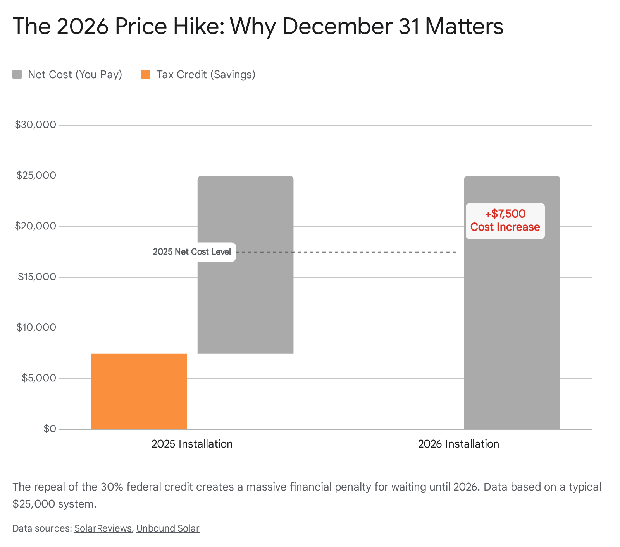
- The "Fiscal Cliff" is Real: The 30% Federal Tax Credit is facing a repeal for expenditures made after December 31, 2025. This is due to the new "One Big Beautiful Bill" legislation. If you do not act before this deadline, the cost of solar will effectively jump by 30% on New Year's Day. 1
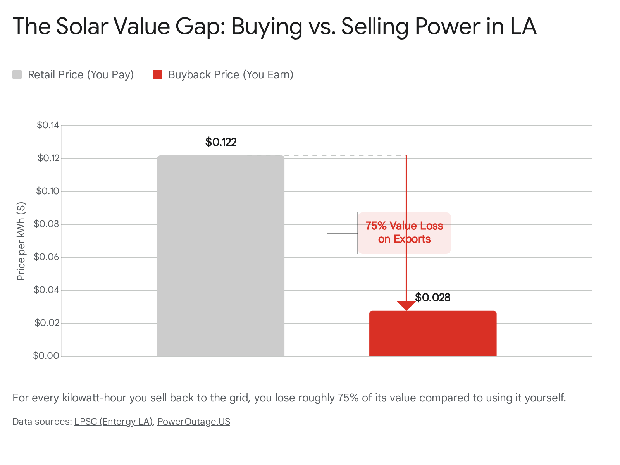
- Net Metering is Dead: For new customers, utilities like Entergy, CLECO, and SWEPCO no longer swap electricity 1-for-1. They pay you "Avoided Cost" for your exports, which is roughly 3 cents per kilowatt-hour (kWh). You buy power at ~12 cents and sell it at ~3 cents. This 75% loss means you should never export power if you can help it. 2
- Batteries Are Mandatory: Because of the low buyback rate, the only way to save money is to store your solar energy and use it yourself. Batteries also provide critical backup during hurricane season, which is becoming increasingly violent. 4
- New Orleans has a "Golden Ticket": As of a City Council vote on December 17, 2025, Orleans Parish has launched a $28 million battery incentive program. If you live in the city, the economics are significantly better than anywhere else in the state. 5
- Lafayette is Difficult: The Lafayette Utilities System (LUS) has implemented high monthly fixed fees for solar customers, making the return on investment (ROI) much slower than in other territories. 7
- Insurance is the Wild Card: Property insurance rates are up nearly 27%. Installing solar can raise your premiums, but pairing it with a "Fortified Roof" can trigger mandatory discounts that offset the cost. 9
---
Part 1: The Federal Context – The "Last Call" for Incentives
For nearly two years, the solar industry has been operating under the assumption that the Inflation Reduction Act (IRA) secured tax credits through 2032. However, the political winds in Washington have shifted dramatically, and Louisiana homeowners are now staring down a deadline that changes everything.
The Rise and Fall of the Investment Tax Credit (ITC)
The Residential Clean Energy Credit, commonly known as the Investment Tax Credit (ITC), has been the primary driver of solar adoption in the United States. It is a dollar-for-dollar reduction in your federal income tax liability.
The Mechanics of the Credit
If you install a solar system that costs $30,000, a 30% tax credit means you can subtract $9,000 from the federal taxes you owe.
- It is not a rebate: The government does not mail you a check for $9,000.
- It is a tax liability reduction: If you owe the IRS $10,000 from your paycheck withholdings, you would now only owe $1,000. If you already paid your taxes through payroll deductions, you would get that $9,000 back as a refund when you file.
The "One Big Beautiful Bill" Repeal
According to legislative analysis of the new federal budget and tax megabill (referred to as the "One Big Beautiful Bill" or OBBB), Section 70506 explicitly repeals this tax credit for any residential renewable energy expenditures made after December 31, 2025. 1
This is a massive disruption. Previous changes to the tax credit were "phase-downs" (going from 30% to 26% to 22%). This is a hard stop.
Why Timing is Critical:
The language regarding the repeal centers on "expenditures made." Historically, tax credits were based on when a system was "placed in service" (turned on). The shift to "expenditures made" in the repeal language suggests a strict financial cutoff.
- The Risk: If you sign a contract in December 2025 but do not pay for the system until January 2026, you may lose the credit.
- The Advice: You need to have the system installed, paid for, and operational before the ball drops on New Year's Eve 2025 to be 100% safe.
What Equipment Qualifies?
While the credit is still active (through the end of 2025), it covers a wide range of equipment. It is important to maximize this while you can.
- Solar Panels: The photovoltaic (PV) modules.
- Labor: Costs for onsite preparation, assembly, and original installation.
- Piping and Wiring: All balance-of-system components.
- Battery Storage: Standalone battery storage technology with a capacity of at least 3 kilowatt-hours (kWh) is eligible. 1 This is crucial for Louisiana homeowners, as we will discuss in the "Net Metering" section. Even if you already have solar, adding a battery in 2025 qualifies for the 30% credit on the battery portion.
The "Carry-Forward" Question
One of the most common questions is: "What if my tax credit is bigger than the taxes I owe?"
- Standard Rule: Under the IRA, you could carry the unused portion forward to the next tax year (up to 5 years).
- Repeal Impact: With the legislation repealing the credit effective Jan 1, 2026, there is ambiguity about whether carry-forward amounts from 2025 will be honored in 2026 tax returns.
- Guidance: Most tax experts suggest that credits earned in a valid year (2025) retain their carry-forward status, but this is a developing area of tax law. You must consult a CPA. Do not assume you can use the credit over 5 years without professional verification. 13
---
Part 2: The Louisiana Utility Reality – "Net Metering" vs. "Net Billing"
To understand the economics of solar in Louisiana, you have to understand the history of "Net Metering." This is the mechanism that determines how you interact with the power grid. It is the single biggest factor in whether your solar system saves you money or just sits on your roof as an expensive ornament.
The Golden Age: True Net Metering (Pre-2020)
Before 2020, Louisiana operated under a true Net Metering policy.
- The Deal: If you sent 1 kWh of electricity to the grid at noon, you received a credit for 1 kWh. Later that night, you could use 1 kWh from the grid, and the credit would cancel it out.
- The Economics: It was a 1-for-1 swap. If electricity cost 10 cents, your solar energy was worth 10 cents. The grid acted like a free battery for your excess power.
- The "Grandfather" Clause: If you installed your system before December 31, 2019, you are likely "grandfathered" into this system for 15 years. 2
The Modern Era: Avoided Cost (Post-2020)
On September 19, 2019, the Louisiana Public Service Commission (LPSC) issued a new General Order that fundamentally changed the math. For any system installed after January 1, 2020, the rules shifted to what is often called "Net Billing" or "Avoided Cost Crediting."
How It Works Now
The transaction is no longer symmetrical. The utility buys from you at one price and sells to you at another.
- Buying Power (Retail Rate): When you pull energy from the grid (at night or on cloudy days), you pay the full retail rate. In Louisiana, this averages around 11 to 12 cents per kWh, plus fuel adjustments.15
- Selling Power (Avoided Cost): When your solar panels produce more energy than your home is using, the excess flows back to the utility. They pay you their "Avoided Cost"—which is essentially the wholesale price of electricity.
- The Rationale: The utility argument, "Why should we pay you 12 cents for power when we can generate it ourselves (or buy it from a massive plant) for 3 cents?"
The 2025 Numbers
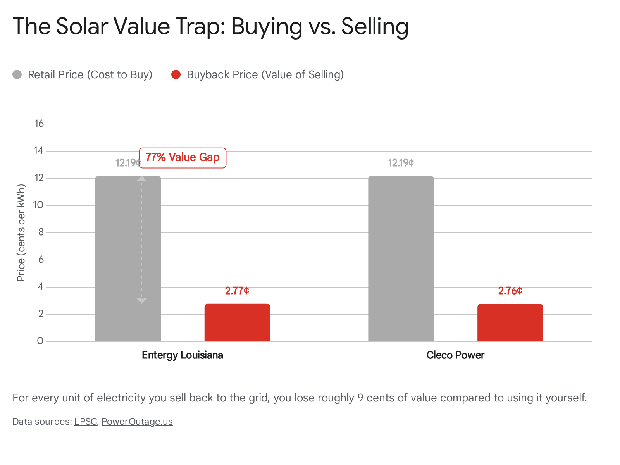
The LPSC publishes the Avoided Cost rates annually. Here is the current reality for the major utilities in the state 3:
| Utility Provider | Retail Rate (What You Pay) | Avoided Cost Rate (What They Pay You) | value Retention |
|---|---|---|---|
| Entergy Louisiana | ~$0.12 / kWh | $0.02768 / kWh | ~23% |
| CLECO Power | ~$0.12 / kWh | $0.02759 / kWh | ~23% |
| SWEPCO | ~$0.11 / kWh | $0.02742 / kWh | ~25% |
| DEMCO | ~$0.12 / kWh | $0.02759 / kWh | ~23% |
The Implication: For every kilowatt-hour of solar energy you send to the grid, you are losing roughly 9 cents of value compared to using that energy yourself.
This creates a perverse incentive: You are penalized for sharing your power.
---
Part 3: The Battery Revolution – Why Storage is Mandatory
Given the math outlined above, a "solar-only" installation (panels with no battery) is rarely a good financial decision in Louisiana today. If you install solar without a battery, roughly 40-60% of your production (the energy generated while you are at work) will be sent to the grid for pennies.
The New Strategy: Self-Consumption
The goal of a modern Louisiana solar system is Self-Consumption. You want to prevent your solar energy from ever touching the utility grid.
- Daytime: Solar panels power your home loads (AC, fridge, lights).
- Excess: Instead of sending excess power to the grid, it is diverted into a Battery.
- Nighttime: When the sun goes down, your house draws power from the Battery, not the grid.
By doing this, every kWh you store in the battery is worth 12 cents (the retail rate you didn't have to pay) rather than 3 cents (the avoided cost you would have been paid).
Battery Technology 101
If you are shopping for batteries in 2025, you will likely encounter two main types of Lithium-Ion technology. It is helpful to know the difference.
- NMC (Nickel Manganese Cobalt): used in Tesla Powerwall 2. High energy density (small size), but slightly higher fire risk and shorter cycle life.
- LFP (Lithium Iron Phosphate): used in Enphase IQ Batteries and FranklinWH. Heavier and bulkier, but extremely safe (no thermal runaway) and lasts for more charge cycles (often 6,000+).
- Recommendation: For the hot, humid climate of Louisiana, LFP batteries are often preferred for their durability and safety profile, though NMC remains very popular due to the Tesla ecosystem.
---
Part 4: New Orleans – The "Solar for All" Oasis
While the state policies are generally restrictive, the City of New Orleans (Orleans Parish) is carving a different path. The city has recognized that its grid infrastructure is fragile, and rather than just building more power plants, it is incentivizing residents to bring their own power.
The $28 Million Battery Incentive (December 2025)
In a landmark move, the New Orleans City Council voted on December 17, 2025, to approve a massive Distributed Energy Resource (DER) program. 5 This is the most significant solar news in the state in a decade.
- The Funding: $28 million allocated to incentivize residential and commercial battery storage.
- The Mechanism: The program pays homeowners an upfront incentive to install batteries.
- Estimated Value: While final applications are being drafted, reports indicate an incentive of approximately $75 per kWh of storage installed.16 For a standard 13.5 kWh battery (like a Powerwall), that is roughly a $1,000 rebate.
- Performance Payments: In addition to the upfront cash, the program creates a "Virtual Power Plant" (VPP). Homeowners can agree to let Entergy New Orleans draw power from their batteries during peak demand events (like a super-hot August afternoon). In exchange, the homeowner receives ongoing bill credits.
- Solar for All NOLA: This is a separate initiative partnering with developers like PosiGen and Solar Alternatives. It includes a subsidy funded by the Climate Pollution Reduction Grant (CPRG) that offers up to $5,000 for low-to-moderate income (LMI) residents to reduce the cost of the solar system itself.17
The Bottom Line for NOLA: If you live in Orleans Parish, do not sign a contract without asking your installer specifically about the "City Council DER Battery Incentive." This money is on the table, and you want to claim it.
---
Part 5: State Incentives – What’s Left?
Outside of New Orleans, state-level incentives are slim. There is a lot of outdated information circulating on the internet—let's clear up the confusion.
1. The 50% Tax Credit (Deceased)
You may have a neighbor or relative who claims the state paid for half their solar system. They are not lying, but they are living in the past.
- The Incentive: Louisiana R.S. 47:6030 was a 50% refundable tax credit.
- The Reality: It expired completely on December 31, 2015. It has not been renewed. Do not budget for it. 18
2. Property Tax Exemption (Alive and Well)
This is the most underrated incentive in the state.
- The Law: Louisiana offers a 100% Property Tax Exemption for solar energy systems. 14
- Why It Matters: In many states, if you add a $40,000 asset to your home, your property tax assessment goes up. In Louisiana, the tax assessor is legally prohibited from increasing your home's assessed value based on the solar panels.
- The Math:
- System Value: $30,000
- Assessment Ratio: 10% (Residential) = $3,000 Assessed Value
- Average Millage: 100 mills (varies by parish)
- Annual Savings: ~$300 per year.
- 25-Year Savings: ~$7,500.
- Note: This doesn't put cash in your pocket, but it prevents money from leaving it.
3. Sales Tax Exemptions
Louisiana has a complex sales tax system with both state (4.45%) and local (up to 7%) layers.
- General Rule: There is no statewide blanket exemption for residential solar purchases. You should expect to pay sales tax on the equipment.
- Exceptions: Some specific parishes or municipalities may have local exemptions, and purchases made by contractors for government projects are exempt. 20 Always ask your installer for a breakdown of the "Out the Door" price including taxes.
---
Part 6: The "Utility-Specific" Field Guide
Louisiana is not a monolith. Your solar experience depends entirely on which company sends you a bill every month. Here is a breakdown of the major players.
Entergy Louisiana (ELL)
- Territory: Most of the state (Baton Rouge, Lake Charles, North LA).
- Stance: Strictly follows LPSC rules.
- Solar Buyback: Avoided Cost (~2.7 cents/kWh).
- Billing: You will see a "net" line item on your bill. If you export 500 kWh, you get a credit of roughly $13.50.
- Advice: Undersize your system slightly (80-90% offset) to minimize exports, or get a battery.
CLECO Power
- Territory: Central Louisiana (Alexandria, parts of Northshore).
- Stance: Similar to Entergy. They have very specific interconnection guidelines.
- Key Detail: CLECO requires a "dual register" meter or a smart meter that tracks In and Out separately.
- Warning: Ensure your installer is "CLECO Certified." Their interconnection department is known for being strict on paperwork. 21
Lafayette Utilities System (LUS) – The Cautionary Tale
Lafayette operates its own municipal utility, and it has taken a stance that is widely considered hostile to solar customers.
- The "Solar Tax": LUS has implemented a specific rate class for solar customers (Rate C1NMO).
- The Fee: This rate includes a monthly customer charge that is significantly higher than the standard residential rate. As of late 2025, this charge is approximately $14.00 to $15.40 per month. 8
- The Economics: You pay a high monthly fee for the "privilege" of having solar, and you get paid a low avoided cost rate for your power.
- Result: The payback period in Lafayette is often 15-20 years, compared to 10-12 years elsewhere. Solar in Lafayette is a decision made for environmental or resilience reasons, not purely financial ones.
SWEPCO (Southwestern Electric Power Company)
- Territory: Shreveport, Bossier City, Haughton.
- Stance: Follows LPSC rules.
- Rider: "Net Metering Rider - Closed". 23 This confirms that new customers are placed on the new billing structure.
- Rates: Their avoided cost is roughly equal to Entergy and CLECO (~2.7 cents).
---
Part 7: The Economics – Does It Pencil Out?
Let's do the math for a "Typical Louisiana Home" in late 2025.
The Scenario:
- Location: Baton Rouge (Entergy Louisiana).
- Usage: 1,200 kWh/month (Average for LA, due to high AC use).
- Bill: ~$150/month ($1,800/year).
- System: 8 kW Solar + 10 kWh Battery.
- Gross Cost: ~$35,000 (Solar + Battery).
The Calculation (Dec 2025 Install):
- Gross Cost: $35,000.
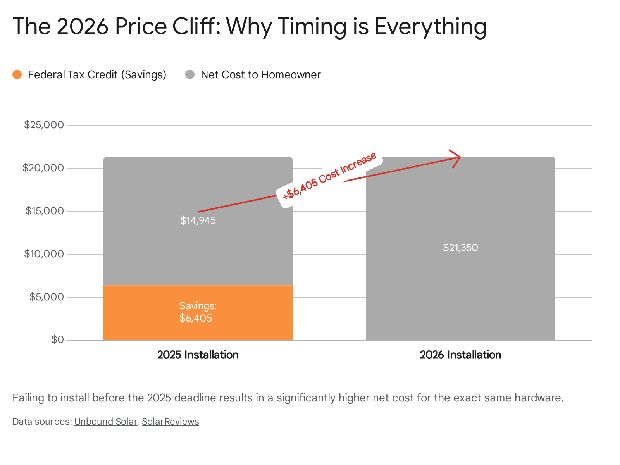
- Federal Tax Credit (30%): -$10,500.
- Net Cost: $24,500.
- Annual Savings: With a battery, you offset roughly 85% of your bill = ~$1,530/year saved.
- Simple Payback: $24,500 / $1,530 = ~16 Years.
The Calculation (Jan 2026 Install - No Tax Credit):
- Gross Cost: $35,000.
- Federal Tax Credit: $0.
- Net Cost: $35,000.
- Annual Savings: ~$1,530/year.
- Simple Payback: $35,000 / $1,530 = ~22.8 Years.
The Verdict:
- With Tax Credit (2025): 16 years is a long payback, but solar panels are warrantied for 25 years. You will have ~9 years of "free" power. It is a decent long-term bond.
- Without Tax Credit (2026): A 22-year payback is very hard to justify financially. At that point, you are doing it primarily for backup power during hurricanes, not for savings.
Important Note on Inflation: These calculations assume electricity prices stay flat. They won't. If Entergy rates rise by 3% a year (which is historically conservative), the payback period drops significantly, likely closer to 10-12 years for the 2025 scenario.
---
Part 8: Insurance – The Hidden Cost
You cannot discuss homeownership in Louisiana without addressing the elephant in the room: Insurance. Louisiana is facing an insurance crisis. Carriers are leaving the state, and premiums are rising faster than almost anywhere else in the nation (projected 27% increase in 2025).9
The Solar Conflict
- Replacement Cost Value (RCV): When you add $30,000 of solar equipment to your roof, your home is worth more. You must increase your "Dwelling Coverage" limit. This raises your premium.
- Wind Peril: Some insurers view solar panels as a liability. They worry about panels tearing off during a Category 4 hurricane and damaging the roof membrane, leading to water intrusion.
- Coverage Denials: We have seen reports of smaller insurers (especially "reciprocal" exchanges) refusing to renew policies for homes with solar panels, or excluding the panels from wind coverage.24
The Solution: The "Fortified Roof" Strategy
There is a way to hack the system. Louisiana has adopted the IBHS "Fortified" Roof Standard.
- The Incentive: Louisiana law mandates that insurers offer a significant discount (often 20-35% off the wind portion of your premium) for homes with a Fortified Roof. 10
- The Strategy: If your roof is more than 10 years old, do not put solar on it.
- Tear off the old roof.
- Install a new "Fortified Roof" (using ring-shank nails, sealed roof deck, and locking shingles).
- Get the Fortified Certificate.
- Install Solar.
- The Result: The discount from the Fortified roof often completely offsets the premium increase from the solar panels. You get a stronger roof, lower insurance, and solar power, all balancing out.
---
Part 9: Consumer Protection – Avoiding the Sharks
The solar industry has a "Wild West" reputation, and Louisiana is no exception. With the looming 2025 deadline, aggressive sales tactics are on the rise. Here is how to protect yourself.
1. The "Free Solar" Scam
If a door-to-door salesperson tells you there is a "Government Program" that will give you "Free Solar," shut the door.
- Truth: The government offers tax credits (which you wait for), not upfront cash. "Free Solar" is usually a misleading pitch for a Power Purchase Agreement (PPA) or a Lease.
- PPA/Lease: In these deals, you don't own the panels. You pay the company for the power the panels produce. These contracts often have "escalator clauses" where the price goes up every year. They can also make selling your home difficult, as the buyer has to agree to take over the lease. 14
2. The "Utility Rebate" Lie
Salespeople may claim that Entergy or CLECO will send you a check to pay for the system.
- Truth: As we established, Louisiana utilities pay avoided cost (pennies). There are no cash rebates from the utilities for solar panels (except the specific battery program in New Orleans).
3. Solar Rights & Your HOA
If you live in a subdivision with a Homeowners Association (HOA), they might try to block your installation.
- The Law: Louisiana Revised Statute 9:1255 is the "Solar Rights Act."
- The Text: "No person or entity shall unreasonably restrict the right of a property owner to install or use a solar collector." 26
- What it Means: Your HOA cannot ban solar. They cannot force you to put panels on the north side of the roof (where they don't work) just because it's "hidden."
- The Exception: Historic Districts. If you live in a designated Historic District (like the French Quarter or Garden District), the preservation commission can restrict or ban solar panels to preserve the historic character of the building.
---
Part 10: Step-by-Step Action Plan
If you have decided to move forward, here is your roadmap for the remainder of 2025.
Step 1: Get Multiple Quotes (Immediately)
Do not buy from the first person who knocks on your door. Get at least 3 quotes. Compare the "Price per Watt" (Total Cost / System Size in Watts). A fair price in Louisiana is roughly $3.00 - $3.50 per watt for solar+battery.
Step 2: Check Your Roof
If your roof has less than 15 years of life left, replace it now. Consider the "Fortified" upgrade for insurance reasons.
Step 3: Secure Financing
If you are taking a loan, watch out for "Dealer Fees." Many "low interest" solar loans (e.g., 2.99%) have massive upfront fees (20-30%) added to the loan balance. It is often better to take a higher interest rate with no dealer fee and pay it off early.
Step 4: Sign and Schedule
You need to be in the installation queue now to beat the December 31, 2025 deadline. Supply chains can slow down at the end of the year as everyone rushes to buy.
Step 5: File Your Tax Credit
When you file your 2025 taxes (in early 2026), you will use IRS Form 5695. This is where you claim your 30% credit.
Conclusion
Louisiana offers a challenging but rewarding environment for solar energy. We have abundant sunshine, but we also have regulatory hurdles and a looming federal deadline. The decision to go solar in 2025 is not just about saving a few dollars on your bill next month. It is about locking in your energy costs for the next 25 years in a world of rising prices. It is about keeping the lights on when the next hurricane strikes. And, for the next few months, it is about capturing a massive federal incentive before it disappears forever. The window is closing. If you are going to jump, jump now.
Disclaimer: This report is for informational purposes only. The author is not a tax professional or a certified financial planner. Tax laws (especially the "One Big Beautiful Bill" provisions) are subject to change and interpretation. Always consult with a CPA regarding your eligibility for tax credits and an insurance agent regarding your specific property coverage.
Works cited
- Solar Rebates and Solar Tax Credits for Louisiana, accessed December 18, 2025, https://unboundsolar.com/solar-information/state-solar-incentives/louisiana
- LPSC – Utilities Net Metering – Louisiana Public Service Commission, accessed December 18, 2025, https://www.lpsc.louisiana.gov/Utilities_NetMetering
- Net metering and distributed generation – Entergy Louisiana, accessed December 18, 2025, https://www.entergylouisiana.com/net-metering
- Avoided Cost Rate by Electric Utility 2024, accessed December 18, 2025, https://www.lpsc.louisiana.gov/docs/utilities/Avoided-Cost-rate-by-Electric-Utility_2024.pdf
- New Orleans City Council to vote on $28 million battery backup incentive program, accessed December 18, 2025, https://www.wwltv.com/article/news/local/orleans/new-orleans-city-council-to-vote-on-28-million-battery-backup-incentive-program/289-91182c85-1e61-417d-98ca-da0bfbb1105d
- Mayor-Elect Moreno Announces Launch of New Orleans' First Distributed Energy Resource Program, Inves, accessed December 18, 2025, https://council.nola.gov/news/december-2025/mayor-elect-moreno-announces-launch-of-new-orleans/
- Local utility quietly clouds solar future – Southern Alliance for Clean Energy (SACE), accessed December 18, 2025, https://cleanenergy.org/news/lafayetteutilitiessystem/
- ELECTRIC, Net metering – Lafayette Utilities System, accessed December 18, 2025, https://www.lus.org/wp-content/uploads/2024/11/2024.11.01_Electric-Rates_Electric_Net-Meter.pdf
- Anti-climate policies driving up insurance costs for homeowners, experts say | The Invading Sea, accessed December 18, 2025, https://www.theinvadingsea.com/2025/12/17/insurance-costs-climate-change-trump-cuts-disaster-relief-resiliency-tariffs-data-renewable-energy/
- Louisiana Insurance Discount Guide – GNO, Inc., accessed December 18, 2025, https://gnoinc.org/business-climate/public-policy/louisiana-insurance-discount-guide/
- Federal megabill threatens Louisiana's clean energy future, accessed December 18, 2025, https://investlouisiana.org/federal-megabill-threatens-louisianas-clean-energy-future/
- 2025 Solar Incentives Guide for New Orleans, LA – Tax Credits & Rebates – EcoWatch, accessed December 18, 2025, https://www.ecowatch.com/solar/incentives/la/new-orleans
- Residential Clean Energy Credit | Internal Revenue Service, accessed December 18, 2025, https://www.irs.gov/credits-deductions/residential-clean-energy-credit
- Louisiana Solar Incentives, Tax Credits & Rebates (2025 Guide) – This Old House, accessed December 18, 2025, https://www.thisoldhouse.com/solar-alternative-energy/solar-incentives-louisiana
- Louisiana Solar Panel Cost: Savings and Payback (December 2025) – PowerOutage.us, accessed December 18, 2025, https://poweroutage.us/solar/la
- New Ways For Entergy Louisiana Customers To Save – AAE, accessed December 18, 2025, https://www.all4energy.org/watchdog/new-ways-for-ell-customers-to-save/
- Resilience & Sustainability – Energy – Solar for All – City of New Orleans, accessed December 18, 2025, https://nola.gov/next/resilience-sustainability/energy/solar-for-all/
- Revenue Information Bulletin No. 25-012 – Louisiana.gov, accessed December 18, 2025, https://dam.ldr.la.gov/lawspolicies/RIB-25-012-Louisiana-Individual-Income-Tax-Reform-1.pdf
- Guide to Louisiana Solar Incentives & Tax Credits in 2025 – SolarReviews, accessed December 18, 2025, https://www.solarreviews.com/solar-incentives/louisiana
- Louisiana Department of Revenue Provides Guidance Regarding Recent Sales Tax Changes | Gulf Coast Business Law Blog, accessed December 18, 2025, https://www.gulfcoastbusinesslawblog.com/2025/08/louisiana-department-of-revenue-provides-guidance-regarding-recent-sales-tax-changes/
- 2025 Cleco Large Commercial & Industrial Energy Efficiency Program 2025 LA Quick Start Phase I Program Year 11 (PY11), accessed December 18, 2025, https://www.cleco.com/docs/default-source/energy-efficiency/contractor/2022-cleco-large-commercial-industrial-program-manual.pdf?sfvrsn=8dd5fb1c_10
- 2025 Cleco Residential Solutions Energy Efficiency Program, accessed December 18, 2025, https://www.cleco.com/docs/default-source/energy-efficiency/contractor/cleco-residential-solutions-program-manual.pdf?sfvrsn=ecea9a9f_43
- LPSC Electric Tariff, accessed December 18, 2025, https://www.swepco.com/lib/docs/ratesandtariffs/Louisiana/LA_Tariff_Book_as_of_082825.pdf
- An arcane type of property insurer is surging on the Gulf Coast – POLITICO Pro, accessed December 18, 2025, https://subscriber.politicopro.com/article/eenews/2025/11/21/an-arcane-type-of-property-insurer-is-surging-on-the-gulf-coast-00660244
- Solar Panels and Homeowners Insurance – What's Covered?, accessed December 18, 2025, https://www.solar.com/learn/solar-panel-insurance/
- RS 9:1255 – Louisiana Laws – Louisiana State Legislature, accessed December 18, 2025, https://legis.la.gov/legis/Law.aspx?d=725379
- 2024 Louisiana Laws Revised Statutes Title 9 – Civil Code-Ancillaries §9:1255. Solar collectors; right of use, accessed December 18, 2025, https://law.justia.com/codes/louisiana/revised-statutes/title-9/rs-9-1255/