If you live in New York and pay an electric bill, you have probably noticed that the price of keeping the lights on isn't going down. You might have looked at your roof and wondered if those solar panels popping up all over the neighborhood are actually worth the hype, or if they are just expensive lawn ornaments. It is a fair question. The world of home energy is filled with confusing jargon, aggressive sales pitches, and government websites that seem designed to put you to sleep.
But here is the reality: New York State is currently sitting in a "Goldilocks" zone for solar energy. We have high electricity rates (which makes making your own power valuable) combined with some of the most generous incentives in the entire country. However, the clock is ticking. We are approaching a massive deadline at the end of 2025 that will change the financial math for everyone.
This report is written for you—the homeowner who wants the truth without the fluff. We are going to walk through every single program, tax credit, and rebate available to you. We will explain how they stack on top of each other, how to claim them, and most importantly, why acting sooner rather than later could save you thousands of dollars.
TL;DR: The Summary for Busy Homeowners
If you don't have time to read every page right now, here are the critical takeaways you need to know immediately:
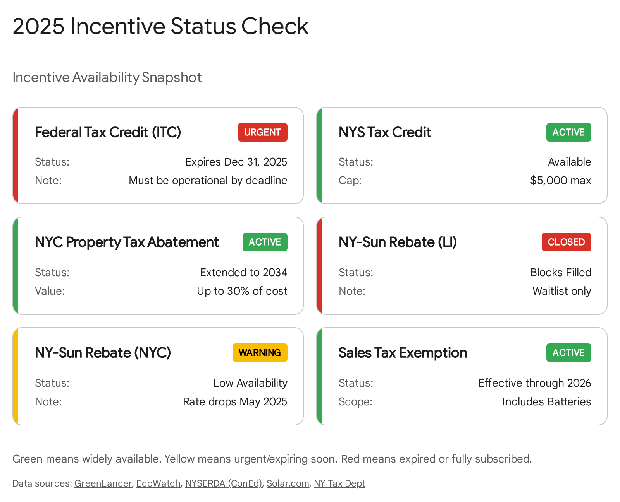
- The Federal Tax Credit is Ending: A major piece of legislation referred to as the "One Big Beautiful Bill" (OBBB) is set to eliminate the 30% Federal Investment Tax Credit after December 31, 2025. If your system isn't turned on by then, you lose this massive discount. 1
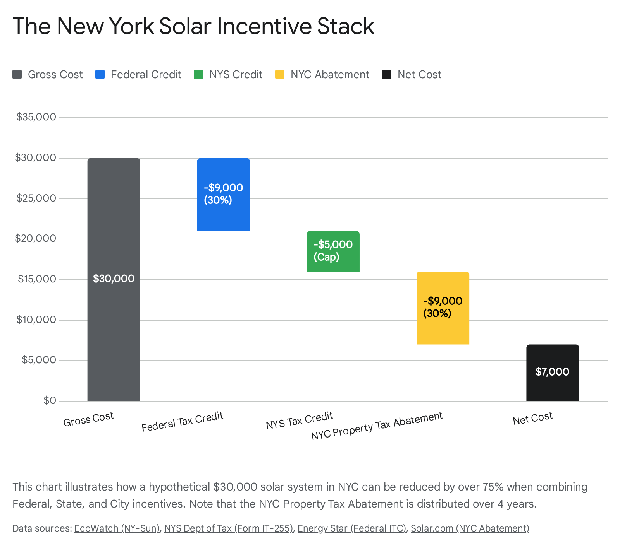
- New York State Pays You Back: On top of the federal money, New York offers its own tax credit worth 25% of your system cost, capped at $5,000. 3
- Where You Live Matters:
- Net Metering is Still Alive (For Now): You can still lock in "Phase One" Net Metering, which is the simple system where you trade power with the grid 1-for-1. This is generally better than the newer "VDER" system for most homes, but you need to act before rules change. 7
---
The Federal Solar Investment Tax Credit (ITC): The Foundation of Savings
When we talk about saving money on solar, the conversation almost always starts with the Federal Investment Tax Credit, often just called the ITC. For years, this has been the bedrock of the solar industry in the United States. It is likely the largest single chunk of money you will get back on your investment. However, due to recent legislative changes, understanding the timeline of this credit is more important now than it has been in a decade.
Understanding the 30% Credit
The mechanism of the ITC is straightforward but powerful. The federal government allows you to claim a tax credit equal to 30% of your total solar system cost. 8
It is important to understand the difference between a "tax deduction" and a "tax credit." A tax deduction lowers the amount of income you are taxed on. If you make $100,000 and get a $10,000 deduction, you are taxed as if you made $90,000. That might save you a couple of thousand dollars depending on your bracket. A tax credit, on the other hand, is a dollar-for-dollar reduction of the taxes you owe. If you owe the IRS $10,000 and you have a $10,000 tax credit, you owe the IRS zero. It is as good as cash in your pocket, provided you have a tax bill to apply it against.
The 30% rate applies to almost every cost associated with the project. This includes the solar panels themselves, the inverter (the box that changes the electricity from DC to AC), the racking equipment that holds the panels on your roof, and all the labor costs for site preparation and installation. 8
For example, if you install a system that costs $25,000, your federal tax credit calculation would look like this:
- Total Cost: $25,000
- Credit Percentage: 30%
- Total Savings: $7,500
This effectively brings the price of your system down to $17,500 before we even look at state incentives.
The "One Big Beautiful Bill" and the 2025 Expiration
Here is the critical news that every homeowner needs to digest. In the past, the solar tax credit was on a schedule to slowly "step down"—dropping from 30% to 26%, then to 22%. However, recent research indicates a significant change in the legislative landscape. A law referred to as the "One Big Beautiful Bill" (OBBB) has altered the timeline dramatically.
According to IRS guidance regarding this legislation, the Residential Clean Energy Credit (Section 25D) will not be allowed for any expenditures made after December 31, 2025. 10
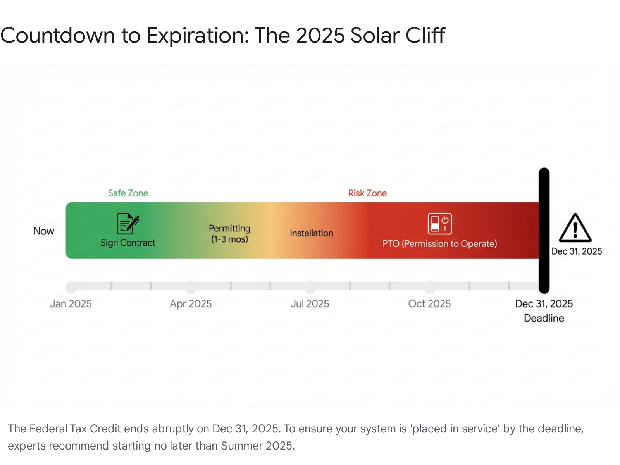
This creates a "hard cliff." There is no phase‑down mentioned in this specific legislative update—just a termination. This makes 2025 a uniquely critical year. If you wait until 2026 to install solar, you are potentially forfeiting 30% of the project's value. On a $30,000 system, waiting one month too long could cost you $9,000.
The "Placed in Service" Rule
To claim the credit for the 2025 tax year, simply signing a contract isn't enough. Buying the panels isn't enough. The IRS requires that the system be "placed in service". 1
What does "placed in service" mean? The IRS defines it as the point when the property is in a condition of readiness and availability for its specifically assigned function. 1 For a solar electric system, this generally means the installation is complete, and the system is capable of generating electricity. Some interpretations suggest it requires the final inspection and "Permission to Operate" (PTO) from your utility company.
This distinction is vital because solar projects take time. The process involves:
- Signing a contract.
- Site assessment and engineering.
- Obtaining municipal building permits (which can take weeks or months).
- Installation (usually 1-3 days).
- Electrical inspection.
- Utility interconnection approval.
If you sign a contract in November 2025, there is a very high probability that your system will not be "placed in service" before the December 31st deadline due to permitting or weather delays. Industry experts recommend starting your project by summer 2025 at the absolute latest to ensure you cross the finish line in time. 1
Eligibility Requirements
To take advantage of the Federal ITC, you need to meet a few basic criteria:
- Home Ownership: You must live in the home where the solar panels are installed. It can be a primary or secondary residence (like a vacation home), but you cannot claim it for a property you rent out to others full-time.12
- System Ownership: You must buy the system. This can be a cash purchase or a loan (which we will discuss later). If you sign a "lease" or "Power Purchase Agreement" (PPA) where a third‑party company owns the panels on your roof, they get the tax credit, not you.9
- Tax Liability: The credit is non‑refundable. This means if your tax credit is $7,500 but you only owe the IRS $5,000 in taxes for the year, the IRS will not write you a check for the difference. However, under current rules, you can usually "carry forward" the unused portion to the next tax year. With the 2025 expiration looming, you should consult a tax professional to see how carry‑forward rules might apply if the credit expires. 12
---
The New York State Solar Energy System Equipment Credit
While the federal government offers a nationwide incentive, New York State has stepped up with one of the most robust state‑level tax credits in the union. This is legally separate from the federal credit, meaning you can utilize both for the same project.
Calculating the State Credit
The New York State Solar Energy System Equipment Credit allows you to deduct 25% of your qualified solar expenditures from your state income taxes. 3 However, unlike the federal credit which has no cap, the state credit is capped at $5,000. 13
Let's look at how this math works for different system sizes:
Scenario A: A Smaller System ($15,000)
- You install a modest system for $15,000.
- 25% of $15,000 is $3,750.
- Since $3,750 is below the $5,000 cap, you receive the full $3,750 credit.
Scenario B: An Average System ($25,000)
- You install a standard residential system for $25,000.
- 25% of $25,000 is $6,250.
- This amount exceeds the cap. Therefore, your credit is limited to $5,000.
Because solar installations in New York often cost between $20,000 and $30,000, most homeowners should budget for receiving the flat $5,000 maximum credit.
Claiming the Credit: Form IT-255
Claiming this credit is done when you file your annual New York State tax return. You will need to complete Form IT-255 (Claim for Solar Energy System Equipment Credit). 3
Like the federal credit, the NYS credit is non‑refundable. If you have a state tax liability of $3,000 and a solar credit of $5,000, you will reduce your tax bill to zero. The remaining $2,000 isn't lost, though—it can be carried forward for up to five years. 3 This is an excellent feature for retirees or those with lower taxable income, as it ensures you eventually capture the full value of the incentive.
---
The NY‑Sun "Megawatt Block" Program
While tax credits are great, they require you to wait until tax season to see the money. New York's signature solar program, NY‑Sun, offers something different: an upfront incentive that reduces the cost of the system immediately.
This program is structured around "Megawatt Blocks." The state has allocated a certain amount of solar capacity (measured in megawatts, or MW) to different regions. Each block has a specific cash rebate rate. When the solar capacity in a block is sold out, that block closes, and the next block opens with a lower incentive rate. It is a system designed to reward early action.
The state is divided into three distinct regions for this program, and the incentives vary wildly depending on where you live.
Region 1: Con Edison (New York City & Westchester)
This region covers the territory served by Con Edison. Due to the high cost of electricity and the density of the grid, incentives here have historically been high, but they are moving fast.
- Current Status: The residential blocks in the Con Edison region have been extremely popular. As of 2025, the incentive rate for the current blocks (Blocks 9 and 10) is roughly $0.20 per watt. 5
- The Math: For a typical 7‑kilowatt (7,000‑watt) system, a $0.20/watt rebate equals $1,400.
- Warning: The data shows that later blocks (like Block 10) drop to $0.15/watt. 14 This means waiting could cost you hundreds of dollars in upfront rebates.
- Availability: These incentives are "fully allocated" in some reports, meaning they are running out or largely spoken for. 15 You must verify with your installer immediately if any capacity remains in your specific area.
Region 2: Long Island (Nassau & Suffolk)
Long Island has been a leader in solar adoption for years. Unfortunately, that success has a downside for latecomers.
- Current Status: The residential Megawatt Blocks for Long Island are fully subscribed (closed). 5
- The Reality: If you live on Long Island, you generally will not receive a NY‑Sun upfront rebate for a standard residential project. However, do not let this discourage you. The high cost of electricity on Long Island still makes solar a very strong investment when you factor in the tax credits and fuel savings.
Region 3: Upstate
This region covers the vast majority of the state's geography, serviced by utilities like National Grid, NYSEG, RG&E, Central Hudson, and Orange & Rockland.
- Current Status: The Upstate region is active. The residential incentive rate is typically around $0.20 per watt. 5
- The Math: Similar to NYC, a 7kW system would receive an upfront discount of roughly $1,400.
- Status Check: While active, these blocks also fill up. As the state moves toward its installation goals, these incentives will eventually phase out entirely.
Income‑Eligible "Adders"
The NY‑Sun program includes special "Adders"—extra incentives for specific circumstances. The most significant one for homeowners is the Affordable Solar Residential Incentive.
If your household income is less than 80% of the median income in your area, you may qualify for a doubled incentive.
- The Impact: In the Upstate region, for example, qualifying for this adder increases the incentive from roughly $0.20/watt to $0.80/watt. 16
- The Math: On that same 7kW system, the rebate jumps from $1,400 to $5,600. This makes solar incredibly accessible for moderate‑income families.
---
The NYC Property Tax Abatement: The City Advantage
If you own a home in New York City (the five boroughs), you have access to a powerful incentive that isn't available to the rest of the state: the Solar Electric Generating System Tax Abatement (SEGS).
How the Abatement Works
This is a reduction in your property taxes—the bill you pay to the NYC Department of Finance—not your income taxes.
- The Rate: The abatement is worth 30% of your solar installation cost. 4
- The Limit: The annual abatement cannot exceed your property tax liability for that year, or $62,500 (whichever is less). 18
The Four‑Year Distribution
You do not get the entire 30% break in a single year. The city spreads the benefit over four years in equal installments. 18
Let's break down an example for a NYC homeowner:
- System Cost: $30,000.
- Total Abatement Value: 30% of $30,000 = $9,000.
- Annual Benefit: $9,000 divided by 4 years = $2,250 per year.
For the next four years, your property tax bill will be reduced by $2,250 each year. If your annual property tax bill is $5,000, you would only pay $2,750.
Note: If your property taxes are very low (perhaps due to other exemptions), and your tax bill is less than the abatement amount (e.g., your tax is only $1,500), the abatement will simply zero out your tax bill. You generally cannot get a refund for the "unused" portion of the abatement in a given year, nor can you carry it forward indefinitely like the state tax credit.
Extension to 2035
Recent legislation has extended this abatement program through January 1, 2035. 4 This makes it one of the most stable long‑term incentives available to NYC residents, contrasting sharply with the expiring federal credit.
---
Sales Tax Exemptions: Saving at the Register
When we buy almost anything in New York, we expect to add nearly 9% to the price tag for sales tax. Solar energy systems are a welcome exception.
State Sales Tax
New York State completely exempts residential solar energy systems from the 4% state sales tax. 19 You do not need to do anything special to claim this; your installer simply should not charge you this tax on the invoice.
Local Sales Tax
In addition to the state tax, we all pay local county or city sales taxes (usually another 4‑4.8%). The state law allows counties and cities to decide whether they want to exempt solar from their local portion as well.
- The Good News: Many major jurisdictions, including New York City, Nassau County, Suffolk County, and Westchester County, have opted to exempt solar from local sales tax.
- The Result: For most homeowners in downstate New York, your sales tax on a $25,000 system is $0.00. This saves you roughly $2,100 upfront compared to buying a car or renovation materials of the same price.
---
Net Metering vs. VDER: How You Get Paid
This section is arguably the most technical part of the report, but it is critical to understanding your long‑term savings. Solar panels produce power during the day when the sun is out. Often, they produce more power than your home is using at that exact moment. That extra electricity flows backward through your meter and onto the grid for your neighbors to use. The big question is: How much does the utility company pay you for that power?
In New York, there are two main systems for this: Net Metering and the Value of Distributed Energy Resources (VDER).
The Old Standard: Net Metering
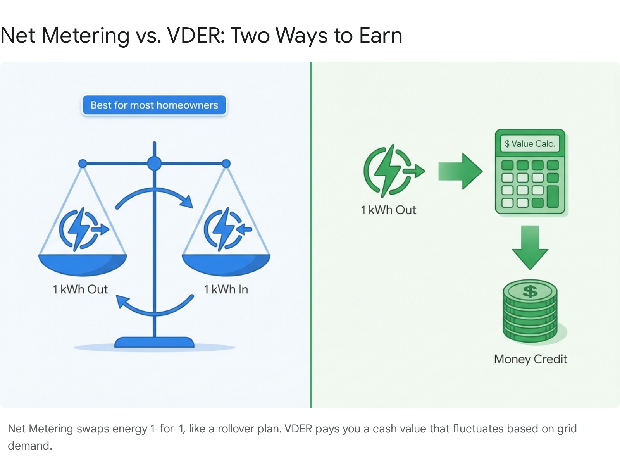
For decades, New York used a simple system called Net Metering. It works like a rollover minutes plan for electricity.
- The Mechanism: If you send 1 kilowatt‑hour (kWh) of electricity to the grid at noon, you get a credit for 1 kWh.
- The Redemption: Later that night, when you turn on your TV and use 1 kWh from the grid, that credit cancels it out.
- The Math: It is a 1‑to‑1 swap. You are effectively "paid" the full retail price for your solar power because every kWh you generate saves you from buying a full‑priced kWh later.
The New System: VDER (The Value Stack)
New York has been transitioning to a more complex system called VDER. Instead of trading kWh for kWh, the utility calculates the monetary value of the electricity you provide based on when and where you provide it. 20 This is called the "Value Stack."
The value is built from several components:
- LBMP (Energy Value): The wholesale price of electricity at that hour.
- ICAP (Capacity Value): The value of helping the grid meet peak demand.
- E (Environmental Value): The value of the carbon you avoided.
- DRV (Demand Reduction Value): The value of reducing strain on the distribution lines.
Under VDER, your credits are in dollars, not kWh. These dollar credits roll over on your bill to pay for future usage.
The "Phase One" Net Metering Life Raft
VDER is complicated, and for many residential customers, it can be less predictable than Net Metering. Recognizing this, New York regulators created a "Phase One" rule.
As of 2025, residential customers generally still have the option to choose classic Net Metering. 7 This is fantastic news because Net Metering offers the ultimate predictability.
The Catch: The Customer Benefit Contribution (CBC)
If you choose Net Metering today, you must pay a small monthly fee called the Customer Benefit Contribution (CBC). This charge is designed to ensure solar customers still contribute to public benefit programs (like low‑income assistance) that are usually funded through energy charges.
- The Cost: The CBC varies by utility but typically ranges from $0.70 to $1.33 per kW per month. 23
- Example: For a 7kW system, the CBC might be roughly $5 to $9 per month.
- The Verdict: Even with this small monthly fee, Net Metering is usually the better, safer, and simpler choice for most homeowners. It locks in your savings model for 20 years. 23
---
Battery Storage Incentives
More homeowners are pairing their solar panels with battery storage (like the Tesla Powerwall) to keep the lights on during blackouts. While batteries are expensive, New York offers specific incentives to help cover the cost.
NYSERDA Battery Incentives
Just like the NY‑Sun rebates for solar panels, NYSERDA has block incentives for batteries.
- Upstate: The current incentive is roughly $200 per kWh of storage capacity. 24 A standard residential battery is often around 13.5 kWh.
- Calculation: 13.5 kWh × $200 = $2,700 rebate.
- Long Island: The incentives here can be even higher, often reaching $250 per kWh or more, depending on the dynamic load management programs available. 25
- NYC: Con Edison territory also has active battery incentives, typically around the $250 per kWh mark. 24
Sales Tax Exemption for Storage
In a significant win for homeowners, New York recently passed legislation creating a sales tax exemption specifically for residential energy storage systems.
- The Window: This exemption is effective from June 1, 2024, through May 31, 2026. 26
- The Benefit: If you install a battery during this two‑year window, you will pay 0% state sales tax on the equipment and installation. On a $15,000 battery job, that saves you another $600+.
---
Financing: Paying for the Project
If you don't have $20,000 cash to pay for the system upfront, you are not alone. New York has established the Green Jobs – Green New York (GJGNY) loan fund to make financing accessible.
GJGNY Residential Loans
These loans are administered by NYSERDA and offer competitive terms compared to high‑interest credit cards or personal loans.
- Interest Rates: As of the latest program manuals, rates are typically tiered based on income and how you pay. Standard rates have historically been around 4.5% or 8.0%. 28
- Auto‑Pay Discount: You can usually knock 0.5% off your interest rate by signing up for automatic payments.
- Loan Terms: You can spread the payments out over 5, 10, or 15 years. 28
- The "On‑Bill Recovery" Loan: This is arguably the most convenient way to pay. Instead of writing a separate check to a bank, your loan payment is added directly to your utility bill (ConEd, National Grid, etc.).
- The Golden Rule: The state requires that your estimated monthly energy savings must be greater than your monthly loan payment. This ensures that your total household cash flow is positive from day one. You are essentially paying for the solar panels using the money you used to pay the electric company.
---
Low‑Income Programs: Solar for Everyone
New York has prioritized "Disadvantaged Communities" to ensure that the clean energy transition doesn't leave anyone behind.
EmPower+
The EmPower+ program helps low‑to‑moderate‑income (LMI) households save energy. If your household income is below 80% of the State Median Income (SMI), you may be eligible for significant subsidies. 29
Solar for All
For families who cannot install panels on their own roof (perhaps because they rent, live in an apartment, or have a shaded roof), Solar for All offers a solution.
- How it Works: The state pays for a subscription to a community solar farm on your behalf.
- The Benefit: You receive a monthly credit on your electric bill, reducing your costs with absolutely no upfront investment or installation required. 32 It is essentially a free utility bill reduction for eligible households.
---
Conclusion: The "2025 Cliff" and Your Action Plan
We have covered an immense amount of detail, from tax forms to kilowatt‑hour calculations. But as we close this report, the most important takeaway is not about math—it is about timing.
The solar landscape in New York is currently defined by the expiration of the Federal Investment Tax Credit at the end of 2025. The legislation known as the "One Big Beautiful Bill" has drawn a line in the sand: December 31, 2025.
If your solar panels are not installed, inspected, and "placed in service" by that date, you lose the 30% federal incentive. On a typical project, that is a loss of $7,000 to $10,000. Combined with the dwindling "Megawatt Blocks" in the NY‑Sun program, we are currently in the "Golden Hour" for New York solar. The incentives have likely peaked and will only decrease from here.
Your Step‑by‑Step Action Plan
- Start Now: Do not wait until late 2025. Installers will be overwhelmed, and permitting offices will be backed up. Aim to have a contract signed by Summer 2025 at the absolute latest to ensure completion by December.
- Ask the Hard Questions: When getting quotes, ask your installer: "Which NY‑Sun block are we in?" and "Can we guarantee installation before the December 31, 2025 deadline?"
- Secure Net Metering: Confirm that your interconnection application selects "Phase One Net Metering" to lock in your 1‑to‑1 credits for 20 years. 23
- Explore Financing: Ask about the NYSERDA On‑Bill Recovery loan to see if you can swap your electric bill for a lower solar loan payment.
The sun is shining on New York's energy market, but the clouds of regulatory change are gathering on the horizon. By acting in 2025, you can secure a financial advantage that will pay dividends for decades to come.
Works cited
- Residential Solar Tax Credit Going Away In US After 2025 – GreenLancer, accessed December 18, 2025, https://www.greenlancer.com/post/solar-tax-credit-ending
- Which IRA Clean Energy Tax Credits Expire in 2025? – DCSEU, accessed December 18, 2025, https://www.dcseu.com/resource-library/2024-ira-clean-energy-tax-credits
- Instructions for Form IT-255 Claim for Solar Energy System Equipment Credit Tax Year 2024, accessed December 18, 2025, https://www.tax.ny.gov/pdf/current_forms/it/it255i.pdf
- NYC Solar Property Tax Abatement Extended Through 2035. Here’s How It Works. – Solar.com, accessed December 18, 2025, https://www.solar.com/learn/new-york-citys-solar-property-tax-abatement-extended/
- Homeowner’s guide to New York’s Megawatt Block solar incentive program – SolarReviews, accessed December 18, 2025, https://www.solarreviews.com/blog/guide-to-new-york-megawatt-block-solar-incentive-program
- 2025 New York Solar Incentives Guide (Tax Credits, Rebates & More) – EcoWatch, accessed December 18, 2025, https://www.ecowatch.com/solar/incentives/ny
- Complete Guide To New York Net Metering – SolarReviews, accessed December 18, 2025, https://www.solarreviews.com/blog/new-york-net-metering
- Federal Tax Credits for Energy Efficiency, accessed December 18, 2025, https://www.energystar.gov/about/federal-tax-credits
- Solar Investment Tax Credit (ITC) – SEIA, accessed December 18, 2025, https://seia.org/solar-investment-tax-credit/
- FAQs for modification of sections 25C, 25D, 25E, 30C, 30D, 45L, 45W, AND 179D under Public Law 119-21, 139 Stat. 72 (July 4, 2025), commonly known as the One, Big, Beautiful Bill (OBBB) | Internal Revenue Service, accessed December 18, 2025, https://www.irs.gov/newsroom/faqs-for-modification-of-sections-25c-25d-25e-30c-30d-45l-45w-and-179d-under-public-law-119-21-139-stat-72-july-4-2025-commonly-known-as-the-one-big-beautiful-bill-obbb
- What to Know About Expiring Energy Tax Credits | NAHB, accessed December 18, 2025, https://www.nahb.org/blog/2025/07/expiring-energy-tax-credits
- Residential Clean Energy Credit | Internal Revenue Service, accessed December 18, 2025, https://www.irs.gov/credits-deductions/residential-clean-energy-credit
- Solar Energy System Equipment Credit – Tax.NY.gov, accessed December 18, 2025, https://www.tax.ny.gov/pit/credits/solar_energy_system_equipment_credit.htm
- Con Edison Dashboard – NYSERDA – NY.Gov, accessed December 18, 2025, https://www.nyserda.ny.gov/All-Programs/NY-Sun/Contractors/Dashboards-and-incentives/ConEd-Dashboard
- NY‑Sun PV Incentive Program (Residential, Low‑Income, and Small Business) – DSIRE, accessed December 18, 2025, https://programs.dsireusa.org/system/program/detail/701
- Upstate Solar Incentive Block Dashboard – NYSERDA – NY.Gov, accessed December 18, 2025, https://www.nyserda.ny.gov/All-Programs/NY-Sun/Contractors/Dashboards-and-incentives/Upstate-Dashboard
- How does the New York State solar tax credit work? | Brooklyn SolarWorks, accessed December 18, 2025, https://brooklynsolarworks.com/blog/nys-solar-tax-credit/
- Solar Electric Generating System (SEGS) Tax Abatement – NYC.gov, accessed December 18, 2025, https://www.nyc.gov/site/finance/property/landlords-solar-roof.page
- 2025 Federal Solar Tax Credit & New York Incentives:… – GreenLogic, accessed December 18, 2025, https://greenlogic.com/blog/2025-federal-solar-tax-credit-new-york-incentives-what-you-need-to-know
- VDER: New York's Replacement For Net Metering – EnergySage, accessed December 18, 2025, https://www.energysage.com/solar/vder-ny-replacement-net-metering/
- the Value Stack – Value of Distributed Energy Resources – nyserda – NY.Gov, accessed December 18, 2025, https://www.nyserda.ny.gov/All-Programs/NY-Sun/Contractors/Value-of-Distributed-Energy-Resources
- New York Solar Incentives, Tax Credits & Rebates 2025 – EnergySage, accessed December 18, 2025, https://www.energysage.com/local-data/solar-rebates-incentives/ny/
- How Solar Net Metering Works in New York and What's Changing Soon – Empire Solar, accessed December 18, 2025, https://empiresolarny.com/net-metering-new-york/
- New York's Battery Incentive Benefits Homeowners – NYSSF, accessed December 18, 2025, https://nyssf.com/new-yorks-battery-incentive-benefits-homeowners/
- Residential Incentive Dashboard – nyserda – NY.Gov, accessed December 18, 2025, https://www.nyserda.ny.gov/All-Programs/Energy-Storage-Program/Developers-and-Contractors/Residential-and-Retail-Storage-Incentives/Residential-Dashboard
- New York State Offers Tax Exemption for Residential Energy Storage Systems – Sales Tax Institute, accessed December 18, 2025, https://www.salestaxinstitute.com/resources/new-york-state-offers-tax-exemption-for-residential-energy-storage-systems
- TSB-M-24(1)S Sales and Use Tax Exemption for Residential Energy Storage Systems – NY State Tax, accessed December 18, 2025, https://www.tax.ny.gov/pdf/memos/sales/m24-1s.pdf
- Green Jobs‑Green New York Residential Financing Program manual for Participating Contractors – NYSERDA, accessed December 18, 2025, https://www.nyserda.ny.gov/-/media/Project/Nyserda/Files/Programs/Home-Energy-Efficiency/gjgny-loan-fund-manual.pdf
- Inflation Reduction Act: Homeowners – NYSERDA – NY.Gov, accessed December 18, 2025, https://www.nyserda.ny.gov/All-Programs/Inflation-Reduction-Act/Inflation-Reduction-Act-homeowners
- EmPower+ – NYSERDA – NY.Gov, accessed December 18, 2025, https://www.nyserda.ny.gov/All-Programs/EmPower-New-York-Program
- EmPower+ Eligibility Guidelines – NYSERDA, accessed December 18, 2025, https://www.nyserda.ny.gov/All-Programs/EmPower-New-York-Program/Eligibility-Guidelines
- Statewide Solar for All – NYSERDA – NY.Gov, accessed December 18, 2025, https://www.nyserda.ny.gov/All-Programs/NY-Sun/Community-Solar/Statewide-Solar-for-All