Kentucky Solar Incentives: The Homeowner’s Guide to the 2026 Landscape
1. Introduction: The Rules Just Changed
If you have been thinking about putting solar panels on your roof in Kentucky, you probably have a lot of questions. Maybe you have heard rumors that the tax credits are gone. Maybe you are worried about rising electric bills. Or maybe you just want to know if solar still makes sense in the Bluegrass State now that the calendar has flipped to 2026.
Here is the straightforward truth: The game has completely changed.
For years, the standard advice was simple: "Buy your panels with cash or a loan, take the big federal tax credit, and watch your meter spin backward." That advice is now outdated. As of January 1, 2026, the federal tax credit for homeowners buying solar (Section 25D) has expired. But that doesn’t mean solar is dead. It just means the math is different. Leasing has made a massive comeback, and battery storage is no longer just a cool gadget—it is practically a requirement for saving money with major utilities like LG&E and KU.1
This guide is written for you—the homeowner. We are going to cut through the legal jargon and the sales pitches to give you a clear, honest look at exactly how to go solar in Kentucky in 2026 without getting burned.
TL;DR: What You Need to Know Right Now
- The "30% Off" Coupon is Gone for Buyers: If you buy a system with cash or a loan today, you get zero federal tax credit. It expired on December 31, 2025.1
- Leasing is the New King: If you lease a system (or sign a Power Purchase Agreement), the solar company can still claim a commercial tax credit (Section 48E) and pass the savings to you. This is likely your cheapest option now.1
- Net Metering Has Weakened: For most people (LG&E, KU, Duke, Kentucky Power), the days of trading electricity 1-for-1 with the power company are over. You now get paid much less for the power you send to the grid than what you pay to buy it.4
- Batteries Are Essential: Because the power company pays you so little for your extra solar energy, it makes more sense to store it in a battery and use it yourself.
- No State Incentives: Kentucky still does not offer a state tax credit, sales tax exemption, or property tax exemption for residential solar.6
---
2. The Big Shake-Up: The Federal Tax Credit Cliff of 2026
To understand why solar looks different this year, we have to talk about taxes. I know, it's boring, but it's where thousands of dollars are either saved or lost.
The Death of the Homeowner Credit (Section 25D)
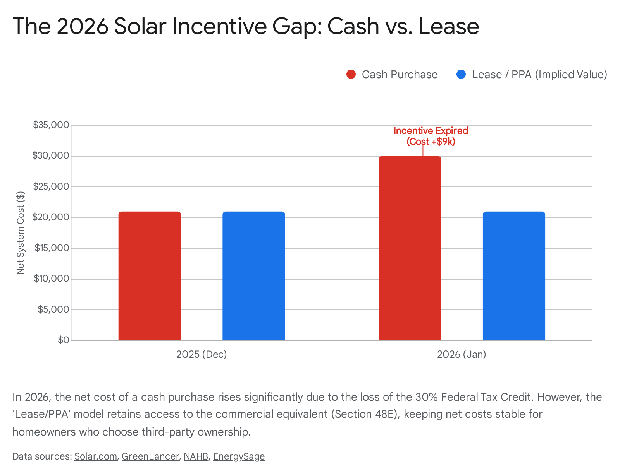
For a long time, the federal government gave homeowners a tax credit called the "Residential Clean Energy Credit" (Section 25D). If you spent $30,000 on solar panels, the IRS would let you knock $9,000 off your tax bill. It was a huge deal.
But laws change. Under the "One Big Beautiful Bill Act" (OBBBA) passed recently, this specific credit for homeowners was scheduled to end abruptly. And it did. The expiration date was December 31, 2025.1
The IRS is very strict about this. The rule isn't about when you signed the contract or when you paid the deposit. It is about when the system was "placed in service." That means fully installed and ready to turn on. If your installer finished the job on January 2, 2026, you missed the window. There is no 30% credit for you if you buy the system yourself.9 This effectively makes buying a solar system about 43% more expensive today than it was a few months ago.
The "Lease Loophole" (Section 48E)
Here is the twist. While the government cut the credit for homeowners, they extended the credit for businesses that produce clean electricity. This is called the "Section 48E" credit, and it is available through the end of 2027.1
So, how does a homeowner get a business tax credit? You don't. But a solar leasing company does.
When you sign a lease or a Power Purchase Agreement (PPA), you don't own the panels—the solar company does. Because they are a business, they can claim the 30% Section 48E credit. In a competitive market, they use that tax credit to lower your monthly lease payment.
This creates a weird situation where leasing is now often cheaper than buying. If you buy, you pay full price. If you lease, the system owner gets a 30% discount from Uncle Sam and (hopefully) shares that savings with you in the form of a lower monthly bill.
---
3. Kentucky’s "No-Frills" State Rules
While the federal government has been on a rollercoaster with tax credits, Kentucky state law has remained pretty consistent: there simply aren't many freebies. Kentucky is traditionally a coal state, and the transition to renewables has been slower here than in places like California or New York.
No State Tax Credit
Some states offer their own tax credit on top of the federal one. Kentucky does not. You cannot deduct solar costs from your Kentucky state income taxes.6
No Sales Tax Exemption
This is a "hidden cost" that surprises many people. In Kentucky, solar equipment is subject to the standard 6% state sales tax.6
- If your solar equipment costs $20,000, you are going to pay an extra $1,200 in sales tax.
- Make sure any quote you get includes this. Some out-of-state installers might forget to add it in their initial estimate, leading to an awkward conversation later.11
No Property Tax Exemption
Installing solar panels adds value to your home. In many states, the government promises not to tax that extra value. Kentucky does not make that promise.
- Legally, if your home is worth $200,000 and you add a $30,000 solar system, your home is now worth $230,000.
- Your local Property Valuation Administrator (PVA) could theoretically increase your property tax bill based on that higher value.6
- However, in practice, some PVAs may not aggressively reassess homes specifically for solar, but there is no law protecting you from it.
Why Do It Then? Rising Rates.
If there are no tax breaks, why is anyone going solar in Kentucky? The answer is simple: Electricity bills are going up.
- Utilities like Kentucky Power have requested rate increases of nearly 15% for residential customers.12
- LG&E and KU have also secured rate hikes recently.13
- The average electricity rate in Kentucky used to be very low, but it has jumped roughly 20% in the last few years.15
Solar in 2026 isn't about getting a tax refund; it's about locking in a steady payment instead of watching your utility bill climb higher every year.
---
4. The Net Metering Deep Dive (The Critical Math)
If you take one thing away from this report, let it be this section. Net Metering is the banking system for solar energy. It determines how the power company treats the electricity you send them.
Here is the basic problem: Solar panels make the most power in the middle of the day (noon to 3 PM) when you are usually at work and your house is empty. You can't use all that power instantly. You have to send it somewhere.
The Old Way: 1-for-1 (NMS-1)
In the "good old days" (before 2021), Kentucky law mandated "1-for-1" net metering. If you sent the grid 1 kilowatt-hour (kWh) of extra power at noon, they gave you a credit for 1 kWh to use later that night. It was an even trade.
- Status: Closed to new customers. If you didn't have your system by 2021, you missed this boat.16
The New Way: The "Sell Low, Buy High" Trap (NMS-2)
Under the current law (Senate Bill 100), major utilities can use a new system called NMS-2.
- You Buy Power at Retail Price: When you pull energy from the grid at night, you pay the full price (e.g., 12 cents).
- You Sell Power at "Avoided Cost": When you send extra solar energy to the grid during the day, the utility pays you a much lower rate (e.g., 7 cents).
This gap makes solar much harder to justify financially unless you change your strategy. You can no longer treat the grid like a free battery. You have to try to use your solar power yourself, rather than selling it.
---
5. Utility Guide: LG&E and KU
If you live in Louisville, Lexington, or many surrounding counties, you are likely an LG&E (Louisville Gas & Electric) or KU (Kentucky Utilities) customer. Together, they are the biggest game in town.
The Rates
- Retail Rate (What you pay): You currently pay around 12.4 to 13.0 cents per kWh for electricity.13
- Export Rate (What they pay you): Under the NMS-2 tariff, the credit for exported solar is significantly lower.
The Strategy for LG&E/KU Customers
Since you lose about 5‑6 cents on every kilowatt-hour you send to the grid, you want to minimize exports.
- Size Down: Don't build a system that covers 100% of your usage. Aim for maybe 60‑70%, so you use almost all of it immediately.
- Get a Battery: This is the best (but more expensive) fix. A battery stores that noon‑time sun so you can use it at 8 PM. This stops you from selling low and buying high.
- Solar Share: If you can't put panels on your roof, LG&E has a "Solar Share" program. You pay a subscription fee to "rent" panels in a solar farm they built.
- Warning: This is usually a premium product. You pay more to participate, not less. It's for people who want to be green, not necessarily for people who want to save huge money.18
---
6. Utility Guide: Duke Energy Kentucky
If you are in Northern Kentucky (Boone, Kenton, Campbell counties), you are likely with Duke Energy.
The New Rules (Rider NM II)
Duke was a bit later to the game than LG&E, but as of January 1, 2025, they have implemented their own version of the lower export rate, called "Rider NM II".4
- The Cut-Off: If your system wasn't working by December 31, 2024, you are on the new plan.
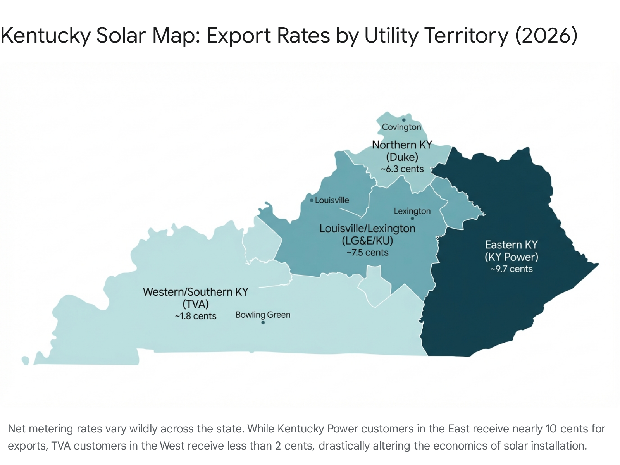
- Export Rate: Approximately 6.3 cents per kWh.4
- Retail Rate: Typical residential rates are often around 12‑13 cents.
What This Means for You
Just like with LG&E, Duke customers are now disincentivized from sending power to the grid. The "avoided cost" rate of roughly 6 cents is barely half of what you pay for power.
- Duke's "Clean Energy Connection": Duke has also proposed a shared solar program where you subscribe to blocks of solar energy. This acts similarly to community solar, allowing you to participate without installing rooftop panels. If your roof is shady or old, this is a valid option, though you should carefully check the contract to see if it actually lowers your bill or just locks in a renewable rate.20
---
7. Utility Guide: Kentucky Power
Kentucky Power serves the mountainous eastern region of the state (places like Ashland, Hazard, Pikeville). This area has unique economic challenges, and interestingly, some of the highest electricity rates in the state.
High Stakes, High Rates
- Retail Rate: Residential rates here are significantly higher than in Louisville or Lexington—often pushing 16 cents per kWh or more due to fuel adjustments and surcharges.12
- Export Rate: The Public Service Commission set the NMS II export rate for Kentucky Power at roughly 9.7 cents per kWh.5
The Good News
This is actually one of the better scenarios for solar in Kentucky right now.
- High Savings: Because your bill is so high (16+ cents), every kWh of solar you use yourself saves you a lot of money.
- Decent Export: The 9.7 cent export rate is better than what LG&E or Duke offer. It's still not a full 1‑for‑1 trade, but it's not a disaster.
If you are a Kentucky Power customer facing those painful monthly bills, solar—even with the tax credit changes—is often a very strong financial move just to stop the bleeding from rate hikes.22
---
8. The TVA Region: Solar Without Net Metering
If you live in Western or Southern Kentucky (Bowling Green, Paducah, Hopkinsville, Glasgow), your power probably comes from a local cooperative or municipal utility that buys its power from the Tennessee Valley Authority (TVA).
This is a totally different world. The Kentucky state laws about "Net Metering" generally do not apply to TVA utilities. TVA makes its own rules.
The "Dual Meter" Problem
In TVA territory, you typically don't get traditional net metering. Instead, they historically used a program called "Green Connect" or "Dispersed Power Production" (DPP).
- Sell Rate: If you send power to the grid, TVA pays you their "wholesale" rate. This is incredibly low—often around 1.8 to 2.5 cents per kWh.23
- Buy Rate: You buy power at the full retail price (around 10‑12 cents).
The Strategy: "Zero Export"
Because the sell rate is practically zero, you should never plan to send electricity to the grid in TVA territory. It is a waste of money.
- Batteries are Mandatory: You essentially need a battery system to store your excess power.
- Smart Inverters: You can also use special inverters programmed to "zero export." This means if your panels are making more power than your house needs, the inverter just turns the panels down rather than sending the extra to the grid. It's better to waste the sunlight than to sell it for pennies if it requires expensive metering gear.
---
9. Specific Cooperative Profiles
Kentucky has many rural electric cooperatives. Each one has slightly different policies, although many follow the lead of their power supplier (like East Kentucky Power Cooperative or TVA).
Owen Electric Cooperative
- Location: Northern/Central KY (Owen, Grant, Pendleton counties).
- Solar Programs: They offer a "Cooperative Solar" program where you can "license" a panel at their solar farm. This is a one‑time fee (often a few hundred dollars per panel) and you get the credit for the energy that panel produces for 25 years.24
- Why choose this? It avoids the hassle of putting holes in your roof. It's great for renters or people with shady properties.
- Net Metering: They follow the NMS-2 rules for rooftop solar, meaning you will face the lower export rates similar to the big utilities.24
Jackson Energy Cooperative
- Location: Southeast KY (McKee, London area).
- Rebates: Jackson Energy is one of the few places offering rebates, but they are generally for energy efficiency (like heat pumps or insulation), not specifically for solar panels. They have strict deadlines—rebates must be submitted within 60 days of purchase.25
- Net Metering: They require a specific application and adhere to the cooperative net metering statutes. Like Owen, they emphasize their "Cooperative Solar" farm options as a hassle‑free alternative.26
Salt River Electric
- Location: Bardstown, Shepherdsville area.
- Solar 101: They provide a "Solar 101" guide to members to help avoid scams. They are very protective of their members and warn against aggressive door‑to‑door sales.27
- Heat Pump Rebates: Like many co‑ops, their best money is in upgrading your HVAC. If you are going solar, you should switch to an electric heat pump to maximize your savings, and Salt River may pay you to do it.28
---
10. Financial Options: Lease vs. Buy in 2026
This is the big decision point. Since the federal tax credit for homeowners is dead, how you pay for solar matters more than ever.
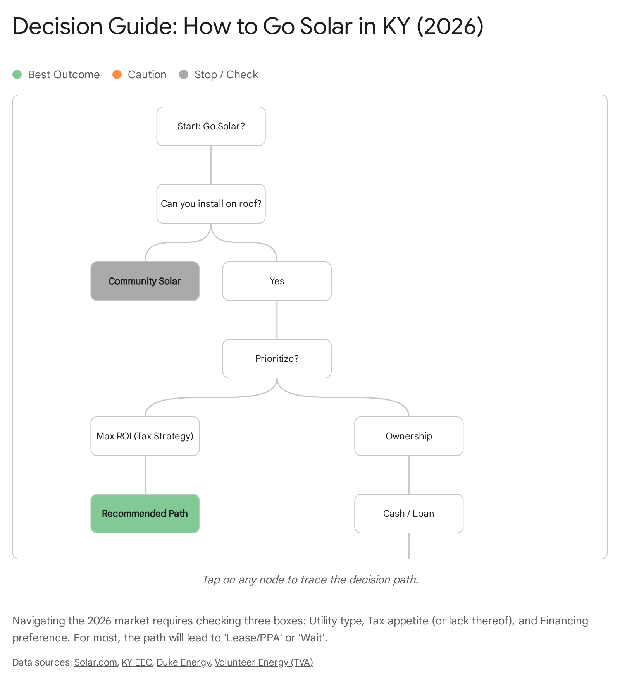
Option 1: The Cash Purchase
- The Deal: You write a check for $25,000. You own the system.
- The Problem: You get $0 back in tax credits.
- The Payback: Without the 30% discount, it might take 18‑22 years for the electricity savings to pay back the upfront cost.
- Who is this for? People who hate monthly bills, have plenty of cash, and plan to stay in their home for 20+ years.
Option 2: The Solar Lease / PPA
- The Deal: You pay $0 upfront. You pay a monthly fee (e.g., $100/month) to the solar company for the next 25 years.
- The Secret Sauce: The solar company (a business) claims the Section 48E commercial tax credit (which still exists!). They use that money to lower your monthly payment.
- The Result: Your monthly lease payment might be lower than your current electric bill from Day 1.
- Who is this for? Almost everyone in 2026. It is the only way to capture the value of the federal subsidy.
Option 3: The Solar Loan
- The Deal: You borrow money from a bank to buy the panels.
- The Problem: Interest rates are high, and like the cash purchase, you get no tax credit.
- Verdict: This is likely the worst option in 2026. You get all the debt, none of the tax credit, and a high monthly payment.
---
11. Financing Deep Dive: PACE and REAP
You might hear salespeople throw around acronyms like "PACE" or "REAP." Be careful—these usually don't apply to typical homes.
PACE Financing (Property Assessed Clean Energy)
PACE allows you to pay for energy upgrades through a special assessment on your property tax bill. It sounds great because the loan is tied to the house, not you.
- The Catch: In Kentucky, PACE is currently available for Commercial (C‑PACE) properties only. It is not available for single‑family residential homes.29
- The Confusion: Some other states (like California or Florida) have residential PACE. If a website says "PACE is available in Kentucky," dig deeper. They almost certainly mean for businesses, farms, or multi‑family apartments, not your house.
REAP Grants (Rural Energy for America Program)
- The Deal: This is a USDA grant that can cover up to 50% of the cost of a solar system. It is incredible.
- The Catch: It is strictly for rural small businesses and agricultural producers (farmers).
- Loophole: If you run a legitimate business out of your home and you live in a qualifying rural area, you might be able to apply REAP to a portion of the system. But this is complex. You need to prove that more than 50% of the energy is used for the business. Do not count on this unless you are a full‑time farmer or business owner.31
---
12. Technology Guide: What to Install
Given the NMS‑2 rules, the equipment you choose is more important than ever.
Batteries: The New Standard
In 2026, a solar system without a battery in Kentucky is like a bucket with a hole in it.
- Why: You need to save your noon‑time solar power for evening use.
- The Tax Credit: Just like panels, the tax credit for buying a standalone battery expired at the end of 2025.32 However, if you lease the battery as part of a solar package, the leasing company can apply their commercial credit to lower the cost.
- Recommendation: Look for the Tesla Powerwall 3 or Enphase IQ Battery. These are the standards. You typically need at least 10‑13 kWh of storage to cover an evening's usage.
Inverters
You have two main choices:
- String Inverters (e.g., SolarEdge): One central box on the wall. Cheaper, but if one panel is shaded, the whole string can suffer.
- Microinverters (e.g., Enphase): A tiny inverter behind every panel. More expensive, but better for complex roofs.
- KY Recommendation: Because of the need for batteries, make sure whatever inverter you choose is "hybrid" or "battery‑ready." Don't buy an old‑school inverter that can't talk to a battery later.
Panels
Don't stress too much about the brand of panel (QCells, REC, Silfab). Most Tier 1 panels are very similar in performance. Focus more on the warranty. You want a 25‑year warranty that covers labor, not just the equipment. If a panel breaks in year 15, you don't want to pay someone $300 to climb the roof to swap a "free" panel.
---
13. Step‑by‑Step Installation Guide for 2026
Ready to move forward? Here is your checklist.
-
Check Your Roof
Solar panels last 25‑30 years. If your shingles are 15 years old, replace the roof first. You do not want to pay $3,000 to take panels off in five years just to fix a leak. -
Gather 12 Months of Bills
Log into your LG&E, KU, or Co‑op account and download your usage history. You need to know exactly how many kWh you use in summer (AC) vs. winter (heat). -
Get 3 Quotes (Focus on Leases)
Ask for "Lease vs. Cash" comparisons from three different companies.- Ask specifically: "Are you passing the Section 48E commercial credit savings to me in this lease price?"
- Ask for the "Price Per Watt." In 2026, a fair cash price (before any incentives) is around $2.75 – $3.20 per watt in Kentucky.15
-
Verify the NMS‑2 Math
Make sure the installer's savings projection uses the correct export rate (e.g., ~7 cents for LG&E). If they show you savings based on a 1‑for‑1 retail swap, they are lying or incompetent. Kick them out. -
Apply for Interconnection
Your installer will handle this, but do not let them start construction until the utility (LG&E, Duke, etc.) has approved the application. In cooperative territories, there can be size limits (e.g., 45 kW). -
Inspection & Turn On
After installation, the electrical inspector and the utility must sign off. Only then can you flip the switch.
---
14. Conclusion: Is Solar Still Worth It?
It is easy to look at the expired tax credit and the lower export rates and think, "I missed the boat." But that is not looking at the whole picture.
Yes, the "easy money" era of 2020‑2025 is over. You can't just slap panels on a roof and get a massive tax refund check anymore. But the fundamental problem—rising energy costs—is worse than ever.
In 2026, solar is no longer an investment scheme; it is a defensive strategy. It is about protecting your household budget from the 15% rate hike Kentucky Power just asked for, or the steady creep of LG&E bills.
Your Winning Strategy:
- Don't Buy, Lease: Let the solar company take the tax credit and give you a lower payment.
- Don't Export, Store: Use a battery to keep your power for yourself.
- Don't Wait: Electricity rates are not going down. The best time to lock in your energy price is today.
The sun is still shining on the Bluegrass State. You just need a smarter plan to catch it.
Works cited
- Trump and the Fate of the 30% Solar Tax Credit, accessed January 1, 2026, https://www.solar.com/learn/trump-and-the-fate-of-the-30-solar-tax-credit/
- Federal Solar Tax Credit (ITC): Ending January 1, 2026, accessed January 1, 2026, https://www.solartopps.com/blog/federal-solar-tax-credit-ending-january-1-2026/
- Residential Clean Energy Credit | Internal Revenue Service, accessed January 1, 2026, https://www.irs.gov/credits-deductions/residential-clean-energy-credit
- Generate Your Own Renewable Energy Business Duke Energy, accessed January 1, 2026, https://www.duke-energy.com/Business/Products/Renewables/Generate-Your-Own?jur=KY01
- net metering programs - DSIRE, accessed January 1, 2026, https://programs.dsireusa.org/system/program/detail/1081
- Resources for Residential Rooftop Solar - Kentucky Energy and Environment Cabinet, accessed January 1, 2026, https://eec.ky.gov/Energy/News-Publications/Pages/Residential-Rooftop-Solar-Resources.aspx
- With a federal tax credit ending early, installing home solar is about to get more expensive, accessed January 1, 2026, https://ipmnewsroom.org/with-a-federal-tax-credit-ending-early-installing-home-solar-is-about-to-get-more-expensive/
- What to Know About Expiring Energy Tax Credits | NAHB, accessed January 1, 2026, https://www.nahb.org/blog/2025/07/expiring-energy-tax-credits
- FAQs for modification of sections 25C, 25D, 25E, 30C, 30D, 45L, 45W, AND 179D under Public Law 119-21, 139 Stat. 72 (July 4, 2025), commonly known as the One, Big, Beautiful Bill (OBBB) | Internal Revenue Service, accessed January 1, 2026, https://www.irs.gov/newsroom/faqs-for-modification-of-sections-25c-25d-25e-30c-30d-45l-45w-and-179d-under-public-law-119-21-139-stat-72-july-4-2025-commonly-known-as-the-one-big-beautiful-bill-obbb
- Kentucky Solar Incentives, Tax Credits & Rebates (2025 Guide) - This Old House, accessed January 1, 2026, https://www.thisoldhouse.com/solar-alternative-energy/solar-incentives-kentucky
- Kentucky Solar Incentive Programs, accessed January 1, 2026, https://www.solarinsure.com/kentucky-solar-incentive-programs
- Kentucky Power Rate Review, accessed January 1, 2026, https://www.kentuckypower.com/company/about/rates/2025-rate-review
- Louisville, KY Solar: 2025 Costs, Incentives & Savings - Palmetto, accessed January 1, 2026, https://palmetto.com/local/kentucky/louisville/
- LG& E and KU reach agreement with key stakeholders on rate requests that strengthen reliability and improve service for customers, accessed January 1, 2026, https://lge-ku.com/newsroom/press-releases/2025/10/20/lge-and-ku-reach-agreement-key-stakeholders-rate-requests
- Kentucky Solar: 2025 Costs, Incentives, Savings - Palmetto, accessed January 1, 2026, https://palmetto.com/local/kentucky/
- Net metering for your home or business | LG& E and KU, accessed January 1, 2026, https://lge-ku.com/net-metering
- COMMONWEALTH OF KENTUCKY BEFORE THE PUBLIC SERVICE COMMISSION In the Matter of: ELECTRONIC TARIFF FILINGS OF LOUISVILLE GAS AND - KY PSC, accessed January 2026, https://psc.ky.gov/pscscf/2023 Cases/2023-00404/20240830_PSC_ORDER.pdf
- Solar Offerings for Your Home or Business | LG& E and KU, accessed January 1, 2026, https://lge-ku.com/environment/solar
- Solar Share Program | Solar Energy | LG& E and KU, accessed January 1, 2026, https://lge-ku.com/solar-share
- Clean Energy Connection, accessed January 1, 2026, https://www.duke-energy.com/business/products/clean-energy-connection
- No panels? No problem. Duke Energy offers its take on community solar, accessed January 1, 2026, https://www.renewableenergyworld.com/solar/community-solar/no-panels-no-problem-duke-energy-offers-its-take-on-community-solar/
- Solar Net Metering Preserved by Public Service Commission for Customers of LG& E and KU, accessed January 1, 2026, https://mtassociation.org/energy/solar-net-metering-preserved-by-psc/
- Solar - Volunteer Energy Cooperative, accessed January 1, 2026, https://vec.org/solar/
- Net Metering & Home Solar Array | Owen Electric Cooperative., accessed January 1, 2026, https://owenelectric.com/net-metering-home-solar-array
- Rebates and Incentives | Jackson Electric Cooperative, accessed January 1, 2026, https://jackelec.com/index.php/rebates-and-incentives
- Net Metering | Jackson Energy Cooperative, accessed January 1, 2026, https://www.jacksonenergy.com/net-metering
- Solar Energy - Salt River Electric, accessed January 1, 2026, https://www.srelectric.com/solar-energy/
- Rebates - Salt River Electric, accessed January 1, 2026, https://www.srelectric.com/rebates/
- PACE Financing in Kentucky - Bricker Graydon LLP, accessed January 1, 2026, https://www.brickergraydon.com/insights/resources/key/Infographic-pace-financing-in-ky
- C-PACE Financing FAQ | How PACE Loans Work, accessed January 1, 2026, https://paceloangroup.com/lending/faq
- Homeowner/Homebuyer Development - AHTF Home Repair Program - Kentucky Housing Corporation, accessed January 1, 2026, https://www.kyhousing.org/Partners/Developers/Single-Family/Development/Pages/AHTF-Home-Repair-Program.aspx
- Home Battery Buyers Taking Advantage of Expiring Clean Energy Tax Credit - EcoFlow, accessed January 1, 2026, https://www.ecoflow.com/us/blog/home-battery-buyers-taking-advantage-of-expiring-clean-energy-tax-credit
- Kentucky Solar Panel Cost: 2025 Prices and Savings - EnergySage, accessed January 1, 2026, https://www.energysage.com/local-data/solar-panel-cost/ky/
- January 1, 2025 - KY PSC, accessed January 1, 2026, https://psc.ky.gov/tariffs/electric/duke energy kentucky/cancelled tariff pages/2025/RIDER NM - NET METERING RIDER/01-01.pdf