If you are a homeowner in New Jersey, you might look up at the sky in February, see a wall of gray clouds, and think, "Solar power? Here? You must be joking." It is a fair thought. We aren't Arizona. We aren't Florida. We have winters, we have snow, and we have plenty of cloudy days. But here is the secret that energy insiders know and most homeowners miss: New Jersey is consistently one of the best states in the entire country for home solar.
Why? It isn't just about the sunshine; it is about the math. Solar savings are driven by two things: how much sun you get, and how expensive the electricity is that you don't have to buy. New Jersey has some of the highest electricity rates in the nation. That means every ray of sunshine you catch is worth more money here than almost anywhere else. But the real magic lies in the incentives. New Jersey has built a stack of financial perks—state programs, tax breaks, and performance payments—that can turn a solar panel system from a "nice eco-friendly idea" into one of the best financial investments you ever make.1
This guide is your roadmap. We are going to skip the engineering lectures and get straight to the money: what you can get, how to get it, and how to avoid the scams along the way. We will break down the Federal Tax Credit, the "SuSI" program (which pays you cash just for producing power), and the tax exemptions that keep money in your pocket. We know you are busy, so we’re starting with the "Too Long; Didn't Read" version right up front.
TL;DR: The "Cheat Sheet" for NJ Solar
If you only read one minute of this guide, read this. Here is the summary of what is on the table for New Jersey homeowners in 2025:
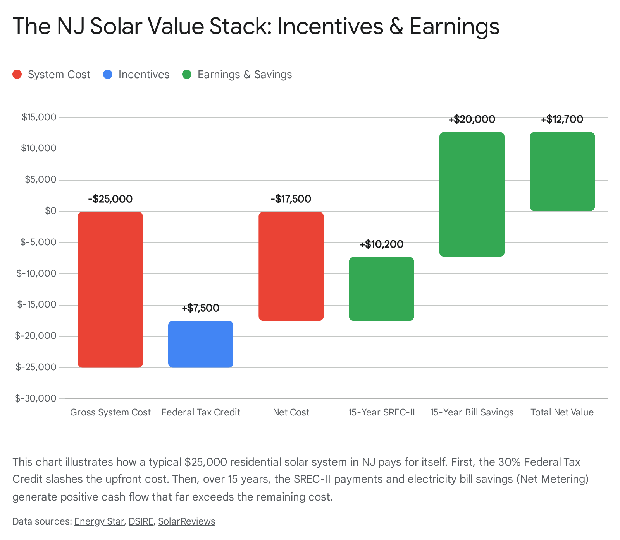
- The Big Federal Coupon (ITC): The federal government will give you a tax credit equal to 30% of the total cost of your solar installation. If your system costs $20,000, that is a $6,000 credit on your taxes.3
- The "SREC-II" Monthly Paycheck (SuSI Program): New Jersey pays you for the clean energy you make, regardless of whether you use it or sell it back. For every 1,000 kilowatt-hours (kWh) your system produces, you earn a credit worth $85. This lasts for 15 years. It’s like getting a dividend check from your roof.6
- Sales Tax Exemption: You pay 0% sales tax on solar equipment. That saves you nearly 7% right off the bat compared to buying a car or furniture.9
- Property Tax Exemption: Your house value will likely go up because it has solar (which is great), but your property taxes will not rise because of that added value. You keep that equity tax‑free.9
- Net Metering: The electric grid acts like a free battery for you. When you make extra power during the day, you send it to the utility for a credit. At night, you use those credits to power your home for free.12
---
1. The Landscape: Why New Jersey?
Before we dive into the specific forms and applications, it helps to understand why the state is throwing so much money at you. Understanding the "why" gives you confidence that these programs are real and not some "too good to be true" scam.
New Jersey sits in a unique spot in the energy world. It is densely populated, meaning there are millions of people flipping on light switches, air conditioners, and TVs every single day. However, it is a small state geographically. We don't have massive empty deserts for giant solar farms like Nevada, nor do we have endless windy plains like Texas. We have suburbs. We have rooftops.
The state government has set very aggressive goals to switch to 100% clean energy. Because they can't just build a few giant power plants to solve the problem, they need you. They need thousands of homeowners to turn their roofs into mini power plants. To make that happen, they have created a market where they essentially "rent" your roof space by paying you for the power you generate. That is the core philosophy behind the SuSI program and SRECs: you are a partner in the state's energy grid, and partners get paid.1
The High Cost of Doing Nothing
Another reason solar works here is the alternative: sticking with the utility company. New Jersey's electricity rates are historically higher than the national average. When you buy power from the grid, you aren't just paying for the electricity; you are paying for the wires, the poles, the maintenance trucks, and the corporate overhead of the utility companies. When you go solar, you are essentially "locking in" your price of power. While utility rates tend to drift upward over the years due to inflation and infrastructure costs, the sun doesn't charge you more money in 2030 than it does in 2025. This "avoided cost" is the invisible incentive that grows every year you own your system.
---
2. Federal Incentives (The ITC)
Let's start with the biggest upfront discount available: The Federal Solar Investment Tax Credit, commonly known as the ITC. While this isn't specific to New Jersey, it is the foundation of your savings. Understanding how it works is critical because it is not a rebate check you get in the mail; it is a tax credit.
What is the 30% Credit?
The US government wants you to go solar. To encourage you, they passed the Inflation Reduction Act, which extended the solar tax credit at 30% until the year 2032. This is a massive piece of legislation that ensures stability for the next decade. You don't have to worry that the program will vanish next month.3
Here is the simple math:
If you sign a contract to install a solar panel system on your roof for $20,000, the federal government gives you a credit of $6,000 (30% of $20,000).
This applies to a wide range of costs associated with the project:
- The Hardware: The solar panels themselves, the inverters (the box that changes the power from DC to AC), and the racking systems that hold them to your roof.
- The Labor: All the costs for site preparation, assembly, and installation. Even the electrician's time is covered.
- Storage: If you decide to add a battery backup system (like a Tesla Powerwall or Enphase IQ Battery) to your solar project, that cost is also eligible for the 30% credit. In fact, thanks to recent rule changes, standalone batteries can sometimes qualify even without solar, but it is easiest when done together.4
Credit vs. Deduction: The Important Difference
This is a point where many people get confused. This incentive is a Tax Credit, not a Tax Deduction. In the world of taxes, a credit is far more valuable than a deduction.
- A Deduction lowers the amount of income you are taxed on. For example, if you earn $50,000 and have a $1,000 deduction, the IRS taxes you as if you earned $49,000. It saves you a little bit, depending on your tax bracket.
- A Credit is a dollar-for-dollar reduction of the tax you owe. If you calculate your taxes and owe the IRS $6,000, and you have a $6,000 credit, you owe $0. It is as good as cash in your pocket, provided you owe taxes.5
"What If I Don't Owe $6,000 in Taxes?"
This is a common worry, especially for retirees on fixed incomes or those with lower taxable income. You might look at your paycheck and say, "I get a refund every year, I don't owe taxes!"
It is important to understand the difference between "owing taxes at the end of the year" and "tax liability." Even if you get a refund check in April, you likely paid taxes all year long via payroll deductions. The tax credit applies to your total tax liability for the year—the total amount the government says you should have paid.
However, let's say your tax liability really is low. Let's say your solar tax credit is $6,000, but when you file your taxes, you calculate that your total tax bill for the year is only $4,000.
- You will use $4,000 of the credit to wipe out your tax bill to zero.
- The remaining $2,000 does not disappear! It rolls over to the next year. You can use it to reduce your taxes the following year. You can carry this forward for several years until the full credit is used up.4
Important Note: This is a "non-refundable" credit. That means if your tax bill is zero, the IRS won't write you a check for the difference. They will just carry the credit forward to help you in future years.
How to Claim It
You don't need to apply for this before you install. You claim it when you file your federal tax return. You will need IRS Form 5695. It is a relatively simple form where you enter the cost of your system and calculate the 30%. If you use tax software like TurboTax or H&R Block, they usually walk you through this automatically. You generally need to keep your receipts and the contract from your solar installer in case the IRS ever asks for proof, but you don't typically have to mail them in with your return.
---
3. The State Incentive: SuSI & SREC-IIs (Getting Paid to Produce)
Now we get to the local flavor. This is what makes New Jersey special. In many states, the only financial benefit of solar is saving on your electric bill. In New Jersey, you get that savings PLUS a separate paycheck just for having panels that work.
This program is called the Successor Solar Incentive (SuSI) program. It replaced the old "SREC" program you might have heard neighbors talk about years ago. To understand why this is so good, we need a tiny bit of history.
A Brief History of New Jersey Solar Money
- The Old Days (Legacy SREC): Years ago, New Jersey had a system where the value of your green credits (SRECs) was determined by the open market, like a stock. Sometimes they were worth $600 each! People made a fortune. But then too many people built solar, and the price crashed to $50. It was a roller coaster.
- The Transition (TREC): To fix the crash, the state created a temporary fixed price program called TREC. It stabilized things but was just a bridge.
- The Current Era (SuSI): Now we have the "Successor" program. The state learned its lesson. They wanted stability. So they created a program with a fixed, guaranteed value for 15 years. No gambling, no stock market crashes. Just a steady check.7
What is an SREC-II?
"SREC" stands for Solar Renewable Energy Certificate. Under the new SuSI program, these are officially called SREC-IIs.
Think of your solar panels as a factory. This factory produces two things:
- Electricity: This flows into your house and keeps your lights on.
- Green Credits (SRECs): These are digital certificates that prove you created clean energy.
New Jersey law requires utility companies to buy these certificates to meet clean energy goals. That means there is a guaranteed market for the green credits you produce.
The Magic Number: $85
Under the current rules for the SuSI program (specifically the ADI section, which covers residential homes), the value of an SREC-II is fixed.
- Rate: $85 for every SREC-II you generate.7
- One SREC-II = 1,000 kilowatt-hours (kWh) of production.
- Duration: You are guaranteed this payment for 15 years.8
This is a huge deal because it removes the risk. In the old days, you had to guess how much money you would make. Now, you can calculate it almost to the penny before you even buy the panels.
Let's Do The Math: How Much Cash is This?
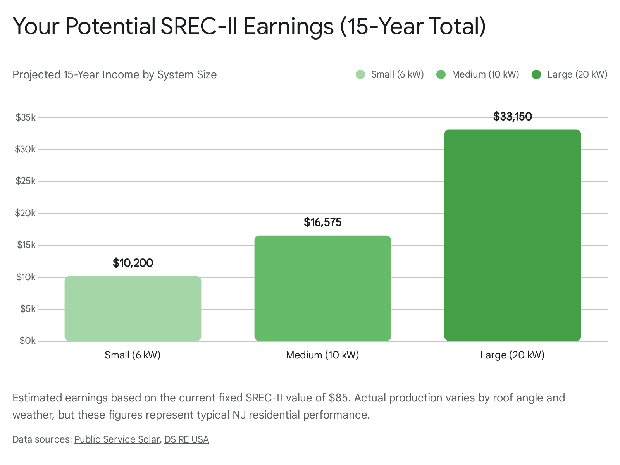
Let's look at a typical New Jersey home. Suppose you install a 10 kilowatt (kW) solar system. In New Jersey, a system this size might produce about 12,000 kWh of electricity per year (depending on your roof's angle and shade).
- Production: 12,000 kWh per year.
- SRECs Earned: 12 SRECs per year (12,000 ÷ 1,000).
- Value: 12 SRECs x $85 each = $1,020 per year.
Over the 15-year life of the program:
$1,020 x 15 years = $15,300.
That is $15,300 in direct payments sent to your bank account, totally separate from the money you saved on your electric bill. For many homeowners, this incentive alone pays for more than half the cost of the system over time.8
Who Owns the SRECs? (Crucial Warning)
This is the most common pitfall for new solar buyers. You only get these payments if you OWN the system.
- Cash Purchase: You own the system. You get the SRECs.
- Solar Loan: You own the system (the bank just has a lien). You get the SRECs.
- Solar Lease / PPA: The solar company owns the system. THEY get the SRECs.
When you see advertisements for "Free Solar" or "Put Solar on your roof for $0 down and just pay for power," usually the solar company is keeping that juicy $15,000 SREC revenue for themselves. That allows them to offer you a lower monthly rate, but you lose the direct income. We will discuss the "Buy vs. Lease" decision in detail later, but for now, remember: SRECs follow ownership.18
How Do You Actually Get the Money?
It’s not magic; it’s administrative work. But don’t worry, your installer usually helps you set it up.
- Registration: Once your system is turned on, your installer registers your system with the state's ADI portal.
- Tracking: You will also need an account with GATS (Generation Attribute Tracking System). This is the system that counts your kilowatt-hours.
- Reporting: Most modern solar inverters (like SolarEdge or Enphase) automatically report your production numbers to GATS every month via your home Wi‑Fi. You don't have to go out and read the meter yourself.
- Selling: Once GATS mints your SREC-II certificates, they sit in your digital account. You can sell them manually on an exchange, or (more commonly) you can sign up with an "aggregator" service. These companies take a tiny fee (usually 1‑3%) to automatically sell your credits for you and direct deposit the cash into your bank account. It becomes passive income.
---
4. Net Metering: The Grid as Your Battery
Even if New Jersey didn't give you SREC checks, solar would still make sense because of Net Metering. This is the policy that governs how you interact with your utility company (PSE&G, JCP&L, or Atlantic City Electric). It is arguably the most important policy for solar economics.
How It Works: The Day/Night Swap
Solar panels have a timing problem. They produce the most power at noon when you are likely at work and using the least amount of electricity. They produce zero power at night when you are home watching TV, running the dishwasher, and turning on lights.
Without Net Metering, you would have to buy expensive batteries to store that noon sunshine for the evening. With Net Metering, the utility grid does it for you.
- Overproduction (Daytime): At 1:00 PM on a Tuesday, your panels are cranking out 5,000 watts of power. But your house is empty and only idling at 500 watts. The extra 4,500 watts flow backward through your electric meter and onto the street's power lines. It goes to power your neighbor's house. Your meter literally spins backward (or registers a digital credit).
- Underproduction (Nighttime): At 8:00 PM, your panels are off. You pull power from the grid like normal. But instead of paying for it, you use up the "credits" you banked earlier in the day.
This trade happens at a 1‑to‑1 Retail Rate. If you sell a kilowatt‑hour (kWh) to the grid, you get a credit for one full kWh. When you pull a kWh back at night, it cancels out perfectly. You don't pay delivery fees on the power you swap. It is a fair trade.12
The Monthly Bill: "Customer Charge" Only
If you size your system perfectly to match your usage, your electric bill for the power itself could be $0.00. However, you will still receive a bill every month. You typically have to pay a "Customer Charge" or "Service Charge" (usually around $5 to $15 depending on your utility) just for being connected to the wires. You cannot escape this unless you go completely off‑grid (which is illegal in most NJ residential zones because homes must have a certificate of occupancy that requires active utility service).20
The "Anniversary Date" Cash Out
What happens if you are extremely efficient? What if, by the end of the year, you have produced more power than you used?
You can't save those credits forever. New Jersey utilities have an annual "True‑Up" or "Anniversary" period.
- The Bank: Month to month, your credits roll over. If you save up a lot of credits in sunny July, you can use them in cloudy December. This is great because you produce way more in summer than you need, and you need that buffer for winter.
- The Cash Out: Once a year, on your anniversary date (usually the month you turned the system on), the utility looks at your "bank." If you have extra credits left over, they "buy" them from you.
- The Catch: They do not buy them at the full retail price (what you pay). They buy them at the Wholesale Rate (Locational Marginal Price, or LMP).
Why this matters:
- Retail Rate (What you save by using your power): ~16‑18 cents/kWh.
- Wholesale Rate (The cash out price): ~3‑5 cents/kWh.12
Strategy Tip: Do not install a system that produces way more energy than you need just to "make money" selling it to the utility. You will sell it for pennies. The goal of Net Metering is to offset your own usage to zero, not to become a power plant. The SREC program is where you make the profit; Net Metering is where you save on bills.
Remote vs. Virtual Net Metering
You might hear these terms thrown around. In New Jersey, "Remote Net Metering" generally applies to public entities (like schools or municipal buildings) that want to build solar on one site and use the credit at another. For a standard homeowner, this doesn't apply. You need the panels on your specific meter to get the net metering benefit.22
---
5. Tax Breaks: Sales & Property
New Jersey offers two other incentives that don't put cash in your hand but stop cash from leaving it. These are the tax exemptions. They are often overlooked but add up to thousands of dollars in value.
1. The Sales Tax Exemption (Save ~6.6%)
When you go to Best Buy and buy a $2,000 TV, you pay sales tax. In NJ, that is currently 6.625%. That adds about $132 to the price. When you buy a $25,000 solar energy system, you pay $0 in sales tax.
New Jersey has a 100% Sales Tax Exemption for solar energy equipment. This applies to the panels, the inverter, the mounting gear, and the storage batteries.9
- The Value: On a $25,000 system, this exemption saves you approximately $1,656 immediately.
- How to get it: You don't have to do anything. Your installer simply won't charge you tax on the invoice. Technically, they use a form called ST‑4 (Exempt Use Certificate), but they handle that paperwork on their end. You just see the lower price.23
2. The Property Tax Exemption (Keep Your Equity)
One of the best things about solar is that it increases your home's value. Studies show homes with solar sell for more money—buyers like the idea of a $0 electric bill. Usually, when you make a major improvement to your home (like adding a deck, finishing a basement, or putting in a pool), the town tax assessor comes by, re‑evaluates your house, and raises your property taxes.
Not with solar.
New Jersey law prohibits towns from increasing your property tax assessment based on the value of your solar system.9
- Scenario: You install a system that adds $20,000 in market value to your home.
- The Win: Your property taxes stay exactly the same as they were before. You get the equity boost without the tax penalty.
How to get it:
In some towns, this is automatic. In others, you may need to file a specific form with your local tax assessor after the installation is complete to ensure they don't accidentally hike your assessment. Your installer usually provides this certificate (often called the "Certificate of Historic Preservation" or simply a "Solar Tax Exemption Form" depending on the municipality's specific paperwork). It is worth a quick call to your town hall to double‑check their specific procedure.
---
6. Community Solar: Solar for Everyone Else
Not everyone can install solar panels. In fact, many people are locked out of the traditional market:
- Renters: You can't drill holes in a roof you don't own.
- Condo Owners: Your HOA might own the roof, not you.
- Shade Issues: If your house is surrounded by beautiful 100‑year‑old oak trees, you have a shade problem. Cutting them down is expensive and hurts the environment.
- Roof Condition: Maybe your roof is slate, or just too old and you can't afford to replace it right now.
In the past, you were out of luck. Now, there is Community Solar.
What is Community Solar?
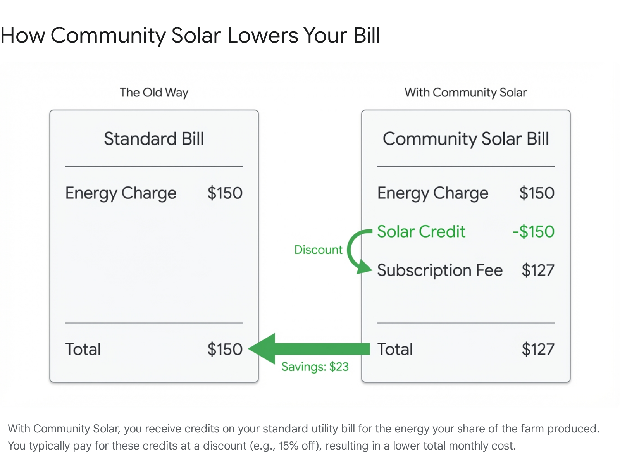
Imagine a huge solar farm built on a massive warehouse roof in an industrial park, or on an old capped landfill near your town. Instead of putting panels on your own roof, you "subscribe" to a portion of that big project. The energy from that farm goes into the main grid. Because you are a subscriber, the utility company gives you a credit on your bill for your share of that energy.14
The Guaranteed Savings Model
Community Solar in New Jersey is designed to be a "no‑brainer." It is almost always structured as a guaranteed discount.
- How it works: You subscribe to the energy. The project sells you the solar credits at a discount—typically 10% to 20% lower than the standard utility rate.
- The Result: You simply pay less for electricity. There is no installation cost, no maintenance crew coming to your house, no 20‑year loan, and no credit check for many projects.
For Low‑to‑Moderate Income (LMI) Households:
New Jersey prioritizes LMI families for these projects. If you qualify (based on income or living in certain census tracts), you often get first access to open spots and sometimes deeper discounts. The state wants to ensure that clean energy isn't just a luxury for the wealthy.26
How to Sign Up
New Jersey has a specific online tool called the Community Solar Project Finder. You can enter your zip code (e.g., 08003 or 07102) and see which projects are accepting new subscribers in your utility territory (PSE&G, JCP&L, etc.).24
Note: You do not switch utility companies. You still get your bill from PSE&G or ACE. You just see a new line item for your solar credits reducing what you owe.
---
7. Storage & Batteries (The Next Frontier)
You might have heard batteries (like the Tesla Powerwall or LG Chem). Do you need one in New Jersey?
The Reality Check: Economics vs. Peace of Mind
From a purely financial standpoint, batteries in NJ are not yet a slam‑dunk investment for most people.
- Why: Because Net Metering already acts like a free battery. You don't need a battery to store night‑time power; the grid does it for free. You sell high during the day and buy low (or equal) at night. There is no "Time of Use" arbitrage (price difference) big enough in standard residential rates to justify the $10,000+ cost of a battery just to save money.
- The Exception: If you want protection from power outages (storms, hurricanes), you need a battery. Solar panels alone will shut off during a blackout. This is a safety regulation to stop your panels from electrocuting utility workers fixing the lines down the street. A battery acts as a "gate," disconnecting you from the grid and keeping your house running. If you live in an area with frequent outages (like parts of Sussex County or the shore), the battery is an insurance policy, not an investment.
Incentives Are Coming: The GSESP
New Jersey is launching the Garden State Energy Storage Program (GSESP). As of mid‑2025, this program has kicked off with "grid‑scale" projects—incentivizing big batteries for the utility companies themselves to stabilize the grid. However, a "distributed" (residential) component is expected to follow.28
Currently, you can use the 30% Federal Tax Credit for batteries. If you spend $12,000 on a battery, you get a $3,600 tax credit. This helps, but it is still a premium product.
Future Watch: Keep an eye out for "Virtual Power Plant" (VPP) pilot programs. In these setups, the utility pays you a monthly fee to "rent" access to your battery during heatwaves. They drain your battery slightly to help the grid, and you get paid. These are just starting to emerge in the Northeast.
---
8. Buying vs. Leasing: The Most Important Choice
We touched on this earlier, but this is the most critical decision you will make. How you pay for solar determines how much money you save (and who gets the incentives). There are three main ways to go solar.
Option 1: Cash Purchase
- Who owns it: You.
- Who gets the Tax Credit: You (30%).
- Who gets the SREC‑IIs: You ($15,000+ over 15 years).
- Who gets the Bill Savings: You.
- Verdict: Highest Savings. If you have the cash sitting in a low‑interest savings account, this is often a better return on investment. Payback periods in NJ are often 5‑7 years. After that, you have 20+ years of free power plus income.
Option 2: Solar Loan
- Who owns it: You.
- Who gets the Incentives: You get everything (Tax Credit + SRECs).
- How it works: You take a loan to pay the installer. Your monthly loan payment replaces your electric bill. Ideally, the loan payment is lower than your old bill.
- Verdict: Great for most people. You get all the benefits of ownership with $0 down.
- Warning: Watch out for "Dealer Fees." Some solar loans have low interest rates (like 3.99%) but charge a massive upfront fee (added to the loan balance) to buy down that rate. Always ask for the "Cash Price" vs. the "Financed Price" to see if there is a hidden markup.30
Option 3: Solar Lease / PPA (Power Purchase Agreement)
- Who owns it: The solar company (SunRun, SunNova, etc.).
- Who gets the Incentives: THEY DO. They take the 30% tax credit. They collect the SREC payments.
- How it works: They install the system for free. You sign a contract to pay them for the electricity the panels produce, usually at a rate lower than the utility company.
- Verdict: Lowest Savings, Least Hassle. You save money, but much less than if you owned it. This is a good option if you have no tax liability (so the tax credit is useless to you) or you simply refuse to take on debt or maintenance responsibilities. Just know you are leaving a lot of money on the table. Also, selling your home can be trickier with a lease, as the buyer has to agree to take over the contract.18
---
9. The Installation Journey: What to Expect
Going solar isn't like buying a TV. It is a construction project. It involves permits, inspections, and engineering. Here is the typical timeline in New Jersey, which can take anywhere from 2 to 5 months.
Phase 1: Assessment & Contract (Week 1‑2)
You meet with installers. They look at your roof (often via satellite imagery first) and your electric bill. They design a system. You sign a contract.
- Tip: Get 3 quotes. Prices vary wildly. Use a comparison site or call local NJ installers, not just the guys knocking on your door.
Phase 2: Engineering & Permitting (Month 1‑3)
This is the "Black Hole" phase where you feel like nothing is happening. The installer is working behind the scenes.
- Engineering: They draw up blueprints showing wind load calculations (to prove the panels won't blow off in a nor'easter).
- Permitting: They submit these plans to your town's building department. New Jersey has 565 municipalities, and some are faster than others. Some towns approve in 2 weeks; others take 2 months. Be patient.
Phase 3: Installation (1‑2 Days)
The easy part! A crew arrives with a truck. They bolt racking to your roof, wire up the panels, and install the inverter near your meter. It is noisy (drilling), but usually done in a day or two.
Phase 4: Inspections & Interconnection (Month 3‑4)
You cannot turn the system on yet!
- Town Inspection: The town building inspector comes out to check the work.
- Utility Interconnection: Your utility (PSE&G/JCP&L) comes out to swap your electric meter for a "bi‑directional" net meter.
- PTO (Permission to Operate): Finally, you get an email saying "You are approved." NOW you can flip the switch.
---
10. Utility Specifics: Know Your Zone
New Jersey is split into a few main utility territories. While the state laws (SRECs, Sales Tax) apply to everyone, the process varies slightly by company.
PSE&G (Public Service Electric & Gas)
- Territory: Most of Northern and Central NJ (Newark, Jersey City, Trenton suburbs).
- Stance: Very solar‑friendly. They have streamlined online portals for interconnection.
- Solar Loan Program: PSE&G used to have a famous "Solar Loan" program where they would lend you money. This program is currently CLOSED to new applicants.31 Do not rely on old articles telling you to apply for it. You will now need a private loan or HELOC.
- On‑Bill Repayment: They offer on‑bill repayment for energy efficiency upgrades (insulation, smart thermostats) but generally not for the solar panels themselves anymore.32
JCP&L (Jersey Central Power & Light)
- Territory: Central NJ, parts of the Shore, and Northwest NJ.
- Stance: Does not offer specific rebates for solar installation.
- Process: Their interconnection process is standard. If you are upgrading your service panel (e.g., from 100A to 200A) to accommodate solar, coordinate with them early, as their engineering review can take time.
Atlantic City Electric (ACE)
- Territory: Southern NJ (Atlantic City, Cape May, Cumberland).
- Stance: Similar to JCP&L. No specific company rebates, but they fully support Net Metering and Community Solar.
- Financing: Through the National Energy Improvement Fund (NEIF), there are sometimes 0% financing options for energy efficiency upgrades, but you must check specifically for solar eligibility as these programs shift often.35
---
11. Living with Solar: Tips & Tricks
Once the panels are up, what do you do?
- Snow: Don't panic when it snows. The panels will be covered and produce zero power. That is fine. Do not climb on your roof with a broom to clean them off; you will void your warranty or hurt yourself. The snow usually slides off quickly because the panels are slick and dark (they absorb heat).
- Cleaning: In New Jersey, we get enough rain that you usually don't need to wash your panels. The rain washes away the pollen and dust. Unless you live right next to a dusty farm or quarry, passive cleaning is enough.
- Monitoring: Download the app for your system (SolarEdge, Enphase, etc.). Check it once a week to make sure everything is green. If you see a zero production day when it is sunny, call your installer.
- Insurance: Call your homeowner's insurance agent. You need to add the system to your policy. It usually raises your premium slightly (maybe $20‑$50/year), but it protects you if a tree branch falls on the panels.
---
12. Conclusion
New Jersey might not have the palm trees of California, but when you stack up the 30% Tax Credit, the $85 SREC‑II payments, the Net Metering savings, and the Tax Exemptions, the Garden State offers one of the fastest financial returns on solar in the nation.
For most homeowners, the question isn't "Does solar work in NJ?"—the math proves it does. The question is "Which financing option works for me?"
Take your time. Get multiple quotes. Own your power (literally). And enjoy watching that electric meter spin backward.
Disclaimer: This guide provides an overview of incentives available as of 2025. Tax codes and state programs subject to change. This does not constitute professional tax or financial advice. Always consult a qualified tax professional before making major financial decisions based on tax credits.
Works cited
- Energy Programs – NJ.gov, accessed December 18, 2025, https://www.nj.gov/agriculture/grants/energy.shtml
- Clean Energy | Incentives – NJDEP, accessed December 18, 2025, https://dep.nj.gov/cleanenergy/incentives/
- Federal Tax Credits for Energy Efficiency, accessed December 18, 2025, https://www.energystar.gov/about/federal-tax-credits
- Making Our Homes More Efficient: Clean Energy Tax Credits for Consumers, accessed December 18, 2025, https://www.energy.gov/policy/articles/making-our-homes-more-efficient-clean-energy-tax-credits-consumers
- Homeowner's Guide to the Federal Tax Credit for Solar Photovoltaics – Department of Energy, accessed December 18, 2025, https://www.energy.gov/sites/prod/files/2021/02/f82/Guide to Federal Tax Credit for Residential Solar PV - 2021.pdf
- Community Solar Energy Program (CSEP) | NJ OCE Web Site, accessed December 18, 2025, https://njcleanenergy.com/renewable-energy/programs/susi-program/csep
- Successor Solar Incentive (SuSI) Program – DSIRE, accessed December 18, 2025, https://programs.dsireusa.org/system/program/detail/22418
- The 2025 Guide to NJ's SREC-II Program – Public Service Solar, accessed December 18, 2025, https://publicservicesolar.com/the-2025-guide-to-njs-srec-ii-program/
- 2025 New Jersey Solar Incentives: Tax Credits, Rebates, Grants & More, accessed December 18, 2025, https://www.solarenergyworld.com/new-jersey-solar/incentives/
- A Guide to New Jersey Solar Incentives for Homeowners – ENACT, accessed December 18, 2025, https://enact.solar/a-guide-to-new-jersey-solar-incentives-for-homeowners/
- Property Tax Exemption for Renewable Energy Systems – DSIRE, accessed December 18, 2025, https://programs.dsireusa.org/system/program/detail/3100
- Solar Power and Net Metering – PSE&G, accessed December 18, 2025, https://nj.pseg.com/saveenergyandmoney/solarandrenewableenergy/netmetering
- Net Metering and Interconnection | NJ OCE Web Site – New Jersey's Clean Energy Program, accessed December 18, 2025, https://www.njcleanenergy.com/renewable-energy/programs/net-metering-and-interconnection
- Clean Energy | Solar – NJDEP, accessed December 18, 2025, https://dep.nj.gov/cleanenergy/technologies/solar/
- Home energy tax credits – Internal Revenue Service, accessed December 18, 2025, https://www.irs.gov/credits-deductions/home-energy-tax-credits
- Administratively Determined Incentive (ADI) Program – NJ OCE Web Site, accessed December 18, 2025, https://njcleanenergy.com/renewable-energy/programs/susi-program/adi-program
- Commercial Solar Energy Incentives In New Jersey – NJ SuSI Program, accessed December 18, 2025, https://www.coredevusa.com/incentives/commercial-solar-incentives/new-jersey/
- Frequently Asked Questions – NJ OCE Web Site – New Jersey's Clean Energy Program, accessed December 18, 2025, https://www.njcleanenergy.com/renewable-energy/programs/susi-program/adi-program/FAQs
- Successor Solar Incentive Program Administratively Determined Incentive (ADI) Program Frequently Asked Questions (FAQ) Install – New Jersey's Clean Energy Program, accessed December 18, 2025, https://www.njcleanenergy.com/files/file/SuSI/SUSI FAQs w Logo.pdf
- Net Metering Billing – First Energy, accessed December 18, 2025, https://www.firstenergycorp.com/help/smart-meters/nj-smartmeter/nj-net-metering.html
- Net Metering in New Jersey: Rules, Rebates & Options – Solar Me, accessed December 18, 2025, https://solarmeusa.com/blog/how-does-net-metering-work-in-new-jersey
- Remote Net Metered Solar Facilities – NJ OCE Web Site – New Jersey's Clean Energy Program, accessed December 18, 2025, https://njcleanenergy.com/renewable-energy/programs/susi-program/remote-net-metered-solar-facilities
- Sales Tax Exemption Administration – NJ.gov, accessed December 18, 2025, https://www.nj.gov/treasury/taxation/pdf/pubs/sales/su6.pdf
- For Subscribers – Community Solar – NJ OCE Web Site, accessed December 18, 2025, https://njcleanenergy.com/CS
- Community Solar – PSE&G, accessed December 18, 2025, https://nj.pseg.com/saveenergyandmoney/solarandrenewableenergy/community_solar
- Sustainable Jersey Community Solar Resources, accessed December 18, 2025, https://www.sustainablejersey.com/fileadmin/media/Actions_and_Certification/Actions/Energy/Community_Solar_Resources.pdf
- Board of Public Utilities – Murphy Administration Expands Nation‑Leading Community Solar Energy Program by 250 MW, NJ.gov, accessed December 18, 2025, https://nj.gov/bpu/newsroom/2025/approved/20250423csep.html
- Inside New Jersey's GSESP: How to Tap into the $2 Billion Battery Storage Incentive, accessed December 18, 2025, https://eticaag.com/inside-nj-gsesp-tap-into-the-2-billion-bess-incentive/
- Board of Public Utilities – N.J. Takes Charge: Launches Landmark Energy Storage Program To Lower Long‑Term Costs and Strengthen Power Grid, accessed December 18, 2025, https://www.nj.gov/bpu/newsroom/2025/approved/20250618solar.html
- Considering Solar? Understand Your Options – NJ OCE Web Site, accessed December 18, 2025, https://njcleanenergy.com/renewable-energy/tools-and-resources/ownership-financing-options
- Legacy Solar Loan Participants – PSEG, accessed December 18, 2025, https://landing.pseg.com/solarloan
- Energy Efficiency Programs – PSE&G, accessed December 18, 2025, https://landing.pseg.com/energyefficiency
- 2025 Jersey Central Power & Light (JCP&L) Net Metering – EnergySage, accessed December 18, 2025, https://www.energysage.com/local-data/net-metering/jcpl/
- The Official Website of City of Atlantic City, NJ – Community Solar Information – ACNJ.gov, accessed December 18, 2025, https://www.acnj.gov/pages/community-solar-information
- Atlantic City Electric – Residential Energy Efficiency Program Financing – NEIF, accessed December 18, 2025, https://www.neifund.org/atlanticcityelectricresidential/