It is January 1, 2026. Happy New Year! If you are reading this, you might be looking at your electric bill and wondering if putting solar panels on your roof is still a good idea. You might have heard some rumors on the news. You might have heard that the big federal tax credit is gone. You might have heard that Connecticut changed its rules again.
Here is the truth: Everything has changed. The old rules are out the window. But does that mean solar is dead? Absolutely not. In fact, for many families in Connecticut, the deal might actually be better than it was a few years ago—if you know which buttons to push.
This guide is going to walk you through everything. We aren't going to use confusing jargon without explaining it. We are going to talk about money, your roof, and how to keep the lights on when the grid goes down. We will keep it friendly, straightforward, and honest.
TL;DR: The "Too Long; Didn't Read" Summary
If you are in a rush and just want the headlines, here is the cheat sheet for 2026:
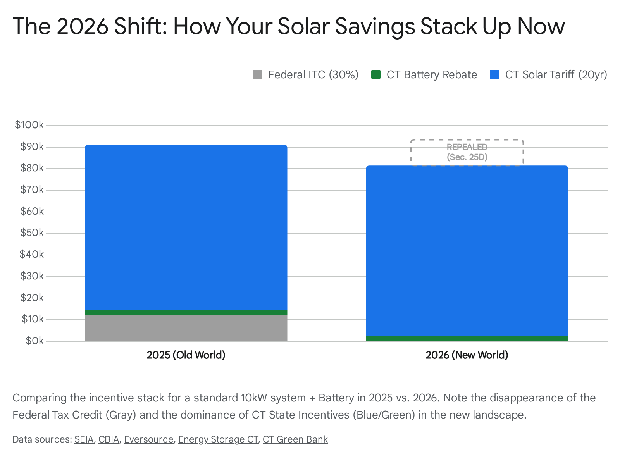
- The Bad News: The Federal Tax Credit (that famous 30% off coupon from the IRS) is expired for new home solar projects starting today, January 1, 20261. If you didn't install last year, you missed it.
- The Good News: Connecticut’s state incentives are massive. The state will pay you a guaranteed cash rate for every bit of power you make, and they are handing out huge rebates for batteries.
- The Choice: You now have to pick between two plans: "Buy-All" (sell everything to the utility for a high fixed price) or "Netting" (use your own power, but pay a new fee).
- The Battery Bonus: You can get up to $16,000 off the cost of a battery system upfront3. This is the biggest pot of "free money" currently available.
- The Bottom Line: Solar in CT is no longer about a tax refund next April. It is about monthly cash flow and battery rebates right now.
---
Part 1: The Federal Landscape (Or, What Just Happened?)
The End of the 30% Tax Credit
Let’s rip the band-aid off first. For nearly twenty years, the biggest reason people went solar was the Investment Tax Credit (ITC), also known as the Residential Clean Energy Credit. It was a simple deal: you spend $30,000 on solar, and the federal government gives you a $9,000 credit on your income taxes.
That deal is dead.
According to the new laws passed last year—specifically a piece of legislation humorously nicknamed the "One Big Beautiful Bill"—Congress voted to eliminate the residential credit (Section 25D) at the end of 20252.
This means if you sign a contract today, you cannot claim that 30% credit when you file your taxes next year. It is gone. The lawmakers in Washington decided it was time for the solar industry to stand on its own two feet without that specific federal crutch4.
Did I Miss the Boat?
If you already installed your panels and turned them on before midnight on December 31, 2025, you are safe! You are "grandfathered" in. You can still claim the credit on your 2025 tax return.
But for everyone starting a project now, in 2026, the sticker price you see is the price you pay—unless we find money somewhere else. And luckily, we can find a lot of it right here in Connecticut.
---
Part 2: The Connecticut RRES Program (Your New Paycheck)
Since Uncle Sam isn't cutting checks anymore, we have to look at our own state. Connecticut has a program called Residential Renewable Energy Solutions, or RRES.
Think of RRES as a 20-year contract between you and your utility company (Eversource or United Illuminating). You agree to put solar panels on your roof, and they agree to pay you for the power you produce.
But here is where it gets tricky. In 2026, you have to choose between two different ways to get paid. This is the most important decision you will make. You need to pick either Option A: Buy-All or Option B: Netting.
Option A: The "Buy-All" Tariff (The Guaranteed Payday)
In a "Buy-All" setup, you don't actually use the solar power you make. It sounds weird, but stay with me.
Your solar panels are wired directly to the electric grid, almost like a separate mini power plant. Every single bit of electricity your roof makes is sold instantly to the utility company. They measure it, and they pay you a fixed cash rate for it.
Then, you just continue to buy electricity for your house from the grid, exactly like you do now. You get two separate things: a bill for what you use, and a check (or bill credit) for what you made.
The 2026 Rate:
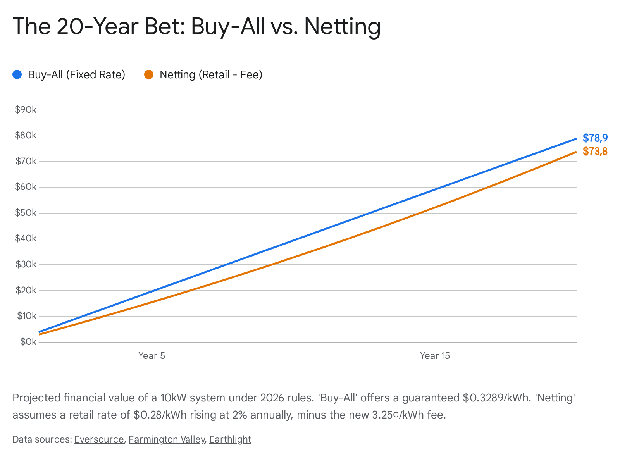
For 2026, the state has raised the payout rate. If you sign up this year, they will pay you $0.3289 for every kilowatt-hour (kWh) you produce5.
Why is this good?
- It’s Guaranteed: That rate of nearly 33 cents is locked in for 20 years5.
- It’s High: Right now, the cost to buy electricity is often around 24 to 28 cents per kWh. If you can sell yours for 33 cents, you are making a profit on every unit of energy.
- It’s Simple: You don't have to worry about whether you are home during the day to use the power. You just sell it all.
Option B: The "Netting" Tariff (The Use-It-Yourself Plan)
This is what most people think of when they imagine solar. Your panels power your house first. If your fridge is running, the solar power goes there. If you make extra, it flows to the grid and you get a credit for later.
The 2026 Catch: The "Fee"
In the old days, this was a great deal. But starting January 1, 2026, there is a new rule. The state has added a "non-bypassable charge" to this plan.
You now have to pay a fee of roughly 3.25 cents per kWh on all the solar energy your system produces6.
Wait, read that again. You pay this fee on everything you generate—even the power you use yourself instantly!
Let’s do the math on the fee:
Imagine electricity costs 30 cents.
- In the past, if you made a kWh of solar, you saved 30 cents.
- Now, you save 30 cents, but you have to pay a 3.25 cent fee. So your "real" savings is only 26.75 cents.
Why did they do this?
The state regulators (PURA) argue that even solar owners rely on the grid (the wires, the poles, the transformers). This fee is their way of making sure solar owners chip in for the cost of maintaining the infrastructure8.
So, Which One Should I Pick?
This is the million-dollar question. Because of the new fee on the Netting plan, the math has shifted.
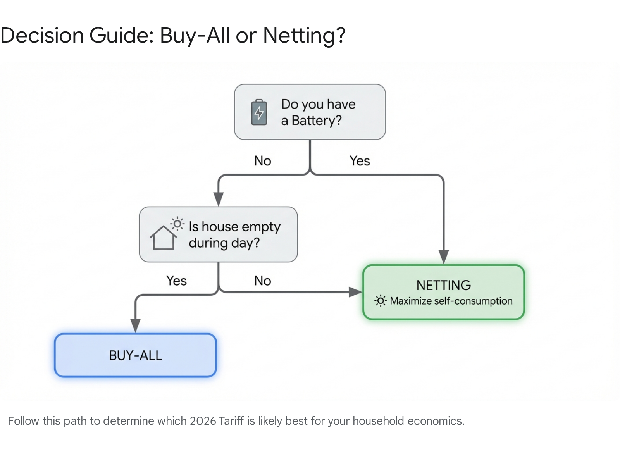
Choose "Buy-All" If:
- You are not buying a battery.
- Your house is empty during the day (you work 9-to-5), so you aren't there to use the solar power when it’s being made.
- You want a guaranteed, safe return on your investment.
Choose "Netting" If:
- You are buying a big battery system (so you can store your power and use it later, avoiding the grid entirely).
- You have huge electric loads during the day (like charging an EV or running a pool pump).
- You think the price of electricity is going to skyrocket way past 33 cents in the next few years.
---
Part 3: The "Income-Eligible" Turbo Boost
Before you make your final choice, we need to check your income. Connecticut has designed this program to be extra generous to households that aren't wealthy.
If your household income is below 60% of the State Median Income, or if you live in a specific "economically distressed" community (like parts of Bridgeport, Hartford, or New Haven), the state adds a massive "bonus" to your payment rate.5
Look at these 2026 Bonus Rates:
| Your Status | Buy-All Bonus | Netting Bonus |
|---|---|---|
| Low-Income (≤ 60% SMI) | + 5.5¢ / kWh | + 3.5¢ / kWh |
| Distressed Community | + 2.75¢ / kWh | + 1.75¢ / kWh |
Why this is a game-changer:
If you qualify as low-income, your total "Buy-All" rate becomes 38.39 cents per kWh ($0.3289 base + $0.055 bonus).
That is an incredibly high rate. It is almost certainly much higher than what you pay for electricity. If you cover your roof in panels with this rate, you could wipe out your entire electric bill and possibly even end up with extra credits.
---
Part 4: The Battery Gold Rush (Energy Storage Solutions)
Here is the secret weapon for 2026. While the federal government took away the solar tax credit, the state of Connecticut is practically throwing cash at you to install a battery.
Batteries are those big boxes (like a Tesla Powerwall or Enphase IQ) that hang on your garage wall. They store power so you can use it at night or when the power goes out.
The state program is called Energy Storage Solutions (ESS). It is run by the Connecticut Green Bank, and the incentives this year are huge.
The Upfront Rebate: Instant Discount
Unlike a tax credit where you have to wait for April 15th, this is an upfront rebate. The money goes directly to your installer, and they take it right off your bill.
The rebates work in "blocks." As more people sign up, the rebate slowly drops. But since it is the start of 2026, we are in a good spot.
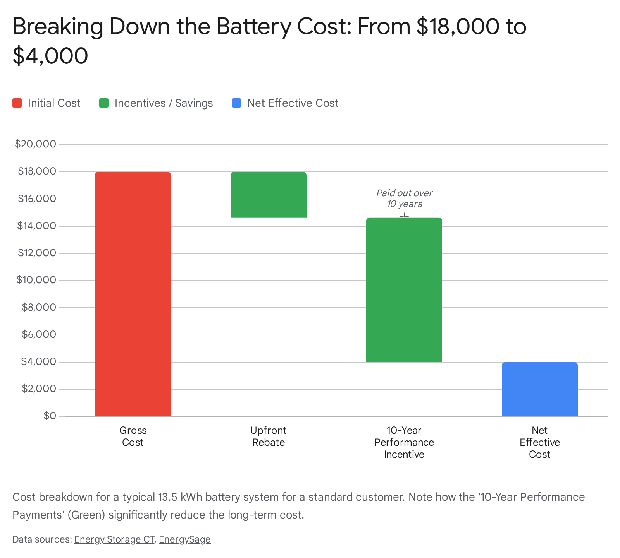
Here is what you can get right now3:
- Standard Homeowner: You get $250 off for every kilowatt-hour (kWh) of battery size.
- Real World Math: A standard battery is about 13.5 kWh.
- 13.5 x $250 = $3,375 Off.
- Underserved Community: You get $450 off per kWh.
- 13.5 x $450 = $6,075 Off.
- Low-Income Homeowner: You get $600 off per kWh.
- 13.5 x $600 = $8,100 Off.
The New Cap: The state recently raised the maximum rebate to $16,000 per project3. That is enough to cover the cost of nearly two whole batteries for a low‑income household!
The "Grid Edge" Bonus
Do you live on a street where the lights flicker every time the wind blows? You might be on a "Grid Edge" circuit. These are the parts of the electric map that are the most unreliable.
If you live here, the state gives you a 50% Bonus on top of your rebate11. They really want you to have a battery so you stop calling them when the power goes out.
The Performance Incentive: Passive Income
The upfront cash is nice, but the program also pays you every single year for 10 years.
Why? Because you agree to let the utility company borrow a tiny bit of your battery power on the hottest days of summer. This is called "Passive Dispatch."
How it works:
- Between 5 PM and 8 PM in the summer (June to August), your battery automatically sends some power to your house or the grid11.
- You don't have to do anything. The software handles it.
- The Payday: You earn $200 per kilowatt in the summer and $25 per kilowatt in the winter for the first 5 years12.
The Bottom Line:
For a typical battery, this adds up to about $1,125 a year in your pocket. Over 10 years, that is more than $9,000 in extra payments.
---
Part 5: Financing (How to Pay for It)
Okay, so we know the federal tax credit is gone. That means your loan balance is going to be higher. You need a loan with a low interest rate to make the monthly payments work.
Do not—I repeat, do not—just sign whatever loan contract a door-to-door salesman hands you. Many of those loans have hidden "dealer fees" that can add 20% or 30% to the cost of your project.
The Smart-E Loan
Connecticut has a special loan program called the Smart-E Loan. It is run by the Green Bank and local credit unions. It is the "gold standard" for solar financing in our state.
Why it’s better:
- No Dealer Fees: The price is the price.
- Low Rates: For 2026, the rates are generally between 6.99% and 7.99%13. That is much cheaper than a credit card or a personal loan.
- Long Terms: You can spread the payments out over 12, 15, or even 20 years to keep the monthly bill low.
Special Tip: If you are also installing heat pumps (like those ductless mini-splits for heating and cooling) at the same time, check for special rates. In late 2025, they were offering rates as low as 0.99% for heat pump projects14. If you bundle your solar with a heat pump, you might be able to blend that rate down!
---
Part 6: The "Silent" Savings (Taxes)
Even though the IRS isn't helping us anymore, the Connecticut Department of Revenue is still on our side. There are two major tax breaks you get automatically.
1. Sales Tax Exemption (Save 6.35%)
When you go to the store and buy a TV, you pay sales tax. When you buy a $30,000 solar system in Connecticut, you pay $0 sales tax15.
- The Savings: On a typical system, this saves you nearly $2,000 instantly. You don't have to fill out a form; the installer just shouldn't charge it to you.
2. Property Tax Exemption (Save Forever)
Usually, if you improve your home—like adding a new kitchen or a pool—your house is worth more, so the town increases your property taxes.
- The Rule: In Connecticut, renewable energy systems (solar panels and batteries) are exempt from property taxes16.
- What this means: Your home value goes up (studies show solar homes sell for more!), but your tax bill stays flat. A new law passed last year clarified this to make sure town assessors can't try to tax your panels.
---
Part 7: Step-by-Step Action Plan
So, you are ready to do this. What actually happens next?
Step 1: Find a "Smart-E" Contractor.
Go to the Connecticut Green Bank website and look for their list of approved contractors. These companies know the rules for the rebates and the loans.
Step 2: Get Quotes & Ask the "Netting" Question.
When a salesperson gives you a quote, ask them: "Are you quoting me the 2026 Buy-All rate or the Netting rate? And did you factor in the new 3.25 cent fee?"
If they look confused or say they don't know about the fee, do not hire them. They are working off old information.
Step 3: Choose Your Tariff.
You have to sign a form telling Eversource or UI which plan you want (Buy-All or Netting). Remember the flowchart we looked at earlier. Once you pick, you are locked in for 20 years.
Step 4: Apply for the Loan.
Once you have the price, apply for the Smart-E loan through a local lender (like Capital for Change or a local credit union).
Step 5: Install & Inspect.
The installer puts the panels on the roof. Then, the town inspector comes out. Finally, the utility company comes out to swap your meter.
Step 6: Turn It On!
Once you get the "Permission to Operate" (PTO) email, you flip the switch.
---
Conclusion: The Sun Is Still Shining
The year 2026 is definitely different. The loss of the federal tax credit is a blow, no doubt about it. It means we can't just rely on a big refund check to make the numbers work.
But Connecticut has built a safety net. With the higher "Buy-All" payment rates and the massive battery rebates, you can still save thousands of dollars and protect your home from power outages.
The key is to be smart. Don't just blindly sign up. Choose the right tariff (Buy-All vs. Netting), grab those battery rebates while they last, and use the state's low-interest financing.
The grid is changing. Prices are rising. But with solar, you can take control of your own power. Good luck with your project!
Works cited
- Federal Solar Tax Credit (ITC): Ending January 1, 2026, accessed January 1, 2026, https://www.solartopps.com/blog/federal-solar-tax-credit-ending-january-1-2026/
- With a federal tax credit ending early, installing home solar is about to get more expensive, accessed January 1, 2026, https://ipmnewsroom.org/with-a-federal-tax-credit-ending-early-installing-home-solar-is-about-to-get-more-expensive/
- Connecticut's Battery Storage Program Implements Changes to Increase Accessibility and Adoption Among Residents – CT Green Bank, accessed January 1, 2026, https://www.ctgreenbank.com/battery-storage-program-increases-accessibility-for-residents/
- 2025 Year-End Guide: Tax Credits, Incentives, accessed January 1, 2026, https://www.cbia.com/news/small-business/2025-year-end-guide-tax-credits-incentives
- Connecticut Residential Solar Incentives | Eversource, accessed January 1, 2026, https://www.eversource.com/residential/save-money-energy/clean-energy-options/solar-energy/learn-about-solar/rres-solar-incentives
- Is Solar Right for Your CT Home? Why 2025 Matters – We Share Real Thoughts, accessed January 1, 2026, https://www.thefarmingtonvalley.com/post/is-solar-right-for-your-ct-home-why-2025-matters-we-share-real-thoughts
- Changes Coming to Connecticut's Residential Solar Program in 2026, accessed January 1, 2026, https://www.earthlighttech.com/blog/changes-coming-to-connecticuts-residential-solar-program-in-2026
- Residential Renewable Energy Solutions Program – CT.gov, accessed January 1, 2026, https://portal.ct.gov/pura/electric/office-of-technical-and-regulatory-analysis/clean-energy-programs/residential-renewable-energy-solutions-program
- Program Manual – Energy Storage Solutions, accessed January 1, 2026, https://energystoragect.com/wp-content/uploads/2025/01/ESS-Program-Manual-01172025-Clean-FINAL.pdf
- Energy Storage Solutions – UI, accessed January 1, 2026, https://www.uinet.com/smartenergy/innovation/energy_storage_solutions
- Due to High Demand, Connecticut's Battery Storage Program Opens New Tranche of Commercial Incentives – CT Green Bank, accessed January 1, 2026, https://www.ctgreenbank.com/battery-storage-program-opens-new-tranche-of-commercial-incentives/
- Connecticut Solar Incentives, Tax Credits & Rebates 2025 | EnergySage, accessed January 1, 2026, https://www.energysage.com/local-data/solar-rebates-incentives/ct/
- Smart-E Loans – CT Green Bank | Accelerating Green Energy ..., accessed January 1, 2026, https://www.ctgreenbank.com/home-solutions/smart-e-loans/
- Smart-E Loan Special Offer Reduces Interest Rate for Residential Heat Pump Installations – CT Green Bank, accessed January 1, 2026, https://www.ctgreenbank.com/smart-e-heat-pump-special-announced/
- 2026-2027 U.S. Solar and HVAC Incentives After Federal Credits End | AC Direct, accessed January 1, 2026, https://www.acdirect.com/blog/2026-2027-us-solar-hvac-incentives-post-federal-credit-era/
- AN ACT ESTABLISHING A UNIFORM SOLAR CAPACITY TAX. – Connecticut General Assembly, accessed January 1, 2026, https://www.cga.ct.gov/2025/ba/pdf/2025HB-07266-R000890-BA.pdf
- Property Tax Exemption for Renewable Energy Systems – DSIRE, accessed January 1, 2026, https://programs.dsireusa.org/system/program/detail/240