If you are a homeowner in California looking up at your roof and thinking about solar panels, you have probably realized that the information landscape is a mess. One website promises you "free solar" from a government program that doesn't exist. Another article warns that "solar is dead" in California because of new utility rules. A third source is just a confusing jumble of acronyms like NEM, ITC, and SGIP. It is enough to make anyone want to close their laptop and just pay the utility bill.
But here is the honest truth: California is still one of the best places in the world to generate your own clean energy. The sun shines constantly, utility rates are some of the highest in the nation, and there are still significant financial incentives to help you make the switch. However, the "wild west" days of simply slapping panels on your roof and watching your meter spin backward are over. The game has changed. It is smarter, more complex, and now almost entirely revolves around not just generating power, but storing it.
This report is designed to be your friendly, expert guide through this new landscape. We are going to strip away the sales fluff and the doom-and-gloom headlines. We will walk through every single incentive available to you in 2026—from the massive federal tax credits to the misunderstood state rebates and the specific local programs for low-income families. We will explain exactly how the money works, how to avoid the common traps, and how to design a system that actually saves you money for the next 25 years.
TL;DR: The Quick Summary (For Busy Homeowners)
We know you are busy, so if you only have a few minutes, here is the executive summary of the state of solar in California for 2026. These are the headline facts you need to know before talking to any contractor.
- The Federal Government Pays 30%: The biggest incentive is the Federal Solar Investment Tax Credit (ITC). It gives you a tax credit equal to 30% of the total cost of your solar and battery project. This is locked in until 2032. It is a dollar-for-dollar reduction of the income taxes you owe.1
- The Rules Changed (NEM 3.0): California's old "Net Metering" rules are gone for new customers. Under the new "Net Billing" (NEM 3.0), the utility pays you pennies (roughly 4-8 cents) for the solar power you send to the grid during the day. This destroys the economics of "solar-only" systems.2
- Batteries Are Now Mandatory: Because you get paid so little for exporting power, you must store it instead. Adding a battery allows you to save your cheap solar power and use it at night when grid electricity is expensive. This is the only way to maximize savings now.3
- Battery Rebates Exist (But Are Tricky): The state has a rebate program called SGIP. For most people, the funds are tight or waitlisted. However, if you live in a "High Fire Threat District" or meet low-income criteria, you could get a massive rebate that covers nearly the entire cost of the battery.4
- Your Property Taxes Are Safe: California has a specific rule that prevents your property taxes from going up just because you increased your home's value with solar panels. This protection applies to systems completed before January 1, 2027.5
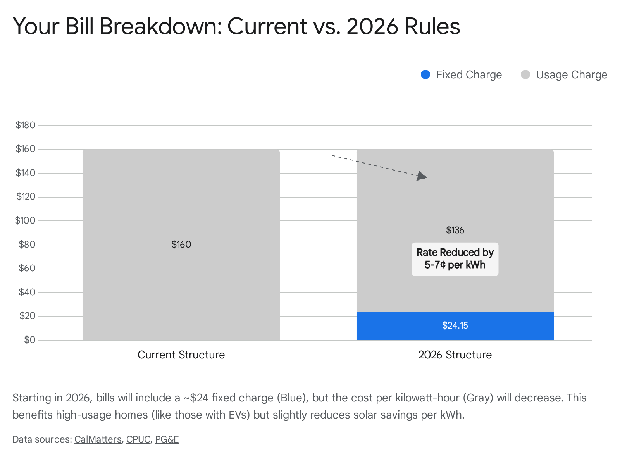
- Fixed Charges Are Coming: Starting in late 2025 or 2026, your electric bill structure will shift. You will pay a higher flat monthly fee (likely around $24), but the price you pay for each kilowatt-hour of energy will drop slightly. This helps high-energy users (like those with Electric Vehicles) but slightly hurts low-energy users.6
---
Part 1: The Foundation — The Federal Investment Tax Credit (ITC)
Before we dive into the complex California-specific rules, we need to understand the bedrock of solar economics in the United States: The Federal Solar Investment Tax Credit, commonly called the ITC. This is the most significant financial benefit available to you, and unlike some state programs that run out of money, this one is guaranteed by federal law for years to come.
What Is the ITC?
The ITC is a federal policy that allows you to claim a credit on your federal income taxes for 30% of the cost of your renewable energy system.1
It is crucial to understand the difference between a "tax deduction" and a "tax credit."
- A Tax Deduction lowers your taxable income. If you make $100,000 and have a $10,000 deduction, you are taxed as if you made $90,000. This might save you $2,000 to $3,000 depending on your bracket.
- A Tax Credit is a direct discount on the tax bill itself. If you owe the IRS $15,000 in taxes for the year, and you have a $10,000 solar tax credit, your bill is instantly reduced to $5,000. It is much more powerful than a deduction.
The Stability of the 30% Rate
For many years, the solar industry lived in fear of this credit expiring. Every year, Congress would fight about whether to extend it. That uncertainty is gone. The Inflation Reduction Act of 2022 established a long-term schedule for the ITC, giving homeowners like you the confidence to plan ahead.
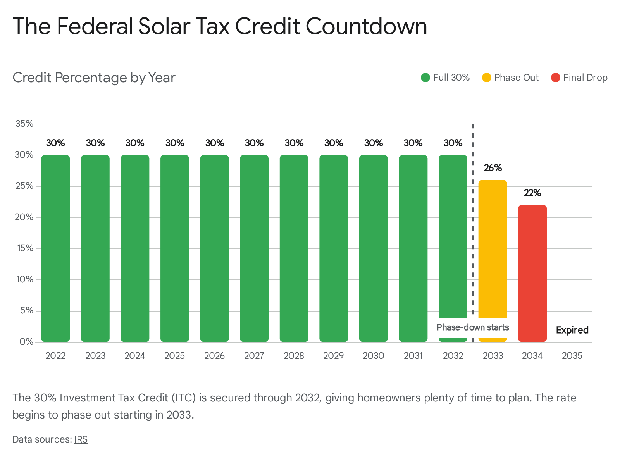
As the timeline illustrates, the credit remains at 30% for any system installed and placed in service between 2022 and 2032. It only begins to phase down in 2033 (to 26%) and 2034 (to 22%), before expiring in 2035 unless Congress acts again.1 This means you do not need to panic if you can't get solar installed this month. You have time to make a considered decision.
Eligibility Checklist
To claim the ITC, you must meet specific criteria. It is surprisingly broad, but there are a few "gotchas" to be aware of.
1. Home Ownership
You must own the home where the system is installed.
- Primary Residence: Yes, definitely qualifies.
- Second Home / Vacation Home: Yes, this also qualifies! You can claim the credit for a system on your beach house or cabin, as long as you live there for part of the year.1
- Rental Property: This is the tricky part. If you are a landlord and you install solar on a rental property where you do not live, you generally cannot claim the Residential Clean Energy Credit. You might qualify for a different business tax credit, but the rules are different. The residential credit requires you to use the home as a residence.
2. System Ownership
You must own the solar system.
- Cash Purchase: You qualify.
- Solar Loan: You qualify. Even if you borrowed 100% of the money from a bank, the IRS views you as the owner of the system.
- Lease or Power Purchase Agreement (PPA): You do NOT qualify. In these arrangements, the solar company (like Sunrun or Tesla) legally owns the panels. They claim the tax credit, not you. They might lower your monthly payment because of it, but you do not get to file for the 30% credit on your taxes.7
3. Tax Liability
The ITC is "non-refundable." This is a tax term that confuses many people. It means the IRS will not write you a check if the credit is bigger than the taxes you owe.
- Example A: You owe $15,000 in federal taxes for the year (this includes money withheld from your paycheck). Your solar credit is $10,000. Result: You use the whole credit. The IRS refunds you the taxes you already paid via withholding.
- Example B: You are retired. Your income is from non-taxable Social Security. You owe $0 in federal taxes. Your solar credit is $10,000. Result: You cannot use the credit this year because you have no tax bill to reduce.
The "Rollover" Safety Net:
Fortunately, if you can't use the whole credit in one year, you don't lose it. You can carry forward the unused portion to the next tax year.1 So in Example B, if the retired couple withdrew money from an IRA the following year and generated a tax bill, they could use the solar credit then.
What Expenses Can You Include?
When calculating your 30% credit, you want to include every legitimate expense to maximize your savings. According to the IRS, the "qualified solar electric property costs" include:
- Solar Panels: The photovoltaic cells themselves.
- Inverters: The equipment that converts DC solar power to AC household power.
- Racking and Mounting: The metal rails that hold the panels to your roof.
- Batteries: Energy storage devices with a capacity of at least 3 kilowatt-hours (kWh).1
- Installation Labor: The cost of the crew on your roof, including onsite preparation, assembly, and original installation.
- Permitting Fees: The money paid to your city or county for building and electrical permits.
- Inspection Costs: Fees for utility or city inspections.
- Sales Tax: Any sales tax you paid on the eligible equipment.
The Roof Replacement Myth:
A common sales tactic is to tell homeowners, "If you need a new roof, we can bundle it with the solar and you get 30% off the whole roof!"
Be very careful. The IRS rules generally say that traditional roofing materials (shingles, underlayment) are not eligible for the credit because they serve a function (shelter) independent of the solar panels. You can only claim the cost of the roof if you are installing specialized "solar shingles" or "solar tiles" that generate electricity themselves. Claiming a standard asphalt roof replacement could trigger an IRS audit. Always consult a tax professional on this specific point.
The Standalone Battery Loophole
One of the best changes in the 2022 law was the separation of batteries from solar panels. Previously, you could only claim the tax credit on a battery if it was charged 100% by solar panels.
Now, standalone battery storage qualifies for the 30% credit regardless of how it is charged.1
- Why this matters: If you installed solar panels five years ago (and already claimed your credit), but now you want to add a Tesla Powerwall or Enphase battery to deal with the new California rates, you can claim a fresh 30% tax credit on the cost of that battery installation. It breathes new financial life into older systems.
---
Part 2: The California Context — Why Is It So Expensive?
To understand why California's solar rules are so complicated, you first have to understand the unique energy market of the Golden State. Why does California have some of the highest electricity rates in the country, and why are they changing how they pay solar owners?
The "Duck Curve" and the Solar Surplus
California has been incredibly successful at deploying solar power. In fact, we have been too successful in some ways. On a sunny spring afternoon, the state generates so much solar power that there is often a surplus. The wholesale price of electricity—what utilities pay to buy power on the open market—crashes to zero. sometimes it even goes negative, meaning the grid operator has to pay neighboring states to take our excess power to prevent the grid from overloading.
However, as soon as the sun goes down (around 5:00 PM to 8:00 PM), that solar power vanishes. But this is exactly when everyone comes home from work, turns on the air conditioning, starts cooking dinner, and watches TV. Demand spikes just as supply collapses.
This phenomenon is called the "Duck Curve" (because the graph looks like the profile of a duck).
- The Belly (Daytime): Low demand for grid power because solar is flooding the system. Prices are cheap.
- The Neck (Evening): Sky-high demand for grid power as solar disappears. Utilities have to fire up expensive, polluting gas "peaker plants" to keep the lights on. Prices are astronomical.
The Problem with the Old Rules (NEM 2.0)
Under the old Net Metering 2.0 rules, the grid treated your solar panels like a 1-for-1 bank account.
- If you sent 1 kWh to the grid at noon (when power was worthless), the utility gave you a credit.
- You could use that credit to buy 1 kWh back at 8:00 PM (when power was expensive).
The utilities argued this was unfair. They were effectively forced to buy your low-value daytime power at full retail price and sell you high-value evening power for free. They claimed this shifted the costs of maintaining the grid onto non-solar customers (often lower-income renters), creating a "cost shift" of billions of dollars a year.
Whether you agree with their logic or not, the California Public Utilities Commission (CPUC) sided with the utilities. This decision led to the creation of NEM 3.0, or the Net Billing Tariff.
---
Part 3: Net Billing (NEM 3.0) — The New Reality
This is the most critical section of this report. If you are reading older articles from 2021 or 2022, they will reference "NEM 2.0." You must ignore that advice. It is obsolete for new customers. We are now living in the NEM 3.0 world, which officially started for new applications on April 15, 2023.3
The Core Mechanism: "Avoided Cost"
Under NEM 3.0, the simple 1-for-1 swap is gone. It has been replaced by a system based on the "Avoided Cost Calculator" (ACC).
- Buying Power: When you pull electricity from the grid (mostly at night), you pay the full retail rate. This is expensive—typically $0.30 to $0.60 per kWh depending on the time of year and your rate plan.
- Selling Power: When you send excess solar power to the grid, the utility pays you what they would have paid to buy that power from a big power plant. This is the "Avoided Cost."
During the day, when your solar panels are producing the most, the "Avoided Cost" is incredibly low. We are talking about $0.04 to $0.08 per kWh.2
The Math Problem:
Imagine you export 10 kWh of solar power to the grid at noon.
- Utility pays you: 10 kWh * $0.05 = $0.50 credit.
Later that night, you need 10 kWh to run your AC and lights. - Utility charges you: 10 kWh * $0.45 = $4.50 charge.
Even though you generated as much power as you used, you still owe the utility $4.00. This is why a "solar-only" system (without batteries) no longer makes financial sense for most California homeowners. You are selling low and buying high.
The Hidden Opportunity: The Evening Spike
However, the "Avoided Cost" isn't always low. Remember the "Duck Curve"? The grid is desperate for power on hot summer evenings.
Because the export rate changes every hour of the year (there are 576 distinct export prices!), there are moments when the export rate skyrockets.
- September Evenings (6:00 PM - 8:00 PM): The export rate can jump to $2.00 or even $3.00 per kWh.3
This creates a new game. If you can save your solar power and export it only during those super-valuable windows, you can wipe out your bill very quickly. But to do that, you need a battery.
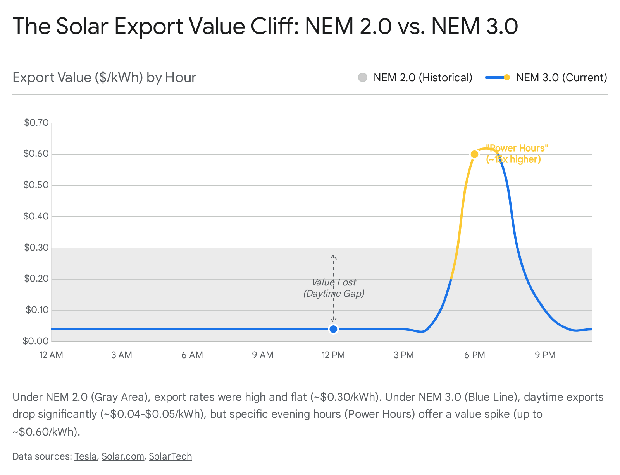
As the chart above demonstrates, the blue line (NEM 3.0) flatlines near zero during the sunny hours. That "lost area" between the gray and blue lines represents the money you lose if you don't have a battery. But look at the spike on the right—that is your opportunity to profit.
The "Export Adders" (A Fading Bonus)
To soften the blow of this transition, the CPUC included temporary "Export Rate Adders" for early adopters of NEM 3.0. These are bonus cents-per-kWh added to your export credits.
- PG&E: Started at roughly 2.2 cents/kWh.
- SCE: Started at roughly 4.0 cents/kWh.
- SDG&E: No adder (because their rates are so high, the payback was already considered fast enough).
The Decline: These adders are not permanent. They are designed to decline by 20% each year for five years.9
- Year 1 (2023-2024): 100% of the adder.
- Year 2 (2024-2025): 80% of the adder.
- Year 3 (2025-2026): 60% of the adder.
By 2026, the value of these adders will be significantly reduced, making them a nice "cherry on top" but not a reason to base your entire financial calculation on them. However, if you lock in an adder, you keep that specific adder rate for 9 years. This means getting in sooner rather than later still has a small benefit.
The "True-Up" Bill
Just like the old system, NEM 3.0 operates on an annual cycle called the "True-Up." You don't pay your solar bill every month.
- Each month, you receive a statement showing your net charges or credits.
- If you have credits, they "roll over" to pay for next month's bill.
- At the end of 12 months, you receive the True-Up Bill. If you used more power than you generated (in dollar value), you owe the difference. If you generated more value than you used, the credits generally expire or are paid out at a very low "Net Surplus Compensation" rate.
Strategy: Your goal should be to size your system to reach a $0 True-Up bill, but not much lower. Oversizing your system to generate huge credits is generally a waste of money because the cash-out rate for excess annual credits is very low.
---
Part 4: The Battery Revolution — Why You Need Storage
In the NEM 3.0 era, the solar panel is the engine, but the battery is the transmission. You can't drive the car effectively without it.
How a Battery Changes the Math
Without a battery, your solar panels are forced to sell their product (electricity) when the market price is lowest (noon). With a battery, you become a smart trader.
1. Self-Consumption Mode (The Daily Grind)
This is the default setting for most homeowners.
- Morning: Solar powers your home. Excess energy charges the battery.
- Noon: Battery hits 100%. Excess energy goes to the grid (for pennies).
- Evening: Sun goes down. Rates spike to Peak pricing ($0.50+/kWh). Your battery kicks in and powers your lights, TV, and dishwasher. You draw zero from the grid during these expensive hours.
- Night: If the battery runs out, you switch back to the grid (but by then, rates have dropped to Off-Peak prices).
2. Arbitrage Mode (The Profit Hunter)
Advanced battery software (like Tesla's "Time-Based Control" or Enphase's "Savings Mode") can do something even smarter.
- During those specific "September Evening" hours when export rates hit $3.00/kWh, the battery will dump its entire stored charge onto the grid.
- Dumping 10 kWh at $3.00 earns you $30.00 in credits in a single hour.
- That $30.00 credit sits in your account and pays for weeks of grid usage in the winter.
Types of Batteries
- Lithium-Ion (NMC): (e.g., Tesla Powerwall 2, LG Chem). High energy density, established technology. However, they can be sensitive to extreme heat.
- Lithium Iron Phosphate (LFP): (e.g., Enphase IQ Battery 5P, Tesla Powerwall 3). This is the new standard. They are safer (less fire risk), last longer (more charge cycles), and degrade slower. Recommendation: If you are buying in 2026, prioritize LFP chemistry for longevity.
How Many Batteries Do You Need?
A common mistake is undersizing the battery.
- 1 Battery (10-13 kWh): Usually enough to cover evening loads (lights, fridge, TV) for a medium house. It will not run your Air Conditioner all night.
- 2 Batteries (20-26 kWh): Required if you want to run central AC after sunset or if you have an Electric Vehicle you charge at night.
- Backup Power: Remember, a grid-tied solar system shuts down during a blackout for safety reasons. Only a system with a battery can keep your lights on when the grid goes down. If you want whole-home backup (running everything including the AC during a blackout), you likely need 2-3 batteries.
---
Part 5: SGIP — The Hidden Battery Rebate
While the federal 30% tax credit is well-known, California has its own state-level incentive program for batteries called the Self-Generation Incentive Program (SGIP). This is a cash rebate, not a tax credit, meaning you get a check (or your installer does, lowering your upfront cost).
SGIP is complex because it is not an unlimited pot of money. It is divided into "budgets" and "steps."
1. The General Market Budget (The Standard Rebate)
This is for the average homeowner who just wants to save money on bills.
- Status: In many utility territories (PG&E, SCE), these funds are often exhausted or stuck in "waitlist" mode. The rebate amount declines with each "Step."
- Value: By 2026, the General Market rebate is relatively small—often around $150 to $200 per kWh. For a standard 13 kWh battery, that is a rebate of roughly $2,000 to $2,600. It helps, but it won't pay for the whole system.
2. The "Equity Resiliency" Budget (The Golden Ticket)
This is the program everyone wants to qualify for. It is designed to help vulnerable people keep the lights on during wildfires and blackouts.
- Value: The rebate is massive—typically $1,000 per kWh or roughly 85-100% of the cost of the battery equipment and installation. We are talking about checks for $15,000+.
Who Qualifies?4
You must meet two sets of criteria:
Criterion A: Location
You must live in a High Fire Threat District (Tier 2 or Tier 3). You can check this on the CPUC website by typing in your address.
OR
You live in an area that has experienced two or more Public Safety Power Shutoff (PSPS) events (where the utility cut power on a windy day to prevent fires).
Criterion B: Vulnerability
You must also meet one of these:
- Medical Baseline: You rely on electric-powered medical equipment (CPAP, dialysis, electric wheelchair) and are enrolled in the utility's Medical Baseline program.
- Low Income: You are eligible for the CARE or FERA rate programs.
- Critical Community Needs: You are a small business grocery store or food bank in a disadvantaged community.
The Strategy:
If you live in a fire zone (which includes huge swathes of the Sierra foothills, wine country, and Southern California canyons), you must verify your eligibility for Equity Resiliency. It can turn a $15,000 battery investment into a nearly free upgrade.
3. Residential Solar and Storage Equity (RSSE)
Starting around mid-2025 and continuing into 2026, the CPUC launched this newer budget specifically for low-income customers to install paired solar and storage.4
- Funding: $280 million authorized.
- Goal: To help low-income families escape rising rates entirely.
- Eligibility: Similar to DAC-SASH (discussed below), requiring low-income status.
How to Apply for SGIP:
You generally cannot apply for SGIP yourself. Your developer (installer) must submit the paperwork. When getting quotes, ask specifically: "What is the status of SGIP funds in my area, and will you handle the application for me?" Note that many installers charge a small administrative fee to process the SGIP paperwork because it is notoriously bureaucratic.
---
Part 6: Help for Low-Income Homeowners (DAC-SASH & DAC-GT)
California has recognized a serious equity problem: rich people get solar and lower their bills, leaving low-income people to pay a larger share of the grid costs. To fix this, several powerful programs exist specifically for families living in "Disadvantaged Communities" (DACs).
DAC-SASH: Free Solar for Families
DAC-SASH stands for "Disadvantaged Communities – Single-Family Solar Homes." This is the gold standard for low-income assistance.
- The Benefit: Qualified homeowners can get a rooftop solar system installed for free or at very low cost. The incentive is roughly $3.00 per watt, which usually covers the entire hardware and labor cost.12
- Who Runs It: A non-profit organization called GRID Alternatives administers the program. They are fantastic. They not only install the systems but often use the projects as job-training sites to teach locals how to become solar installers.13
Eligibility Criteria:15
- Income: You must qualify for the CARE or FERA programs (income limits below).
- Location: You must live in a designated "Disadvantaged Community." This is defined by the state using a tool called CalEnviroScreen 4.0. It scores neighborhoods based on pollution burden and socioeconomic factors. You must be in the top 25% of these tracts.
- Ownership: You must own and occupy the home.
DAC-GT and CSGT: If You Can't Install Panels
What if your roof is old, shaded, or you are a renter?
- DAC-GT (Green Tariff): This program allows you to subscribe to 100% renewable energy from the grid and receive a 20% discount on your bill.
- CSGT (Community Solar Green Tariff): This allows a neighborhood to share a local solar project (like solar on a nearby warehouse). Participants also get a 20% bill discount.12
CARE and FERA: The Essential Rate Discounts
Even if you don't get solar, every eligible household should be enrolled in these rate programs. They provide a discount on every kilowatt-hour you buy.
- CARE (California Alternate Rates for Energy): Provides a 30-35% discount on your electric bill.
- FERA (Family Electric Rate Assistance): Provides an 18% discount on electricity for slightly higher-income families (must be a household of 3+ people).
Income Limits (Effective June 1, 2025 – May 31, 2026)17:
| Household Size | CARE Income Limit (Gross Annual) | FERA Income Limit (Gross Annual) |
|---|---|---|
| 1 - 2 | $42,300 | Not Eligible |
| 3 | $53,300 | $53,301 - $66,625 |
| 4 | $64,300 | $64,301 - $80,375 |
| 5 | $75,300 | $75,301 - $94,125 |
| 6 | $86,300 | $86,301 - $107,875 |
| Each Additional | + $11,000 | + $11,000 - $13,750 |
Important Note for Solar shoppers on CARE:
If you are on CARE, your electricity rates are already cheap (discounted by 35%). This means your "savings" from solar are technically lower than a neighbor paying full price. However, because low-income budgets are tighter, the impact of wiping out the remaining bill is often even higher. Programs like DAC-SASH are designed to work perfectly alongside CARE.
---
Part 7: The "Active Solar Energy System" Property Tax Exclusion
One of the most common fears homeowners have is: "If I spend $30,000 upgrading my home with a high-tech power plant, won't the Tax Assessor show up and hike my property taxes?"
In almost any other renovation (adding a bathroom, remodeling a kitchen), the answer is yes. But for solar, California law says No.
How the Exclusion Works
California Revenue and Taxation Code Section 73 provides an "Active Solar Energy System Exclusion."
- The Rule: When the county assessor values your property for tax purposes, they must exclude the value of the solar energy system.5
- The Math: If your home is assessed at $600,000 and you add a $30,000 solar system, your assessment stays at $600,000.
- The Savings: Since California property taxes are roughly 1.1% to 1.25%, avoiding tax on that $30,000 saves you roughly $330 to $375 per year. Over 20 years, that is nearly $7,500 in savings.
What Counts as an "Active Solar Energy System"?
The definition is broad5:
- Solar Electric (PV) Systems: Yes.
- Solar Water Heating: Yes (for domestic use).
- Space Conditioning: Yes.
- Process Heat: Yes.
- Storage: Yes, thermal storage and battery storage that is part of the system is generally included.
- Exclusions: It does NOT apply to solar swimming pool heaters or hot tub heaters. If you install solar specifically to heat your pool, that value can be assessed.
The Sunset Date (Timing Is Key)
This exclusion is not permanent. It has a "sunset date."
- Current Law: The exclusion applies to systems completed before January 1, 2027.5
- Construction in Progress: What if you start in 2026 but don't finish until 2027?
- If you are under construction as of Jan 1, 2026, that unfinished work is excluded from the 2026 tax bill.
- Critically, the system must be completed by Jan 1, 2027, to lock in the permanent exclusion. If you finish on Jan 2, 2027, and the legislature hasn't extended the law, you might be out of luck.21
Action Item: If you are reading this in 2026, do not wait until December to start your project. Permitting delays or equipment shortages could push your completion date past the deadline. Aim to have "Permission to Operate" (PTO) from your utility well before New Year's Eve.
---
Part 8: The New Fixed Charge (IGFC) — The 2026 Curveball
Just as homeowners were getting used to NEM 3.0, the state threw another curveball: The Income-Graduated Fixed Charge (IGFC). This is a fundamental restructuring of how electric bills are calculated, mandated by Assembly Bill 205.
The Concept: Splitting the Bill
Historically, your electric bill was mostly "volumetric." You paid for every kilowatt-hour (kWh) you used. This price included the cost of the fuel (energy) AND the cost of the poles, wires, and wildfire prevention (infrastructure).
The new logic is that infrastructure costs (poles/wires) are "fixed"—they cost the same whether you use 1 kWh or 1,000 kWh. Therefore, everyone should pay a flat fee for access to the grid, and the volumetric price of electricity should be lowered to reflect just the energy cost.
The Numbers: What to Expect in 2026
After much controversy and debate (with some proposals reaching as high as $128/month), the CPUC settled on a more moderate structure.6
- The Fixed Charge:
- General Rate: Approximately $24.15 per month.
- Low-Income (CARE): Discounted to roughly $6 per month.
- Very Low-Income (FERA): Discounted to roughly $12 per month.
- The Rate Reduction:
- Because the utility is collecting this fixed money, they are lowering the price per kWh by roughly 5 to 7 cents.
The Impact on Solar Economics
This change creates winners and losers.
- The "Loser" (Low Energy User): If you live in a small apartment or a very efficient home and use very little power, your bill might go up. You are paying $24 upfront to save 5 cents on a few hundred kWh.
- The "Winner" (High Energy User): If you have an electric car (EV) and a heat pump, you use a lot of power. Paying a flat $24 to save 7 cents on thousands of kWh is a great deal.
- The Solar Owner: It's a mixed bag.
- Negative: Your solar savings come from avoiding grid purchases. If grid power is 7 cents cheaper, your "savings per kWh" drops.
- Positive: The lower electricity rate makes it much cheaper to charge your backup battery from the grid in winter if you need to.
The Electrification Synergy:
The hidden goal of this policy is to encourage "Electrification." The state wants you to replace your gas car with an EV and your gas furnace with a heat pump. By lowering the per-kWh price of electricity, running these machines becomes more affordable. For a solar owner, this means your best long-term strategy is to expand your system to cover your car and heating, leveraging the cheap solar power against the lower grid rates.
---
Part 9: The Financials — Payback Period and ROI
Let's get down to the brass tacks. Is this still a good investment?
Cost Trends in 2026
The average cost of solar in California has stabilized around $3.10 to $3.50 per watt (cash price, before incentives).24
- 6 kW System (Small Home): ~$20,000.
- Battery (13 kWh): ~$12,000 - $15,000 installed.
- Total Project: ~$32,000 - $35,000.
After 30% Tax Credit: The net cost drops to ~$22,000 - $24,000.
Payback Period Analysis
The "Payback Period" is the time it takes for your bill savings to equal your net cost.
- Solar Only (NEM 3.0): This is the danger zone. Because exports are worth so little, a solar-only system might take 10-12 years to pay back. It is generally not recommended unless you work from home and can use 100% of the power while the sun is up.26
- Solar + Battery (NEM 3.0): This is the sweet spot. By self-consuming your power and avoiding expensive evening rates, typical payback periods are in the 6 to 9 year range.9
- ROI: With a 25-year warranty on panels, a 7-year payback means you get 18 years of "free" energy. This typically results in an Internal Rate of Return (IRR) of 10-15%—far better than a savings account and tax-free.
Payment Options: Cash vs. Loan vs. Lease
How you pay determines your savings.
1. Cash (The King)
- Pros: Highest savings. Instant 30% tax credit. No interest.
- Cons: Requires liquidity.
2. Solar Loan (The Standard)
- Pros: $0 down. Swap your electric bill for a loan payment.
- Cons: Watch out for "Dealer Fees." To offer a "low" interest rate (e.g., 3.99%), banks often charge a 15-25% fee upfront, inflating the system cost. Always ask for the "Cash Price" to see the difference.
- Tax Credit Trick: Most loans assume you will pay the 30% tax credit into the loan within 18 months. If you keep the cash instead, your monthly payment will "re-amortize" and jump up significantly.
3. Lease / PPA (The "Hassle-Free" Option)
- Pros: Company handles maintenance. Good if you don't have tax liability for the credit.
- Cons: You lose the 30% ITC. The company gets it. Escalator clauses (where payments rise 2.9% a year) can eat into savings. Makes selling your home harder as the buyer must qualify to take over the lease.
4. PACE Loans (The Danger Zone)
Property Assessed Clean Energy (PACE) programs (like HERO, Ygrene) attach the loan to your property tax bill.
- Warning: These loans take "first lien position" on your home.28 This scares mortgage lenders. If you try to refinance or sell your home, most banks will require you to pay off the entire PACE balance (tens of thousands of dollars) immediately. Many homeowners have lost home sales because of this. Proceed with extreme caution.
---
Part 10: Consumer Protection — How to Avoid Scams
The California solar market is competitive, and unfortunately, that breeds aggressive sales tactics. Here is how to protect yourself.
1. The "Three Quote" Rule
Never sign the first contract. Prices can vary by 50% for the exact same equipment. Get quotes from:
- A large national installer (for a baseline).
- Two highly-rated local installers (often better service and pricing).
2. License Verification
In California, your installer must hold a valid license from the Contractors State License Board (CSLB).
- Look for classification C-46 (Solar) or C-10 (Electrical).
- Check the license number on the CSLB website. Ensure their "Workers Compensation" and "Bond" are active. If they are "Exempt" from workers comp, do not hire them—you could be liable if a worker falls off your roof.
3. The "Government Program" Lie
If a salesperson knocks on your door and says, "I'm here from the state energy program to check your meter," close the door. The state does not send door-to-door salespeople. They are lead generators trying to look official.
4. Contract Red Flags
- Escalators: In a PPA/Lease, look for the "Annual Escalator." If it is higher than 2.9%, run. 0% is ideal.
- System Size: Ensure the estimated production (kWh) matches your actual annual usage. Don't buy a system that produces 150% of your needs unless you are buying an EV immediately—under NEM 3.0, that excess power is wasted money.
---
Part 11: Future Proofing — The Big Picture
Finally, when planning your solar project in 2026, don't just look at today's bill. Look at your future life.
- Electric Vehicles (EVs): If you plan to buy an EV in the next 3-5 years, size your system up now. Adding 6-8 panels later is much more expensive than adding them today. An EV typically consumes 3,000 - 4,000 kWh per year.
- Heat Pumps: California is moving to ban gas appliances. When your gas furnace or water heater dies, you will likely replace it with an electric Heat Pump. This will increase your electric load.
- V2H (Vehicle-to-Home): Emerging technology allows your EV to act as a backup battery for your house. If you are buying a bi-directional charger, make sure your solar inverter is compatible.
Conclusion: The Path Forward
Solar in California has matured. It is no longer a "get rich quick" scheme based on regulatory loopholes. It is a serious infrastructure investment that provides financial stability, safety, and environmental impact.
The combination of the 30% Federal Tax Credit, the NEM 3.0 reality favoring batteries, and the Property Tax Exclusion creates a robust path for homeowners. Yes, the upfront cost is higher because of the battery requirement. But the long-term payoff—locking in your energy costs in a world of inflation—is more valuable than ever.
By doing your homework, ignoring the sales hype, and focusing on the fundamentals of storage and self-consumption, you can turn your home into a personal power plant that serves your family for decades.
Summary Checklist for 2026
- [ ] Assessment: Check your roof age and main electrical panel (do you need an upgrade?).
- [ ] Quotes: Get 3 comparison quotes focusing on "Cash Price" and "Battery Size."
- [ ] Incentives: Check your SGIP eligibility (Fire Zone?) and Tax Credit eligibility (Tax Liability?).
- [ ] Sizing: Factor in future EV or Heat Pump additions.
- [ ] Timing: Start early to ensure completion before the Jan 1, 2027 Property Tax Sunset.
Disclaimer: This report is for informational purposes only. Tax laws, utility tariffs, and incentive program rules are subject to change. Always consult with a qualified CPA or tax professional regarding your eligibility for tax credits, and verify current program status with your local installer.
Works cited
- Residential Clean Energy Credit | Internal Revenue Service, accessed January 5, 2026, https://www.irs.gov/credits-deductions/residential-clean-energy-credit
- What is NEM 3.0 and How Will it Impact California Solar Owners?, accessed January 5, 2026, https://www.solar.com/learn/nem-3-0-proposal-and-impacts-for-california-homeowners/
- Net Billing Tariff (NEM 3.0) | Tesla Support, accessed January 5, 2026, https://www.tesla.com/support/energy/solar-panels/learn/net-billing
- Self-Generation Incentive Program (SGIP) - California Public Utilities Commission, accessed January 5, 2026, https://www.cpuc.ca.gov/industries-and-topics/electrical-energy/demand-side-management/self-generation-incentive-program
- Active Solar Energy System Exclusion - California State Board of Equalization - CA.gov, accessed January 5, 2026, https://boe.ca.gov/proptaxes/active-solar-energy-system/
- CPUC Approves A New Billing Structure That Will Cut Residential Electricity Prices And Accelerate Electrification, accessed January 5, 2026, https://www.cpuc.ca.gov/news-and-updates/all-news/cut-residential-electricity-prices
- Federal Solar Tax Credit (ITC): Ending January 1, 2026, accessed January 5, 2026, https://www.solartopps.com/blog/federal-solar-tax-credit-ending-january-1-2026/
- Federal Tax Credits for Energy Efficiency, accessed January 5, 2026, https://www.energystar.gov/about/federal-tax-credits
- What Is NEM 3.0? Complete Guide To California's New Solar Policy (2025) - SolarTech, accessed January 5, 2026, https://solartechonline.com/blog/what-is-nem-3-0-california-solar-guide/
- NEM 3.0 Export Rate Adders: Why It Pays to Go Solar Early in NEM 3.0 | Solar.com, accessed January 5, 2026, https://www.solar.com/learn/nem-3-0-export-rate-adders/
- Participating in Self-Generation Incentive Program (SGIP), accessed January 5, 2026, https://www.cpuc.ca.gov/industries-and-topics/electrical-energy/demand-side-management/self-generation-incentive-program/participating-in-self-generation-incentive-program-sgip
- Solar in Disadvantaged Communities - California Public Utilities Commission, accessed January 5, 2026, https://www.cpuc.ca.gov/industries-and-topics/electrical-energy/demand-side-management/customer-generation/solar-in-disadvantaged-communities
- Guide to California Solar Incentives & Tax Credits in 2026 - SolarReviews, accessed January 5, 2026, https://www.solarreviews.com/solar-incentives/california
- DAC-SASH - GRID Alternatives, accessed January 5, 2026, https://gridalternatives.org/what-we-do/program-administration/dac-sash
- DAC-SASH Eligibility Requirements - GRID Alternatives, accessed January 5, 2026, https://gridalternatives.org/dac-sash-eligibility-requirements
- Low Income Solar Programs - California Public Utilities Commission - CA.gov, accessed January 5, 2026, https://www.cpuc.ca.gov/industries-and-topics/electrical-energy/demand-side-management/customer-generation/california-solar-consumer-protection-guide/low-income-solar-programs
- California CARE Program - Pacific Power, accessed January 5, 2026, https://www.pacificpower.net/my-account/payments/bill-payment-assistance/california-care-program.html
- CARE & FERA - SCE, accessed January 5, 2026, https://www.sce.com/save-money/income-qualified-programs/care-fera
- California Alternate Rates for Energy Program | PG&E, accessed January 5, 2026, https://www.pge.com/en/account/billing-and-assistance/financial-assistance/california-alternate-rates-for-energy-program.html
- California Clarifies Sunset Dates for Solar Energy Tax Exclusion - DMA, accessed January 5, 2026, https://dmainc.com/news-and-insights/california-boe-clarifies-sunset-dates-solar-energy-tax-exclusion/
- California's Solar Property Tax Exclusion is Going Away – Make Sure You're Prepared!, accessed January 5, 2026, https://www.leoberwick.com/californias-solar-property-tax-exclusion-is-going-away-make-sure-youre-prepared/
- Californians will see lower electricity rates and a new fee that won't vary with power use, accessed January 5, 2026, https://calmatters.org/housing/2024/05/californians-electricity-rates/
- California approves uncapped fixed charges on electricity bills - pv magazine USA, accessed January 5, 2026, https://pv-magazine-usa.com/2024/05/09/california-approves-uncapped-fixed-charges-on-electricity-bills/
- California Solar Panel Cost Data in 2026 - SolarReviews, accessed January 5, 2026, https://www.solarreviews.com/solar-panel-cost/california
- How Much Do Solar Panels Cost in California? (Janaury 2026) - NRG Clean Power, accessed January 5, 2026, https://nrgcleanpower.com/learning-center/how-much-do-solar-panels-cost-in-california/
- Is Solar Worth It in California? (2026 Homeowner's Guide) - EcoWatch, accessed January 5, 2026, https://www.ecowatch.com/solar/worth-it/ca
- NEM 3.0 in California: What You Need to Know - EnergySage, accessed January 5, 2026, https://www.energysage.com/blog/net-metering-3-0/
- California Solar Incentives, Rebates & Tax Credits (2026 Guide) - EcoWatch, accessed January 5, 2026, https://www.ecowatch.com/solar/incentives/ca